

This physics problem tests your understanding of fundamental physical laws and their applications. The step-by-step solution below breaks down the problem using relevant equations and physical reasoning.
ScanSolve AI Answer
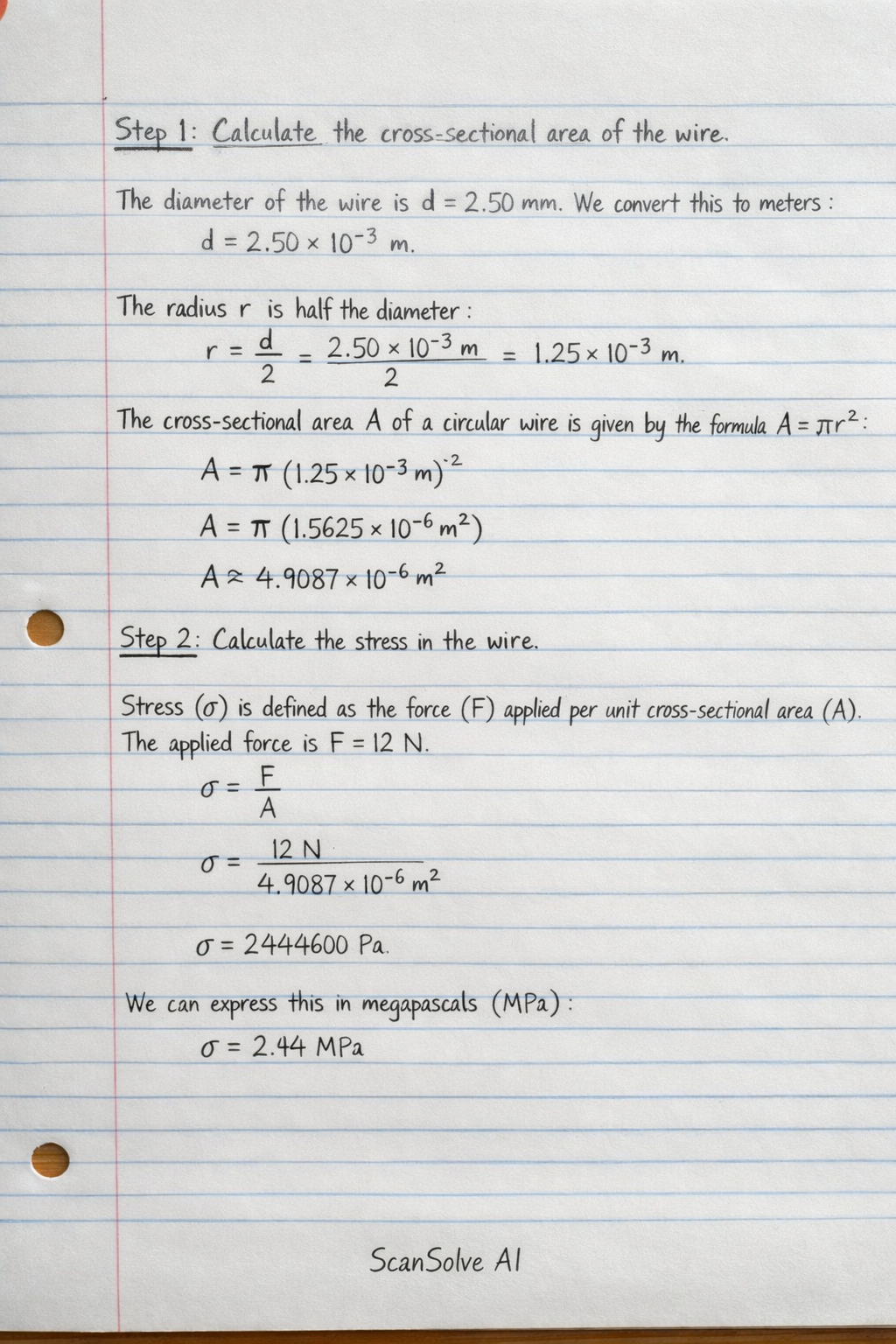
Step 1: Calculate the cross-sectional area of the wire. The diameter of the wire is d = 2.50 mm. We convert this to meters: d = 2.50 × 10^-3 m The radius r is half the diameter: r = (d)/(2) = 2.50 × 10^-3 m2 = 1.25 × 10^-3 m The cross-sectional area A of a circular wire is given by the formula A = r^2: A = (1.25 × 10^-3 m)^2 A = (1.5625 × 10^-6 m^2) A ≈ 4.9087 × 10^-6 m^2 Step 2: Calculate the stress in the wire. Stress () is defined as the force (F) applied per unit cross-sectional area (A). The applied force is F = 12 N. = (F)/(A) = 12 N4.9087 × 10^-6 m^2 ≈ 2444600 Pa We can express this in megapascals (MPa): ≈ 2.44 MPa Step 3: Calculate the strain in the wire. The original length of the wire is L_0 = 2 m. The problem states "it stretches to a new length of 2.53 mm". Given that the original length is 2 m, it is physically impossible for the new length to be 2.53 mm after stretching. Therefore, we assume that "2.53 mm" refers to the elongation or change in length ( L). So, L = 2.53 mm. We convert this to meters: L = 2.53 × 10^-3 m Strain () is defined as the change in length ( L) divided by the original length (L_0): = ( L)/(L_0) = 2.53 × 10^-3 m2 m = 0.001265 The stress in the wire is 2.44 MPa. The strain in the wire is 0.001265.