
We read your photo as:
Explain the elastic constant of a substance. (b) The graph of force applied to an elastic substance against extension produced is a straight line through the origin. State the physical significance of the area under the graph.
ScanSolve AI Answer
a) The elastic constant (or spring constant, ) of a substance is a measure of its stiffness or resistance to deformation. It quantifies the force required to produce a unit extension or compression in the substance, assuming it obeys Hooke's Law. A higher elastic constant means the substance is stiffer.
b) The graph of force applied against extension produced for an elastic substance that is a straight line through the origin indicates that the substance obeys Hooke's Law. The area under this force-extension graph represents the work done in deforming the elastic substance, which is stored as elastic potential energy within the substance.
Still stuck on this one?
Ask a follow-up, and the answer starts from this question.
More Physics Questions
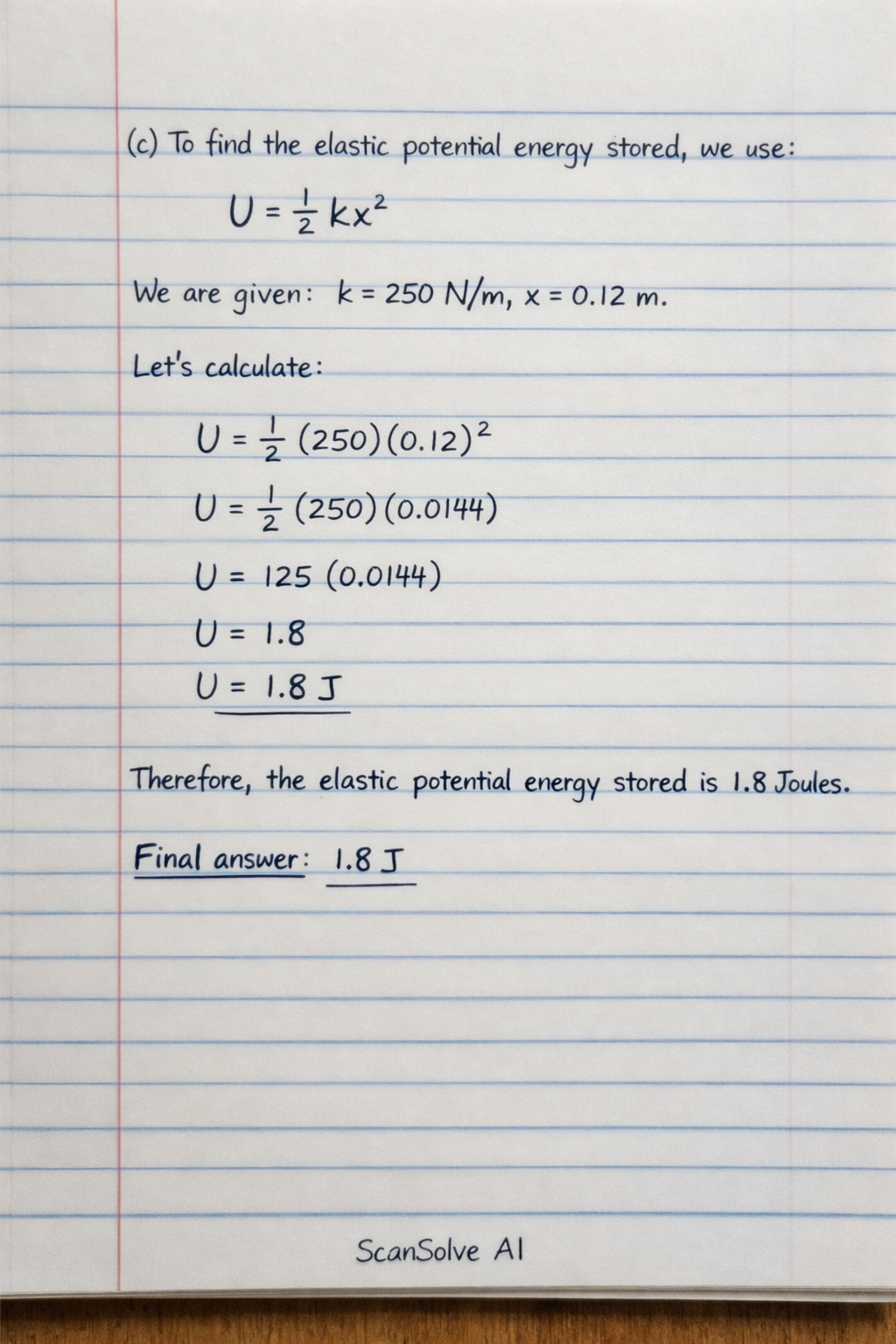
Handwritten Step-by-Step Solution
Get this as a handwritten image on WhatsApp — like a tutor wrote it for you.
Try on WhatsApp