
We read your photo as:
Understand the Force-Extension graph for a single spring.
ScanSolve AI Answer
This answer stops before the end.
It was cut off when it was first written. Ask ScanSolve this question again for the full working.
6.
a)
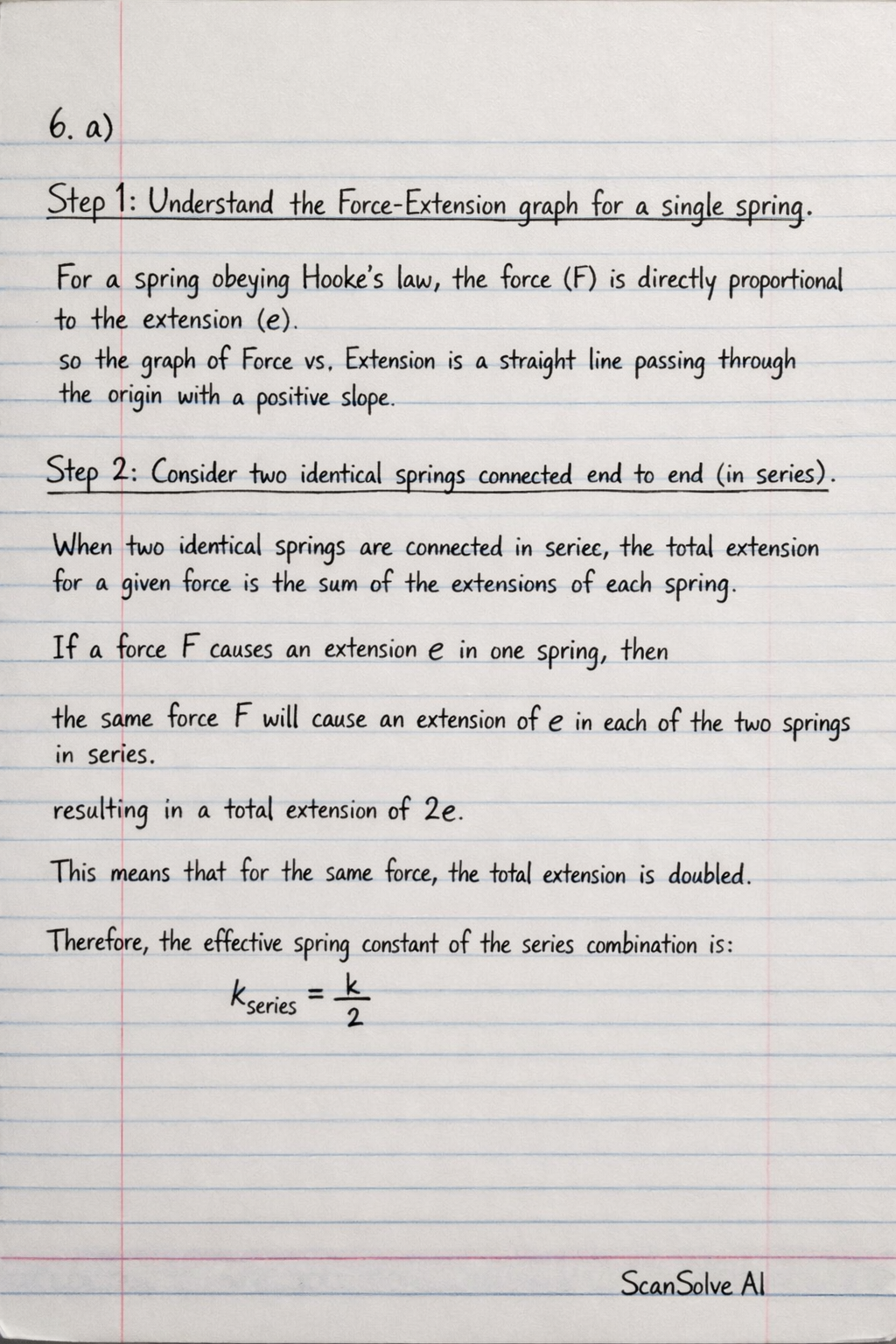
Step 1: Understand the Force-Extension graph for a single spring.
For a spring obeying Hooke's law, the force () is directly proportional to the extension (), so the graph of Force vs. Extension is a straight line passing through the origin, with a positive slope.
Step 2: Consider two identical springs connected end to end (in series).
When two identical springs are connected in series, the total extension for a given force is the sum of the extensions of each spring. If a force causes an extension in one spring, then the same force will cause an extension of in each of the two springs in series, resulting in a total extension of .
This means that for the same force, the total extension is doubled. Therefore, the effective spring constant of the series combination is half that of a single spring ().
Step 3: Sketch the graph.
The new graph for two springs in series will also be a straight line passing through the origin. However, its slope will be half the slope of the graph for a single spring, indicating that it is less steep.
\begin{tikzpicture}
\begin{axis}[
    xlabel={Extension},
    ylabel={Force (N)},
    xmin=0, xmax=5,
    ymin=0, ymax=10,
    axis lines=middle,
    xtick=\empty, ytick=\empty,
    clip=false
]
\addplot[thick, blue, domain=0:4] {2*x}; % Original spring (steeper)
\node[above right, blue] at (axis cs: 3, 6) {Single spring};

\addplot[thick, red, domain=0:4] {x}; % Two springs in series (less steep)
\node[above right, red] at (axis cs: 3, 3) {Two springs in series};
\end{axis}
\end{tikzpicture}
(Description of sketch: Draw a graph with "Extension" on the x-axis and "Force (N)" on the y-axis. Draw two straight lines starting from the origin. The first line (representing a single spring) should have a steeper positive slope. The second line (representing two springs connected end to end) should have a less steep positive slope, approximately half the slope of the first line.)
b) Determine the extension of the system.
Step 1: Determine the extension of a single spring under a given force.
Given that each spring extends by when a force of is suspended from it.
So, for one spring: .
Step 2: Analyze the series combination of springs C and D.
The load is suspended from spring D, which is suspended from spring C. In a series connection, the force acting on each spring is the same as the total load.
Force on spring C () = .
Force on spring D () = .
Extension of spring C () = (since it's an identical spring under ).
Extension of spring D () = (since it's an identical spring under ).
The total extension of the series combination (C and D) is the sum of their individual extensions:
Step 3: Analyze the parallel combination of springs A and B.
The horizontal bar supports the combination of C and D, which carries the load. Therefore, the total force acting downwards on the horizontal bar is .
This force is distributed equally between springs A and B because they are identical and connected in parallel.
Force on spring A () = .
Force on spring B () = .
Now, calculate the extension of spring A (or B) under a force of . Since extension is proportional to force:
Still stuck on this one?
Ask a follow-up, and the answer starts from this question.
More Physics Questions
Handwritten Step-by-Step Solution
Get this as a handwritten image on WhatsApp — like a tutor wrote it for you.
Try on WhatsApp