
We read your photo as:
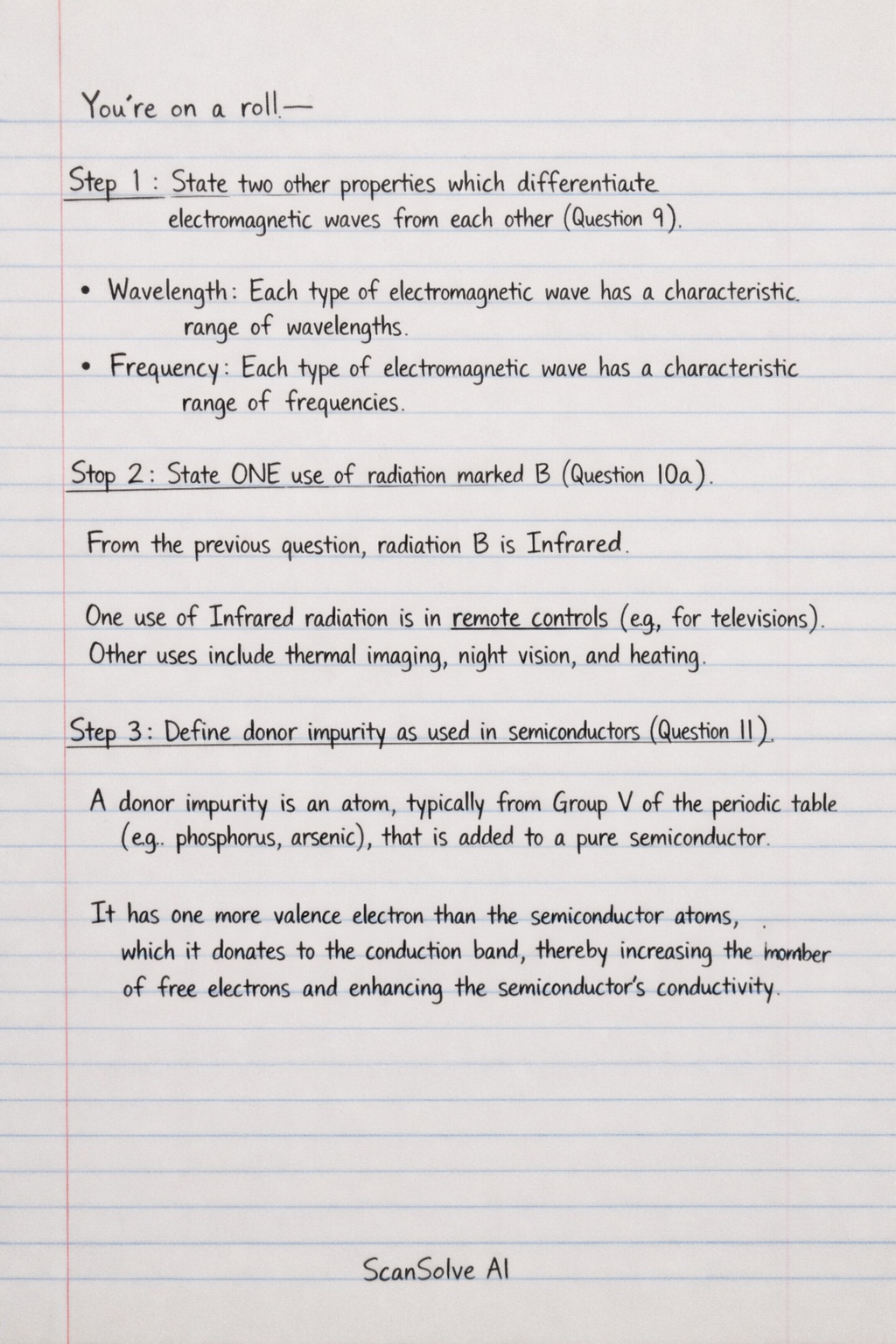
State two other properties which differentiate electromagnetic waves from each other (Question 9).
ScanSolve AI Answer
Step-by-step solution
4 stepsState two other properties which differentiate electromagnetic waves from each other (Question 9).
Other than energy, electromagnetic waves can be differentiated by:
- Wavelength: Each type of electromagnetic wave has a characteristic range of wavelengths.
- Frequency: Each type of electromagnetic wave has a characteristic range of frequencies.
State ONE use of radiation marked B (Question 10a).
From the previous question, radiation B is Infrared.
One use of Infrared radiation is in remote controls (e.g., for televisions). Other uses include thermal imaging, night vision, and heating.Define donor impurity as used in semiconductors (Question 11).
A donor impurity is an atom, typically from Group V of the periodic table (e.g., phosphorus, arsenic), that is added to a pure semiconductor. It has one more valence electron than the semiconductor atoms, which it donates to the conduction band, thereby increasing the number of free electrons and enhancing the semiconductor's conductivity.
Explain what happens between X and Y (Question 12).
The setup shows material Y being charged negatively by induction using object Z, with Y connected to the ground (X).
- For Y to be charged negatively by induction, the inducing object Z must be positively charged.
- When the positively charged object Z is brought near Y, it attracts the free electrons in Y towards the side closer to Z.
- Since Y is connected to the ground (X), electrons from the Earth (X) are attracted through the connecting wire to Y.
- These electrons accumulate on Y, giving it an excess of negative charge. This flow of electrons from X to Y continues until Y's potential equals that of the Earth.
Still stuck on this one?
Ask a follow-up, and the answer starts from this question.
More Physics Questions
Handwritten Step-by-Step Solution
Get this as a handwritten image on WhatsApp — like a tutor wrote it for you.
Try on WhatsApp