
We read your photo as:
Explain in detail the polarization of electromagnetic wave. Briefly explain the behavior of electromagnetic waves in ionized and non-ionized media.
Physics
ScanSolve AI Answer
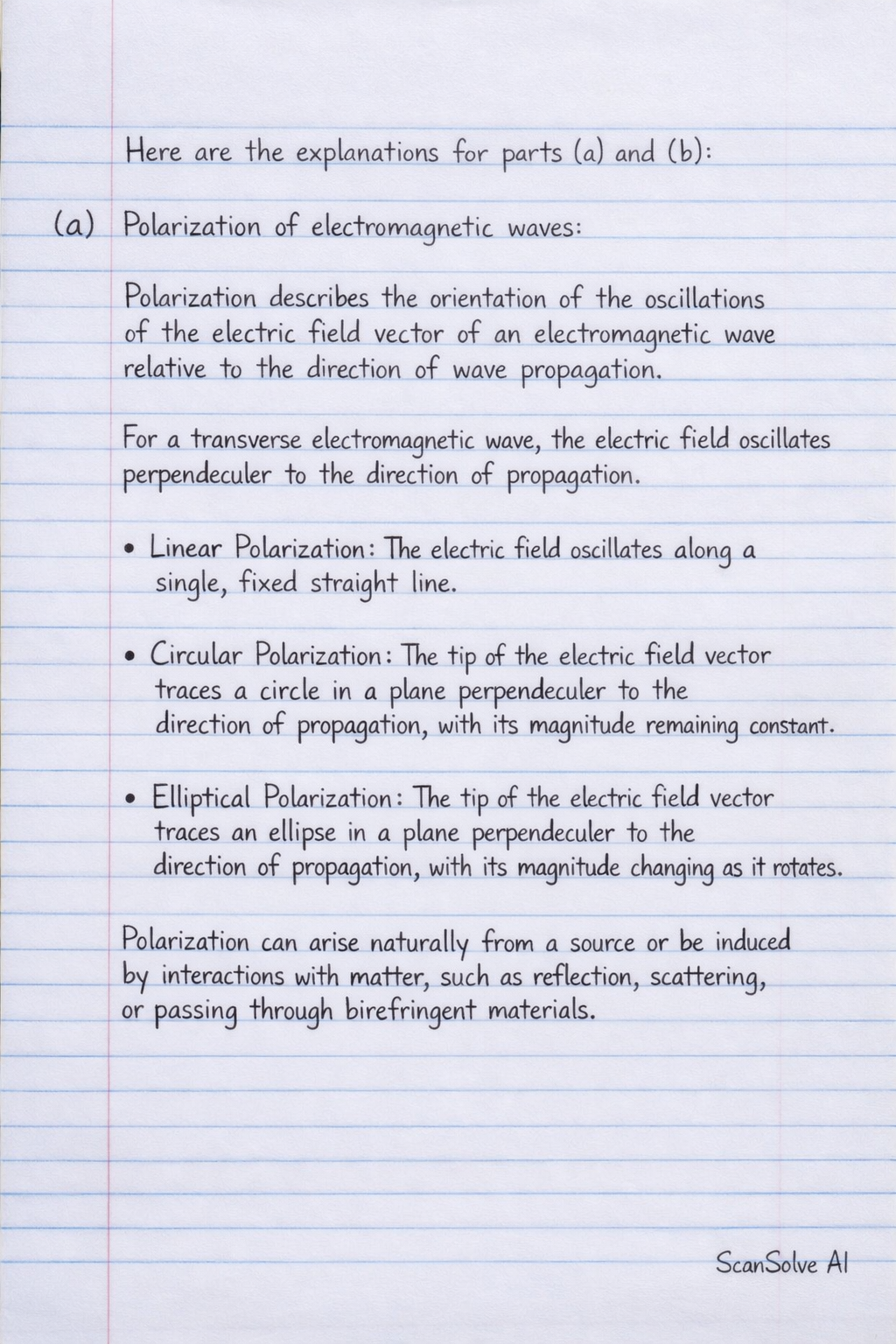
Here are the explanations for parts (a) and (b):
a) Polarization of electromagnetic waves:
Polarization describes the orientation of the oscillations of the electric field vector of an electromagnetic wave relative to the direction of wave propagation. For a transverse electromagnetic wave, the electric field oscillates perpendicular to the direction of propagation.
- Linear Polarization: The electric field oscillates along a single, fixed straight line.
- Circular Polarization: The tip of the electric field vector traces a circle in a plane perpendicular to the direction of propagation, with its magnitude remaining constant.
- Elliptical Polarization: The tip of the electric field vector traces an ellipse in a plane perpendicular to the direction of propagation, with its magnitude changing as it rotates. Polarization can arise naturally from a source or be induced by interactions with matter, such as reflection, scattering, or passing through birefringent materials.
b) Behavior of electromagnetic waves in ionized and non-ionized media:
- Non-ionized media (Dielectrics): In these materials, electrons are bound to atoms. An electromagnetic wave causes these bound electrons to oscillate, which in turn re-radiate secondary electromagnetic waves. This interaction leads to a reduction in the wave's speed (resulting in a refractive index greater than 1) and can cause absorption of the wave's energy, depending on the material's properties and the wave's frequency.
- Ionized media (Plasma): Plasma contains free electrons and ions. The electric field of an electromagnetic wave causes these free electrons to oscillate. If the wave's frequency is higher than the plasma frequency, the wave can propagate through the plasma. However, if the wave's frequency is lower than the plasma frequency, the free electrons effectively screen the electric field, causing the wave to be reflected or strongly attenuated. This interaction also leads to dispersion, where the wave's phase velocity depends on its frequency.
Was this helpful?
Still stuck on this one?
Ask a follow-up, and the answer starts from this question.
Got a different question?Ask your own question
More Physics Questions
QState two other properties which differentiate electromagnetic waves from each other (Question 9).QExplain the following with reference to magnetostatics: (i) diamagnetic material; (ii) lossy media…QSECTION B: ELECTROMAGNETIC FIELD THEORY. Answer any TWO questions from this section. (a) Describe…QDescribe electromagnetic shielding. A uniform wave propagating in free space strikes a lossy medium…QDescribe the properties and behavior of alpha, beta, and gamma radiation, including their deflection…
Browse by topic:Electromagnetism
Handwritten Step-by-Step Solution
Get this as a handwritten image on WhatsApp — like a tutor wrote it for you.
Try on WhatsApp