
We read your photo as:
Describe the behavior of parallel conductors with currents in opposite directions and waves moving from deep to shallow medium.
Physics
ScanSolve AI Answer
Step-by-step solution
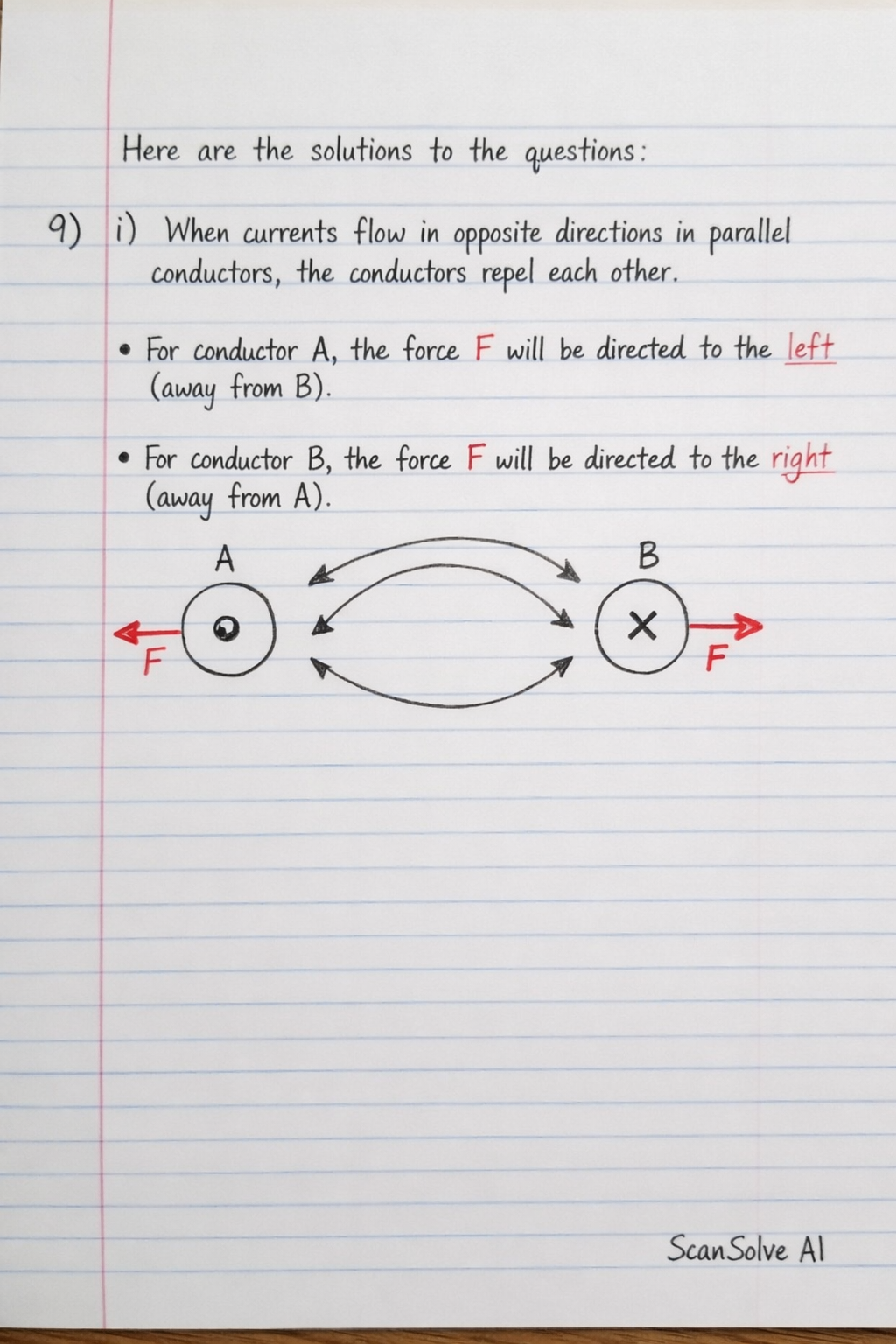
4 stepsHere are the solutions to the questions:
9)
i) When currents flow in opposite directions in parallel conductors, the conductors repel each other.
- For conductor A, the force will be directed to the left (away from B).
- For conductor B, the force will be directed to the right (away from A).
\begin{tikzpicture}[scale=0.8]
    % Conductor A
    \draw (0,0) circle (0.5);
    \node at (0,0) {$\odot$}; % Current out of page
    \node at (0,1) {A};

    % Conductor B
    \draw (4,0) circle (0.5);
    \node at (4,0) {$\otimes$}; % Current into page
    \node at (4,1) {B};

    % Magnetic field lines (simplified representation for repulsion)
    \draw[->] (2, -2) arc (-90:90:2 and 2);
    \draw[->] (2, 2) arc (90:270:2 and 2);

    % Forces
    \draw[->, thick, red] (0,0) -- (-1,0);
    \node[red] at (-1.3,0) {F};
    \draw[->, thick, red] (4,0) -- (5,0);
    \node[red] at (5.3,0) {F};
\end{tikzpicture}
10)
When waves travel from a deep to a shallow medium, their speed decreases, and their wavelength decreases. If they approach the boundary at an angle, they also refract (bend) towards the normal. The wave crests in the shallow medium will be closer together and bent.
\begin{tikzpicture}[scale=0.8]
    % Deep medium waves
    \foreach \x in {-2,-1,0,1,2} {
        \draw (\x, -2) -- (\x, 2);
    }
    \draw[->] (0.5, 0) -- (1.5, 0); % Direction of propagation
    \node at (0, -2.5) {Deep};

    % Boundary
    \draw[thick] (2,-2) -- (4,2);
    \node at (4.5, 2.5) {Shallow};

    % Shallow medium waves (refracted and shorter wavelength)
    \draw (2.2, -1.8) -- (3.2, 0.2);
    \draw (2.4, -1.4) -- (3.4, 0.6);
    \draw (2.6, -1.0) -- (3.6, 1.0);
    \draw (2.8, -0.6) -- (3.8, 1.4);
    \draw (3.0, -0.2) -- (4.0, 1.8);
\end{tikzpicture}
Radioactive decay question (unnumbered):
Convert the total time to minutes.
Calculate the number of half-lives ().
Calculate the mass remaining after 3 half-lives.
Calculate the mass decayed.
11)
Two dangers of X-rays are:- They are ionizing radiation and can cause cell damage or mutations in DNA, leading to cancer.
- Excessive exposure can cause radiation sickness, leading to symptoms like nausea, vomiting, hair loss, and fatigue.
Was this helpful?
Still stuck on this one?
Ask a follow-up, and the answer starts from this question.
Got a different question?Ask your own question
More Physics Questions
QA) In a transverse wave, the particles of the medium oscillate perpendicular to the direction of…QOn Fig. 4.3, draw four wave fronts to show what happens to the wave fronts in the shallow water…QExplain whether the water wave produced is longitudinal or transverse. The circular lines represents…QDescribe the production of equal and opposite charges by induction and the effect on a charged…QIn physics, what term describes the phenomenon where a wave changes direction as it passes from one…
Handwritten Step-by-Step Solution
Get this as a handwritten image on WhatsApp — like a tutor wrote it for you.
Try on WhatsApp