
We read your photo as:
A diffraction grating has 500 lines/mm. What is the maximum order of diffraction visible for light with a wavelength of 600 nm?
ScanSolve AI Answer
Answer
Step-by-step solution
4 stepsHere's the solution for Question 15:
To find the total number of diffraction images, we first need to determine the maximum order of diffraction () that can be observed. The formula for a diffraction grating is given by:
where:
- is the grating spacing (distance between adjacent lines)
- is the diffraction angle
- is the order of the diffraction image
- is the wavelength of the light
Calculate the grating spacing .
The grating has 500 lines per millimeter.
Convert the wavelength to meters.
Given wavelength .
Calculate the maximum order of diffraction .
The maximum possible value for is 1 (when ).
So, for the maximum order, the equation becomes:Since the order must be an integer, the maximum observable integer order of diffraction is .
Determine the total number of images.
The possible integer orders of diffraction are .
- corresponds to the central image (1 image).
- correspond to images on one side of the central maximum (3 images).
- correspond to images on the other side of the central maximum (3 images).
Total number of images = (images on one side) + (images on other side) + (central image)
Total number of images = .The total number of diffraction images seen, including the central image, is 7.
The final answer is .
Try one yourself
A new problem that tests the same skill.
Still stuck on this one?
Ask a follow-up, and the answer starts from this question.
More Physics Questions
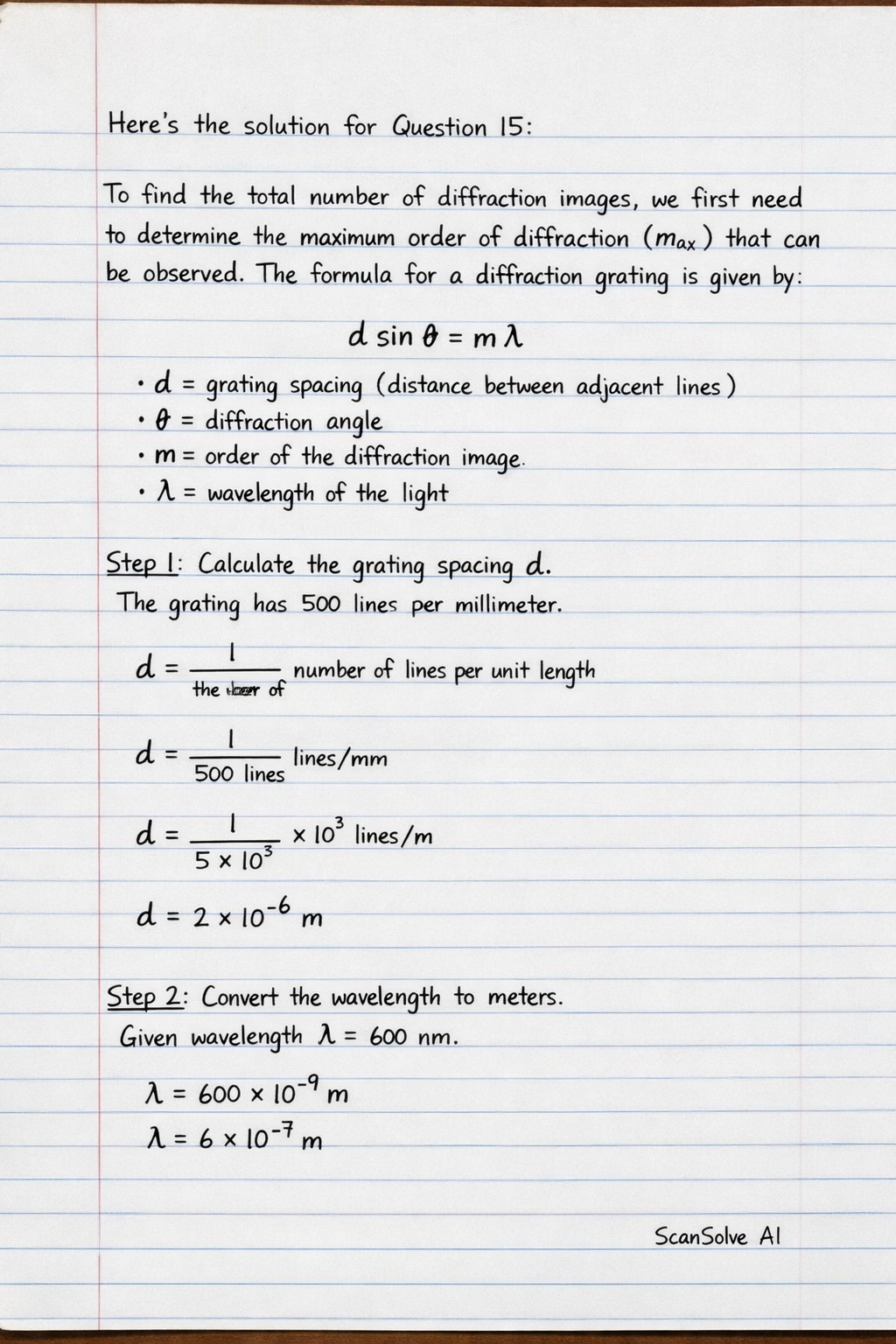
Handwritten Step-by-Step Solution
Get this as a handwritten image on WhatsApp — like a tutor wrote it for you.
Try on WhatsApp