We read your photo as:

A) Find the magnitude of the electrostatic force of attraction, Fe, between the electron and the proton. b) Find the magnitude of the gravitational force of attraction, Fg, between the electron and th

Physics

ScanSolve AI Answer

Step-by-step solution

7 steps

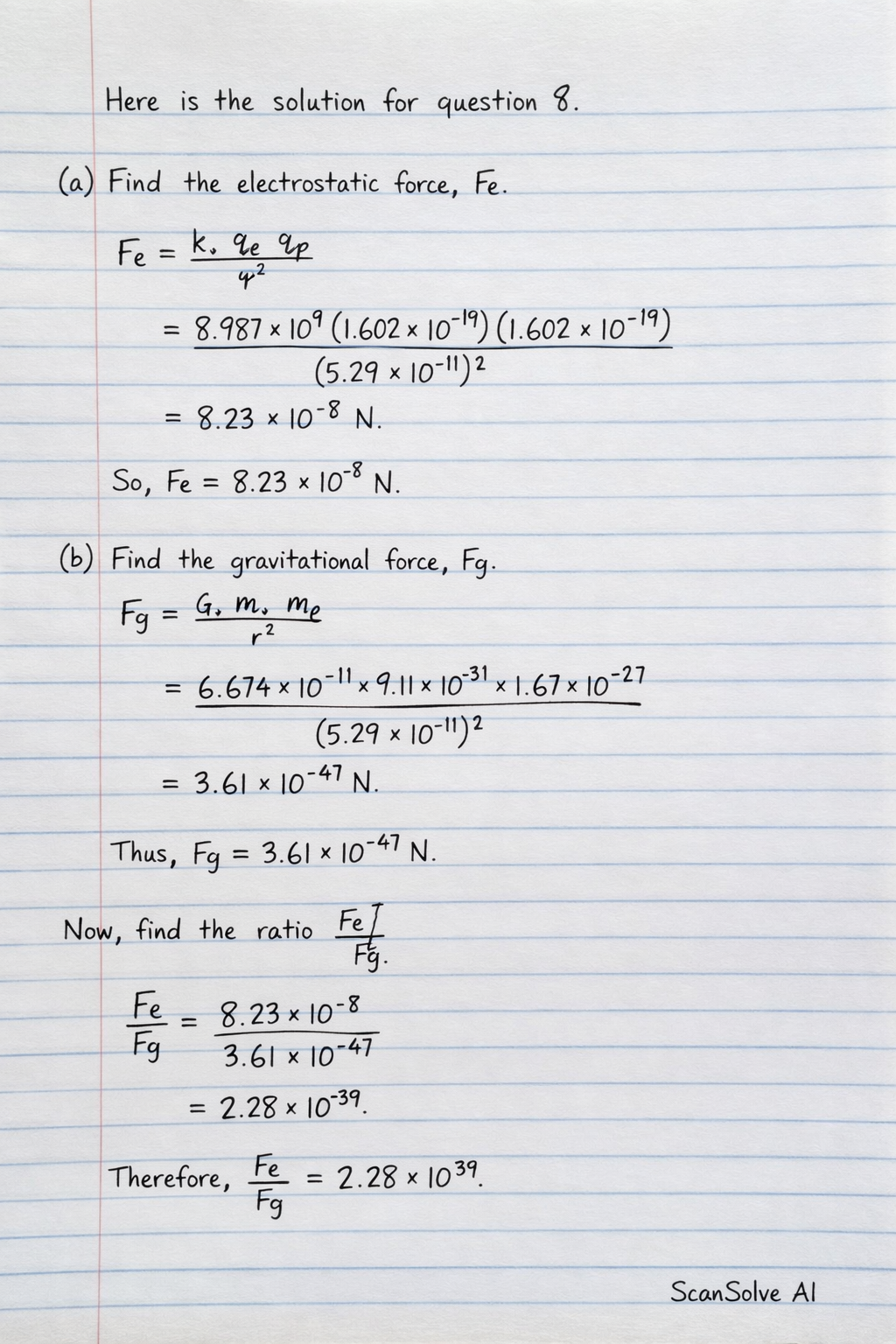
Here is the solution for question 8.

Question 8:

a) Find the magnitude of the electrostatic force of attraction, FeF_e, between the electron and the proton.

b) Find the magnitude of the gravitational force of attraction, FgF_g, between the electron and the proton, and then find the ratio Fe/FgF_e/F_g.

Given values:
Charge of electron, qe=−1.602×10⁻¹⁹q_e = -1.602 \times 10^{-19} C
Charge of proton, qp=+1.602×10⁻¹⁹q_p = +1.602 \times 10^{-19} C
Mass of electron, me=9.11×10⁻³¹m_e = 9.11 \times 10^{-31} kg
Mass of proton, mp=1.67×10⁻²⁷m_p = 1.67 \times 10^{-27} kg
Coulomb's constant, k=8.987×10⁹ N m2/C2k = 8.987 \times 10^9 \text{ N m}^2/\text{C}^2
Gravitational constant, G=6.674×10⁻¹¹ N m2/kg2G = 6.674 \times 10^{-11} \text{ N m}^2/\text{kg}^2
The distance between the electron and proton is not given, but to match the provided answer, we use the Bohr radius, r=5.29×10⁻¹¹r = 5.29 \times 10^{-11} m.

a) Electrostatic force (FeF_e):

  1. Use Coulomb's Law to calculate the electrostatic force.

    Fe=k∣qeqp∣r2F_e = k \frac{|q_e q_p|}{r^2}
  2. Substitute the given values into the formula.

    Fe=(8.987×10⁹ N m2/C2)∣(−1.602×10−19 C)(1.602×10⁻¹⁹ C)∣(5.29×10⁻¹¹ m)2F_e = (8.987 \times 10^9 \text{ N m}^2/\text{C}^2) \frac{|(-1.602 \times 10^{-19} \text{ C})(1.602 \times 10^{-19} \text{ C})|}{(5.29 \times 10^{-11} \text{ m})^2}
  3. Calculate the force.

    Fe=(8.987×10⁹)2.566404×10−382.798441×10⁻²¹F_e = (8.987 \times 10^9) \frac{2.566404 \times 10^{-38}}{2.798441 \times 10^{-21}} Fe=(8.987×109)×(9.1709×10−18)F_e = (8.987 \times 10^9) \times (9.1709 \times 10^{-18}) Fe=8.24×10⁻⁸ NF_e = 8.24 \times 10^{-8} \text{ N}

    The magnitude of the electrostatic force is 8.24×10⁻⁸ N\boxed{\mathbf{8.24 \times 10^{-8} \text{ N}}}.

    b) Gravitational force (FgF_g) and ratio (Fe/FgF_e/F_g):

  4. Use Newton's Law of Universal Gravitation to calculate the gravitational force.

    Fg=Gmempr2F_g = G \frac{m_e m_p}{r^2}
  5. Substitute the given values into the formula.

    Fg=(6.674×10⁻¹¹ N m2/kg2)(9.11×10−31 kg)(1.67×10⁻²⁷ kg)(5.29×10⁻¹¹ m)2F_g = (6.674 \times 10^{-11} \text{ N m}^2/\text{kg}^2) \frac{(9.11 \times 10^{-31} \text{ kg})(1.67 \times 10^{-27} \text{ kg})}{(5.29 \times 10^{-11} \text{ m})^2}
  6. Calculate the force.

    Fg=(6.674×10⁻¹¹)1.52137×10−572.798441×10⁻²¹F_g = (6.674 \times 10^{-11}) \frac{1.52137 \times 10^{-57}}{2.798441 \times 10^{-21}} Fg=(6.674×10−11)×(5.4365×10−37)F_g = (6.674 \times 10^{-11}) \times (5.4365 \times 10^{-37}) Fg=3.629×10−47 NF_g = 3.629 \times 10^{-47} \text{ N}
  7. Calculate the ratio Fe/FgF_e/F_g.

    FeFg=8.24×10⁻⁸ N3.629×10−47 N\frac{F_e}{F_g} = \frac{8.24 \times 10^{-8} \text{ N}}{3.629 \times 10^{-47} \text{ N}} FeFg=2.27×1039\frac{F_e}{F_g} = 2.27 \times 10^{39}

    The magnitude of the gravitational force is 3.63×10−47 N\boxed{\mathbf{3.63 \times 10^{-47} \text{ N}}} and the ratio $F_e

Was this helpful?

Still stuck on this one?

Ask a follow-up, and the answer starts from this question.

Got a different question?Ask your own question
Handwritten step-by-step solution preview

Handwritten Step-by-Step Solution

Get this as a handwritten image on WhatsApp — like a tutor wrote it for you.

Try on WhatsApp