
We read your photo as:
A force f = (4−v²) N is acting on a particle of mass 3kg where v is velocity in ms⁻¹ of the particle. Initially, the particle is at rest at the origin. Find, i. The time taken for the particle to reach a velocity of 0.5 ms⁻¹ ii. The displacement when the velocity is 0.5 ms⁻¹
ScanSolve AI Answer
Answers
2 partsStep-by-step solution
6 stepsHere's the solution to the problem:
Given:
Force (assuming '4' from the handwritten text, as '2x' from OCR would make the problem significantly more complex and likely beyond the scope of this type of question)
Mass
Initial velocity (at rest)
Initial position (at the origin)
Part i· 3 steps
The time taken for the particle to reach a velocity of
Apply Newton's Second Law () and express acceleration as .
Separate variables and integrate to find time.
Integrate from to and to :
Using the standard integral , with :
Evaluate the definite integral.
Part ii
The displacement when the velocity is
Apply Newton's Second Law () and express acceleration as .
Separate variables and integrate to find displacement.
Integrate from to and to :
Use substitution: Let . Then , so .
When , . When , .Evaluate the definite integral.
Using the logarithm property :
Dernière correction gratuite aujourd'hui — reviens demain, ou tape /upgrade pour l'illimité.
Try one yourself
A new problem that tests the same skill.
Still stuck on this one?
Ask a follow-up, and the answer starts from this question.
More Physics Questions
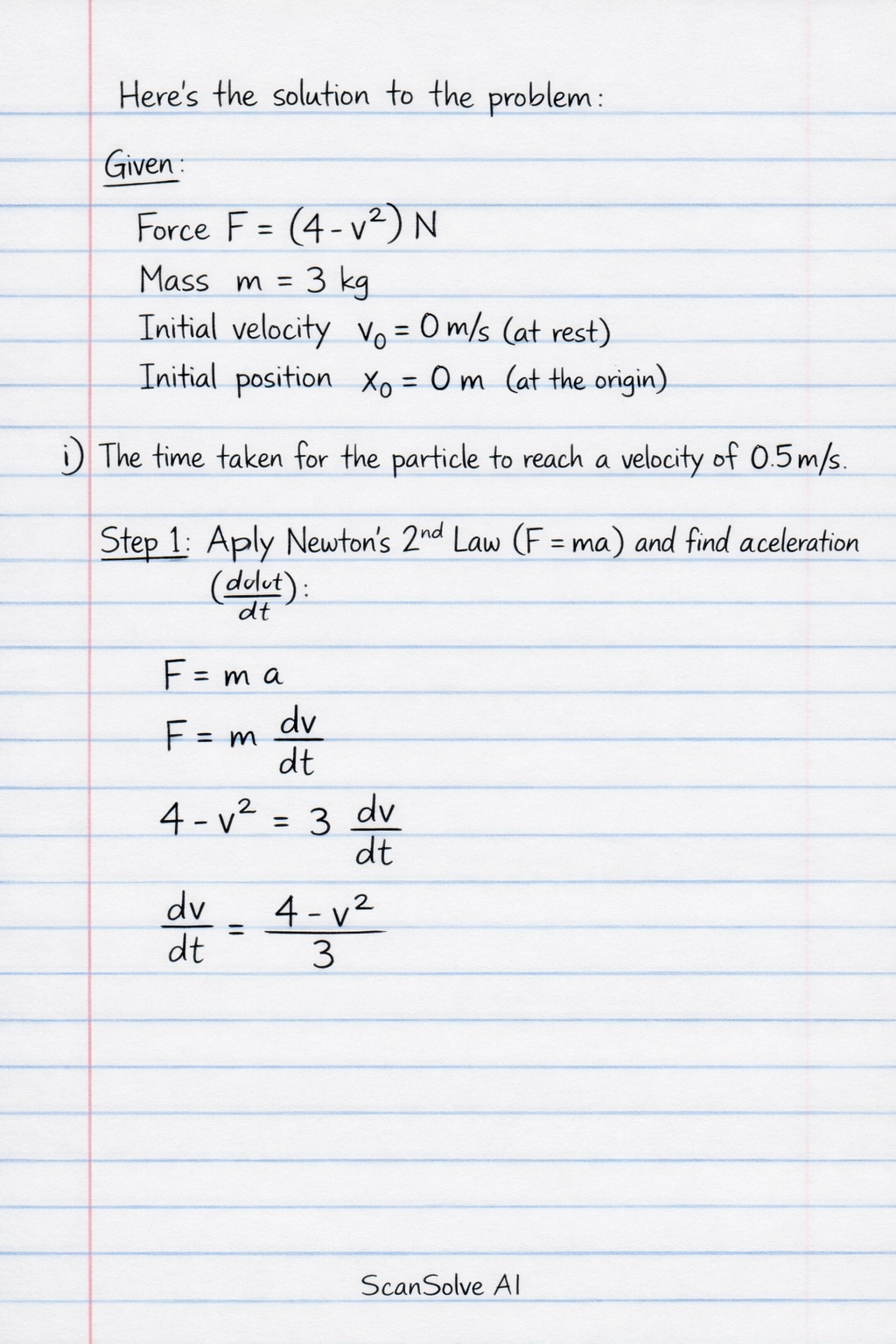
Handwritten Step-by-Step Solution
Get this as a handwritten image on WhatsApp — like a tutor wrote it for you.
Try on WhatsApp