
We read your photo as:
A gas at constant temperature has an initial pressure of 1.5 atm and an initial volume of 200 ml. If the pressure is changed to 1.01 atm, what is the final volume?
ScanSolve AI Answer
Answer
Step-by-step solution
4 stepsThe problem involves Boyle's Law, which relates the pressure and volume of a gas at constant temperature.
State Boyle's Law.
Boyle's Law states that the product of the initial pressure and volume is equal to the product of the final pressure and volume:
Rearrange the formula to solve for the final volume, .
From the given steps, it appears you are trying to find the final volume, which is typically denoted as . The equation shown in your work, , should be . We will proceed with this corrected formula.
Substitute the given values into the formula.
Given:
Substitute these values:
Calculate the final volume.
First, multiply the values in the numerator:
Now, divide to find :
Rounding to two decimal places:
The final volume is:
Try one yourself
A new problem that tests the same skill.
Still stuck on this one?
Ask a follow-up, and the answer starts from this question.
More Physics Questions
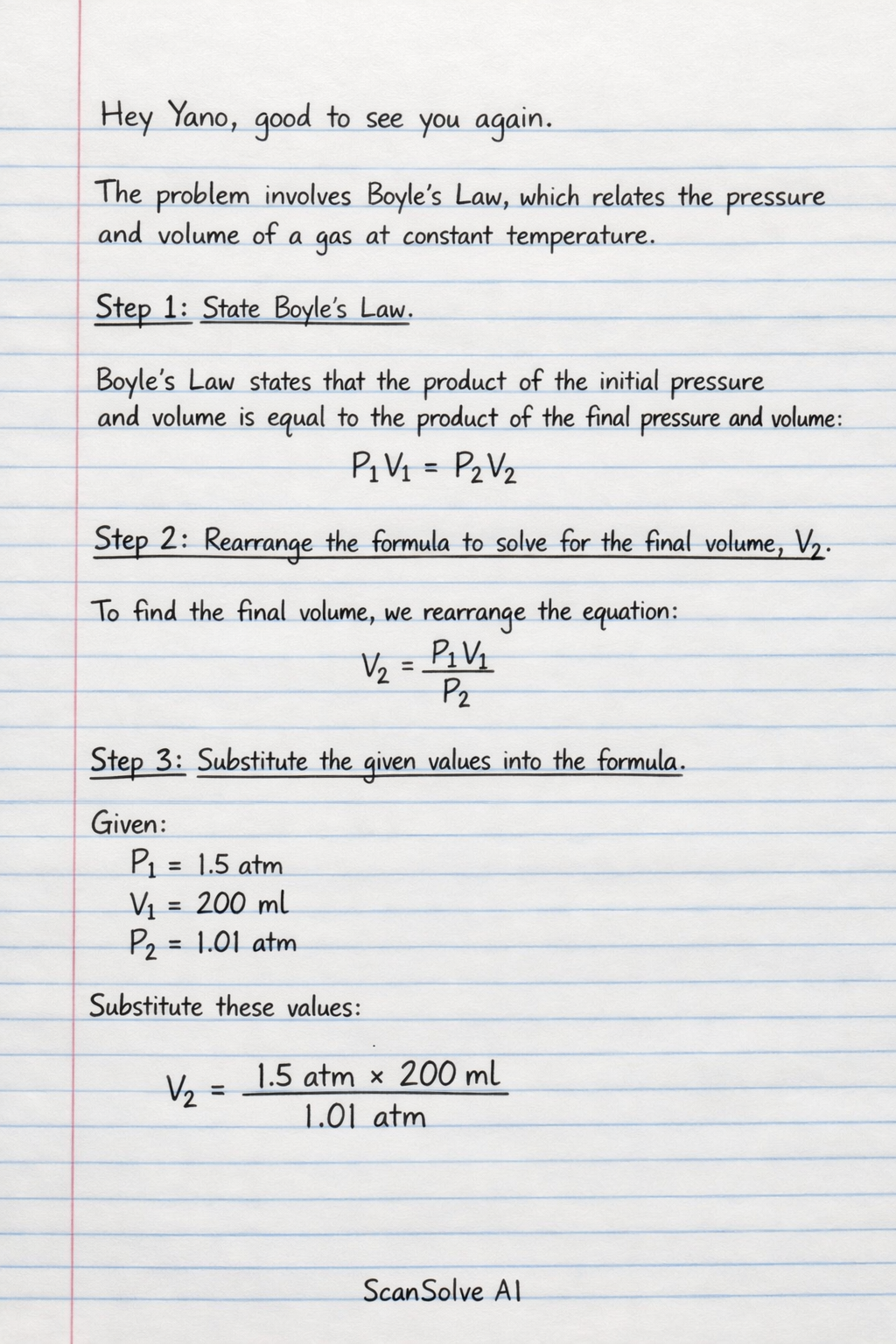
Handwritten Step-by-Step Solution
Get this as a handwritten image on WhatsApp — like a tutor wrote it for you.
Try on WhatsApp