
We read your photo as:
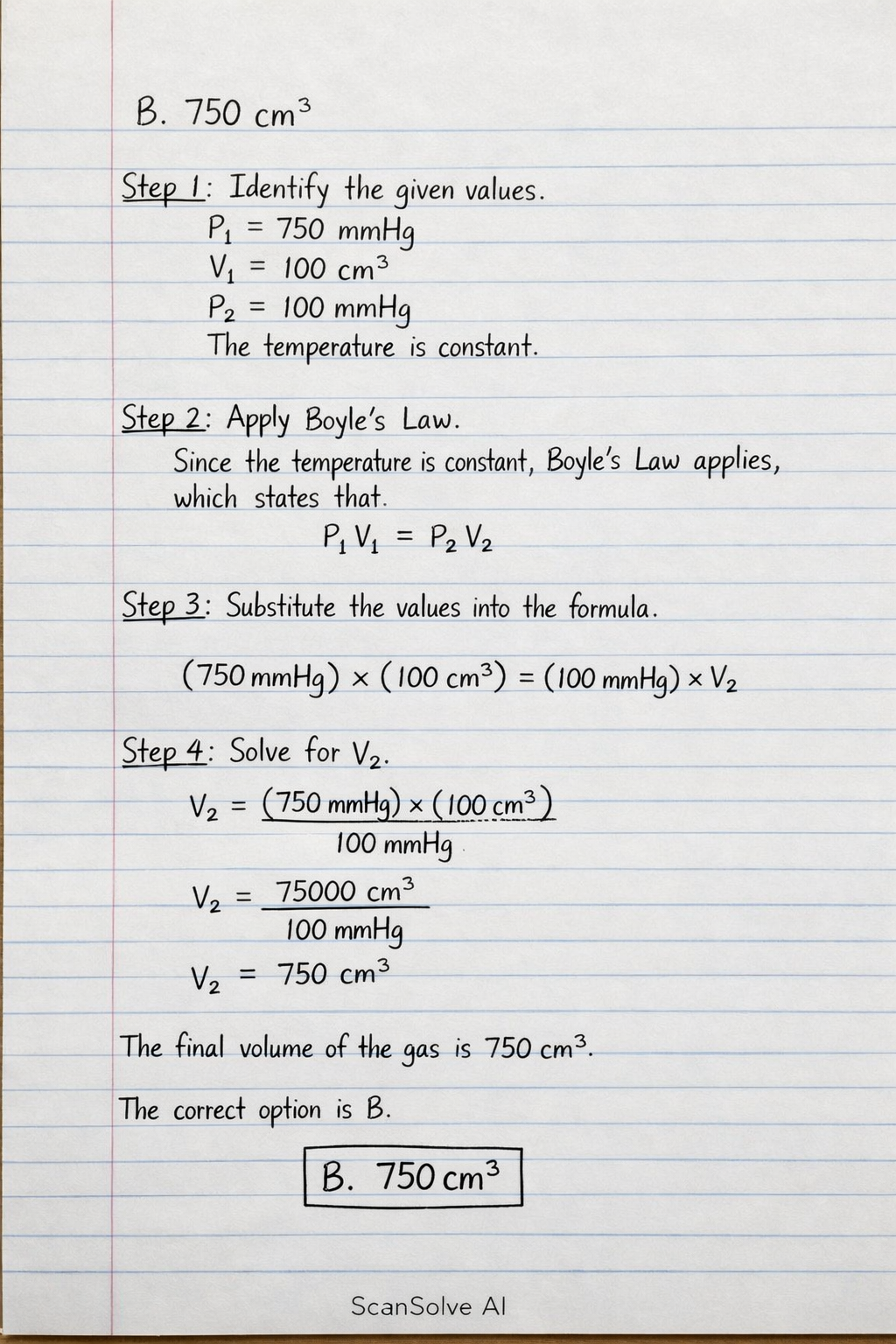
A container of gas has an initial pressure of 750 mmHg and an initial volume of 100 cm³. If the pressure is decreased to 100 mmHg while the temperature remains constant, what is the final volume of th
Physics
ScanSolve AI Answer
Answer
B
Step-by-step solution
4 stepsB.
Identify the given values.
Initial pressure,
Initial volume,
Final pressure,
The temperature is constant.Apply Boyle's Law.
Since the temperature is constant, Boyle's Law applies, which states that .
Substitute the values into the formula.
Solve for .
The final volume of the gas is .
The correct option is B.
Was this helpful?
Try one yourself
A new problem that tests the same skill.
Still stuck on this one?
Ask a follow-up, and the answer starts from this question.
Got a different question?Ask your own question
More Physics Questions
QA gas in a container has a volume of 2000 cm3. If the pressure is reduced to 1/5 of its original…QA gas at constant temperature has an initial pressure of 1.5 atm and an initial volume of 200 ml. If…QA container has 0.05 m3 of gas at 1.99 × 10⁵ Pa and 27C. The gas is compressed to 0.02 m3 at 127C…QA gas occupies a volume of 2000 cm³ at a certain pressure. If the pressure is reduced to 1/5 of its…QA container with initial volume 0.05 m3 and initial gauge pressure 1.99 × 10⁵ Pa is compressed to a…
Handwritten Step-by-Step Solution
Get this as a handwritten image on WhatsApp — like a tutor wrote it for you.
Try on WhatsApp