
We read your photo as:
A gas in a container has a volume of 2000 cm3. If the pressure is reduced to 1/5 of its original pressure while the temperature remains constant, what is the new volume?
Physics
ScanSolve AI Answer
Answer
Step-by-step solution
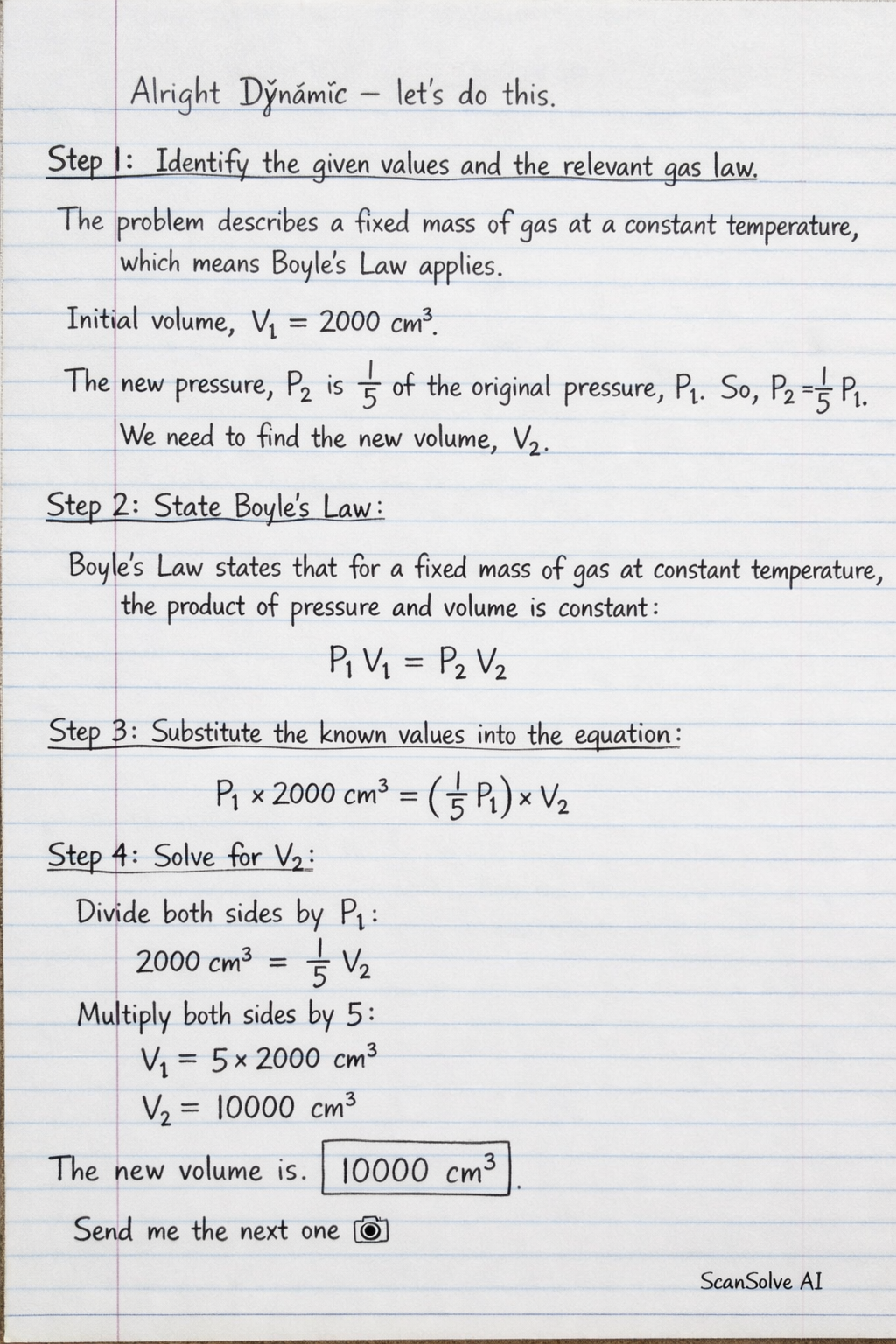
4 stepsIdentify the given values and the relevant gas law.
The problem describes a fixed mass of gas at a constant temperature, which means Boyle's Law applies.
Initial volume, .
The new pressure, , is of the original pressure, . So, .
We need to find the new volume, .State Boyle's Law.
Boyle's Law states that for a fixed mass of gas at constant temperature, the product of pressure and volume is constant:
Substitute the known values into the equation.
Solve for .
Divide both sides by :
Multiply both sides by 5:
The new volume is .
Was this helpful?
Try one yourself
A new problem that tests the same skill.
Still stuck on this one?
Ask a follow-up, and the answer starts from this question.
Got a different question?Ask your own question
More Physics Questions
QWhen the pressure on 200 cm3 of a gas is doubled, and its absolute temperature is halved, its volume…QA gas at constant temperature has an initial pressure of 1.5 atm and an initial volume of 200 ml. If…QA container of gas has an initial pressure of 750 mmHg and an initial volume of 100 cm³. If the…QA gas has a volume of 2.5 L at a pressure of 100 kPa. If the temperature is kept constant, what is…QA container has 0.05 m3 of gas at 1.99 × 10⁵ Pa and 27C. The gas is compressed to 0.02 m3 at 127C…
Handwritten Step-by-Step Solution
Get this as a handwritten image on WhatsApp — like a tutor wrote it for you.
Try on WhatsApp