
We read your photo as:
A gas at 50°C and 30 cm³ is heated to 80°C at constant pressure. What is the fractional increase in volume?
ScanSolve AI Answer
Step-by-step solution
5 stepsConvert the given temperatures from Celsius to Kelvin.
The initial temperature .
The final temperature .
To convert Celsius to Kelvin, add 273.15 (or 273 for common approximations). We will use 273.15 for better accuracy.Apply Charles's Law.
Charles's Law states that for a fixed amount of gas at constant pressure, the volume is directly proportional to its absolute temperature. The formula is:
Where is the initial volume, is the initial absolute temperature, is the final volume, and is the final absolute temperature.
We are given . We need to find the fractional increase in volume, which is .Calculate the ratio of volumes.
From Charles's Law, we can write:
Substitute the Kelvin temperatures:
Calculate the fractional increase in volume.
The fractional increase in volume is defined as , which is .
This can be rewritten as .
Using the ratio calculated in Step 3:Round the result and compare with the options.
Rounding 0.09279 to three decimal places gives 0.093.
Comparing this to the given options:
A) 0.009
B) 0.093
C) 0.910
D) 1.090The calculated fractional increase matches option (B).
The final answer is
Still stuck on this one?
Ask a follow-up, and the answer starts from this question.
More Physics Questions
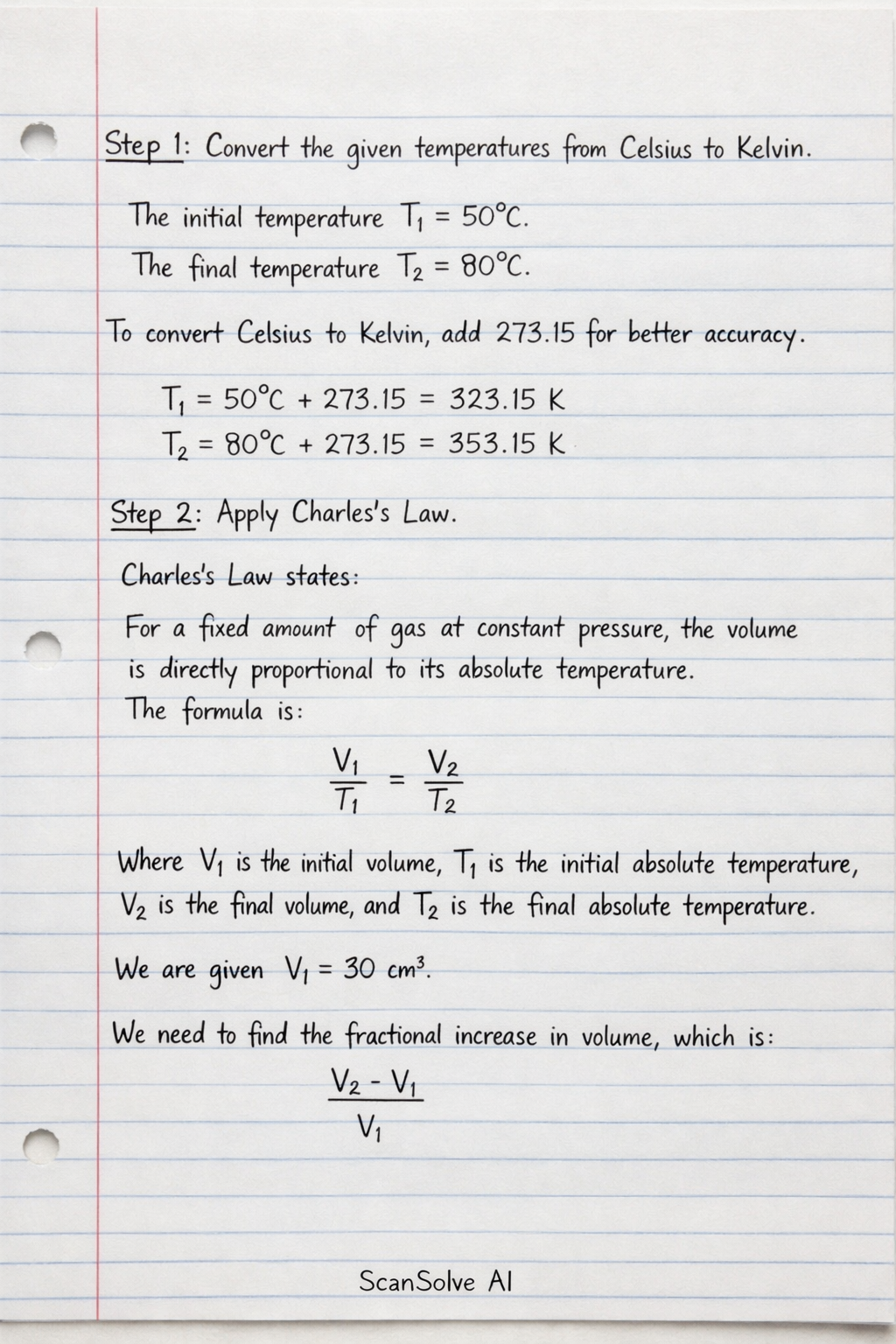
Handwritten Step-by-Step Solution
Get this as a handwritten image on WhatsApp — like a tutor wrote it for you.
Try on WhatsApp