
We read your photo as:
A gas occupies 1 L at 27°C. If the pressure is held constant, what is its volume at 40°C? Use 273.15 for the conversion from Celsius to Kelvin.
ScanSolve AI Answer
Answer
Step-by-step solution
4 stepsHey Yano, this problem involves Charles's Law, not Boyle's Law, because it relates volume and temperature. Boyle's Law relates pressure and volume. The notation "v²" likely refers to the final volume, .
State Charles's Law.
Charles's Law states that for a fixed amount of gas at constant pressure, the volume is directly proportional to its absolute temperature. The formula is:
Rearranging to solve for :
Convert temperatures from Celsius to Kelvin.
Gas law calculations require temperatures to be in Kelvin.
Given:
Convert :
Convert :
Substitute the values into the Charles's Law formula.
Calculate the final volume, .
The final volume is:
Try one yourself
A new problem that tests the same skill.
Still stuck on this one?
Ask a follow-up, and the answer starts from this question.
More Physics Questions
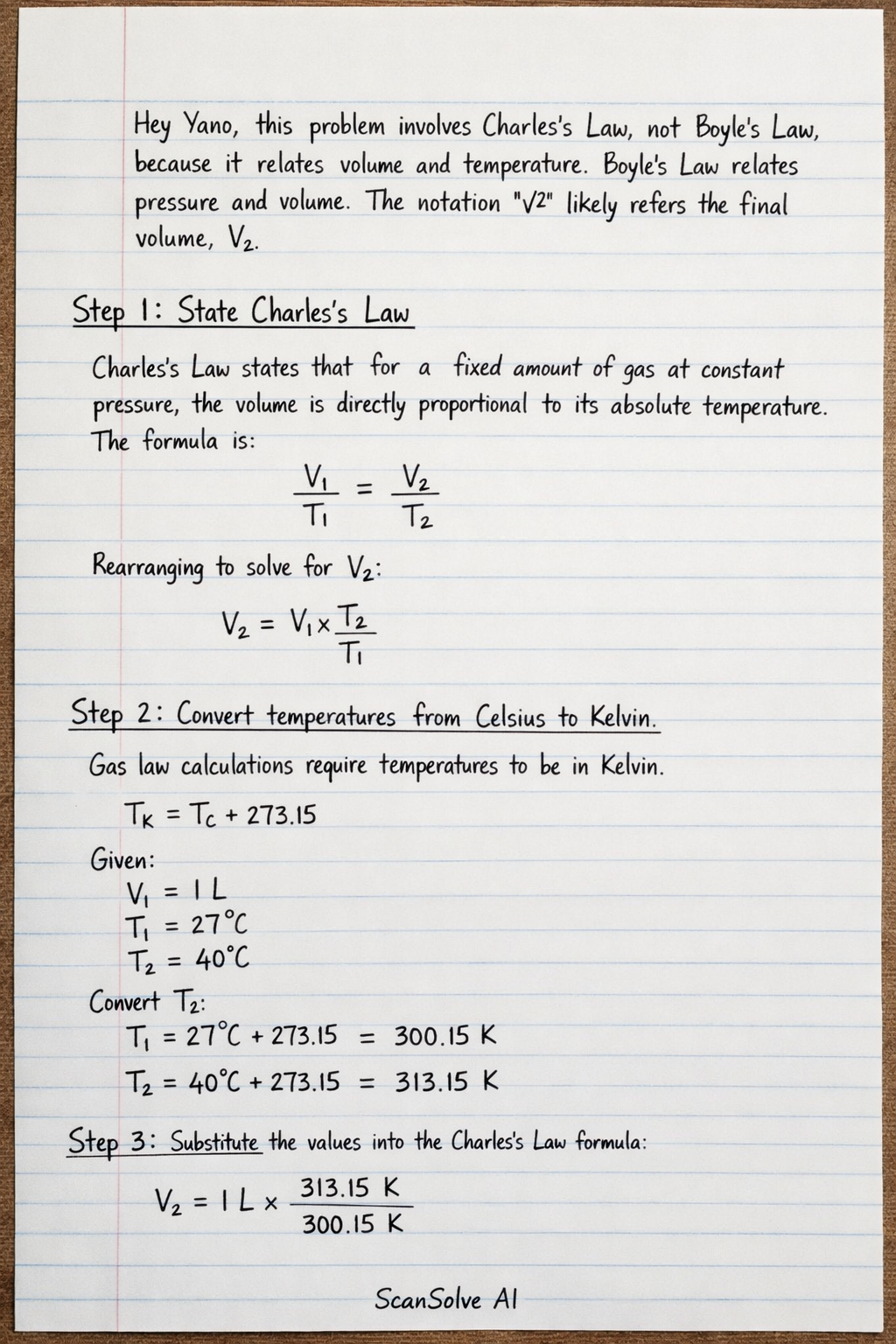
Handwritten Step-by-Step Solution
Get this as a handwritten image on WhatsApp — like a tutor wrote it for you.
Try on WhatsApp