
We read your photo as:
One mole of CO2(g) occupies 0.382 × 10⁻³ m³ at 40°C. Calculate the pressure that the gas would exert assuming ideal behavior. Take R = 8.314 J·mol⁻¹·K⁻¹.
Physics
ScanSolve AI Answer
Step-by-step solution
3 stepsHere are the solutions to your exercises:
- One mole of occupies at . Calculate the pressure that the gas would exert assuming ideal behavior. Take .
Convert temperature to Kelvin.
Use the ideal gas law, , to calculate pressure .
Substitute the given values and calculate .
Since , then $\frac{J}{m^3} = \frac{N \cdot m}{m^3} = \frac{N}{m^2}
Was this helpful?
Still stuck on this one?
Ask a follow-up, and the answer starts from this question.
Got a different question?Ask your own question
More Physics Questions
QA gas occupies 1 L at 27°C. If the pressure is held constant, what is its volume at 40°C? Use 273.15…QSix grams of oxygen gas at a temperature of 30 °C have a volume of 0,00142 m³. Calculate: a) The…QCalculate the number of moles in 44 g of CO2.QDefine mole, Boyle's Law, allotropes of Carbon and period. Calculate the number of moles in 440g of…QA gas at 27°C has a volume of 4 m³ and a gauge pressure of 2.202 × 10⁵ Pa. It is compressed to a…
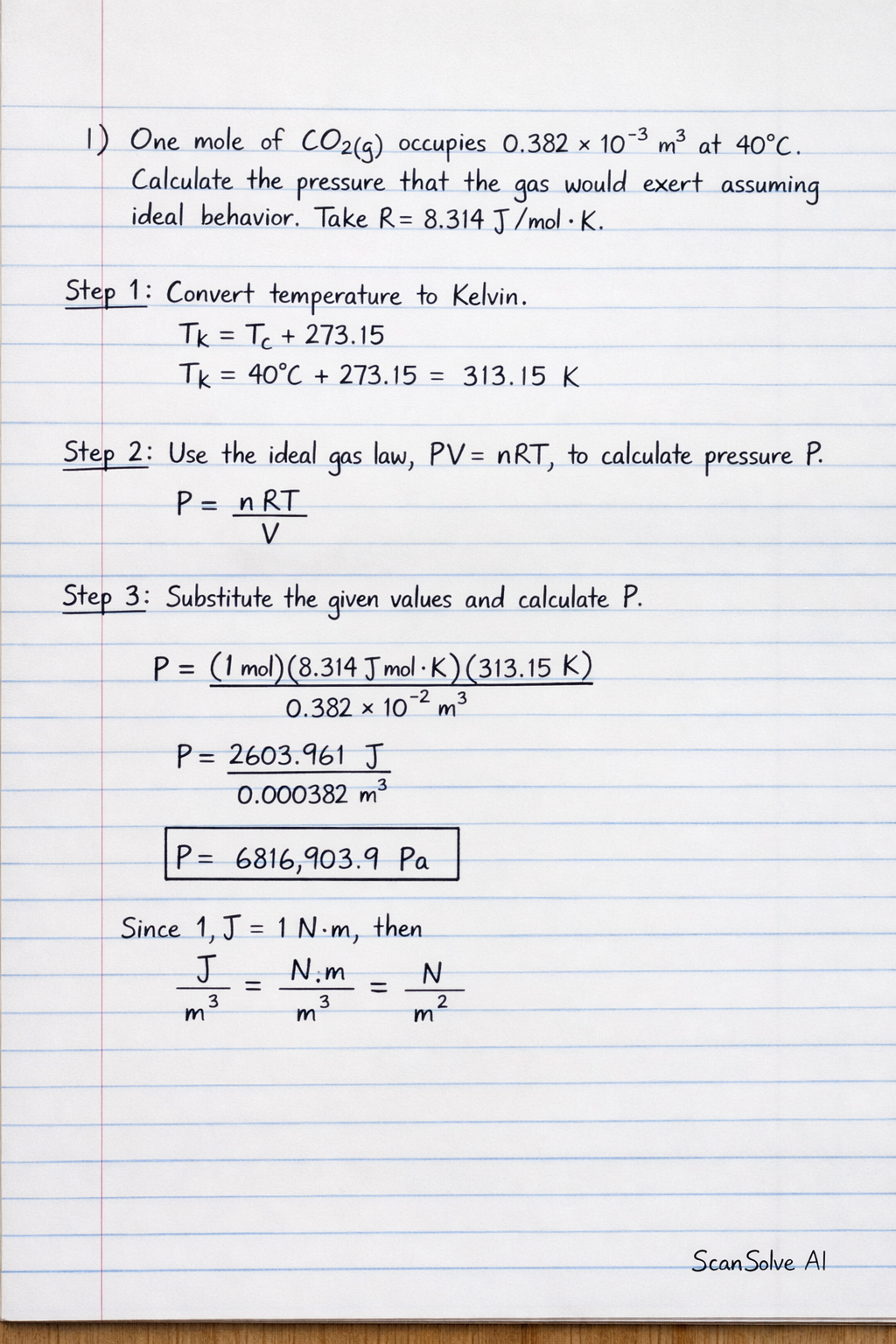
Handwritten Step-by-Step Solution
Get this as a handwritten image on WhatsApp — like a tutor wrote it for you.
Try on WhatsApp