
We read your photo as:
A quantity of gas has a volume of 25 L at 17 °C and 3 atm of pressure. To what volume must the gas be increased for a gas to be under STP conditions?
ScanSolve AI Answer
Answer
Water changes from a liquid to a solid state
Step-by-step solution
12 stepsOkay, Gezahagn, let's continue with these questions.
20. A quantity of gas has a volume of 25 L at 17 °C and 3 atm of pressure. To what volume must the gas be increased for a gas to be under STP conditions?
Identify the given values and the law to use.
This is a Combined Gas Law problem: .
Temperatures must be in Kelvin. STP conditions are and .
Given:
(STP)
Rearrange the formula to solve for .
Substitute the values and calculate .
Compare with the given options.
The closest option is c. 70.60 L.
The final answer is21. What is the molecular weight of a pure gaseous compound having a density of 4.95 g/L at -35 °C and 1020 torr?
Identify the given values and the appropriate formula.
We use the Ideal Gas Law in terms of density: , where is the molecular weight.
Given:
Density () =
Temperature () =
Pressure () =
Gas constant () = (since pressure is in torr)Rearrange the formula to solve for .
Substitute the values and calculate .
Compare with the given options.
The closest option is b. 72 g/mol.
The final answer is22. If helium (He) diffuses through a porous barrier at a rate of 4.0 moles per minute, at what rate (in moles per minute) would oxygen (O₂) gas diffuse?
Identify the given values and the appropriate law.
We use Graham's Law of Diffusion: .
Given:
Rate of He () =
Molar mass of He () =
Molar mass of O₂ () =
We need to find the rate of O₂ ().Set up Graham's Law equation.
Substitute the values and solve for .
Compare with the given options.
The closest option is a. 1.4.
The final answer is23. What will happen water when freezes?
The correct answer is b. Water changes from a liquid to a solid state.
Freezing is the phase transition of a substance from a liquid to a solid state.24. What is sublimation?
The correct answer is a. When a solid turns into a gas.
Sublimation is the process where a substance changes directly from a solid to a gas without passing through the liquid phase.25. What eventually happens if energy is continually removed from a liquid?
The correct answer is b. It freezes.
Removing energy from a liquid causes its temperature to decrease. If enough energy is removed, the liquid will undergo a phase transition to a solid state, which is called freezing.
Try one yourself
A new problem that tests the same skill.
Still stuck on this one?
Ask a follow-up, and the answer starts from this question.
More Physics Questions
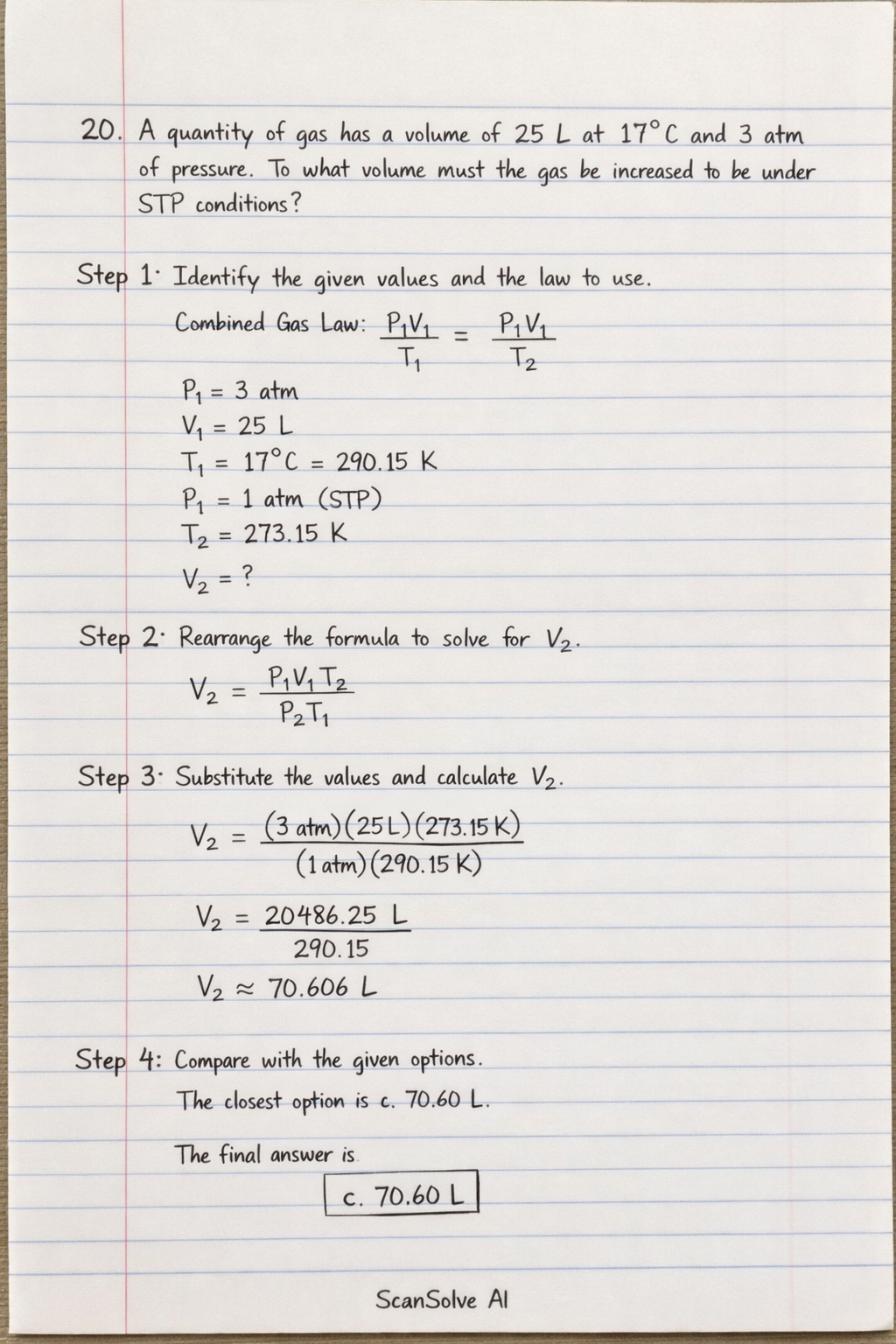
Handwritten Step-by-Step Solution
Get this as a handwritten image on WhatsApp — like a tutor wrote it for you.
Try on WhatsApp