
We read your photo as:
A gas expands from 50 m3 to 58 m3 at a constant pressure of 105 Nm⁻². Calculate the work done by the gas.
Physics
ScanSolve AI Answer
Step-by-step solution
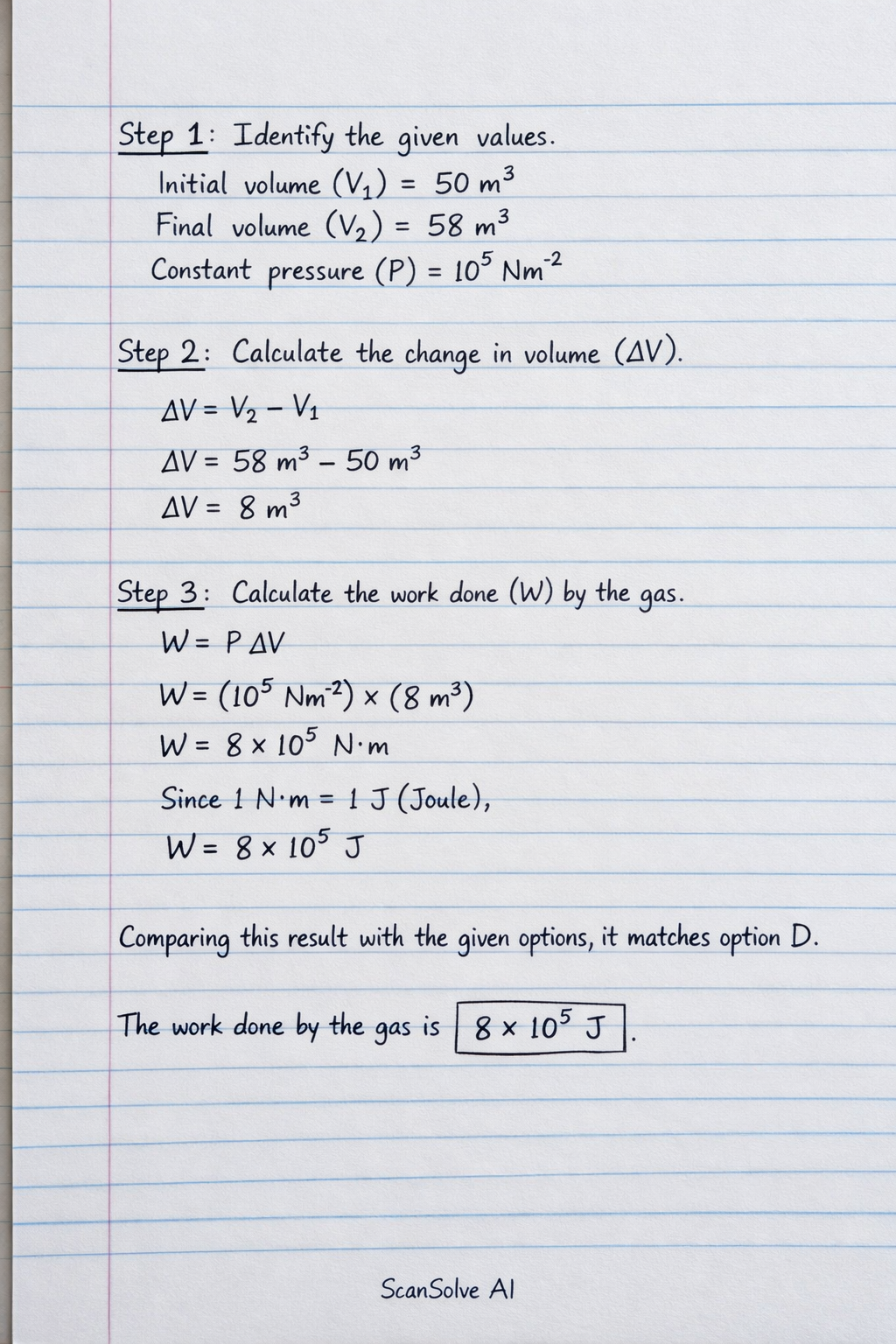
3 stepsIdentify the given values.
Initial volume () =
Final volume () =
Constant pressure () =Calculate the change in volume ().
The change in volume is the final volume minus the initial volume.
Calculate the work done () by the gas.
For expansion at constant pressure, the work done by the gas is given by the formula:
Substitute the values of pressure and change in volume:
Since (Joule),
Comparing this result with the given options, it matches option D.
The work done by the gas is
\boxed{\text{8 \times 10^5 J}}.
Was this helpful?
Still stuck on this one?
Ask a follow-up, and the answer starts from this question.
Got a different question?Ask your own question
More Physics Questions
QA gas expands polytropically from a pressure of 4 MPa to 230 KPa. The polytropic expansion n= 1.4…QCalculate the work done for a reversible isothermal expansion of 1 mole of an ideal gas at 25°C from…QCalculate the work done by an ideal gas during an irreversible expansion from 5 atm to 1 atm at 25°C…QA gas at 50°C and 30 cm³ is heated to 80°C at constant pressure. What is the fractional increase in…QA gas at 27°C has a volume of 4 m³ and a gauge pressure of 2.202 × 10⁵ Pa. It is compressed to a…
Browse by topic:Mechanics
Handwritten Step-by-Step Solution
Get this as a handwritten image on WhatsApp — like a tutor wrote it for you.
Try on WhatsApp