
We read your photo as:
A hollow circular shaft has inside and outside diameters of 30 mm and 40 mm, respectively. The material has a shear modulus of 60 kN/mm². Determine the maximum stress in the shaft when it is subjected to a twist of 5° in a length of 2.5 m. What is the maximum torque the shaft can carry?
ScanSolve AI Answer
Step-by-step solution
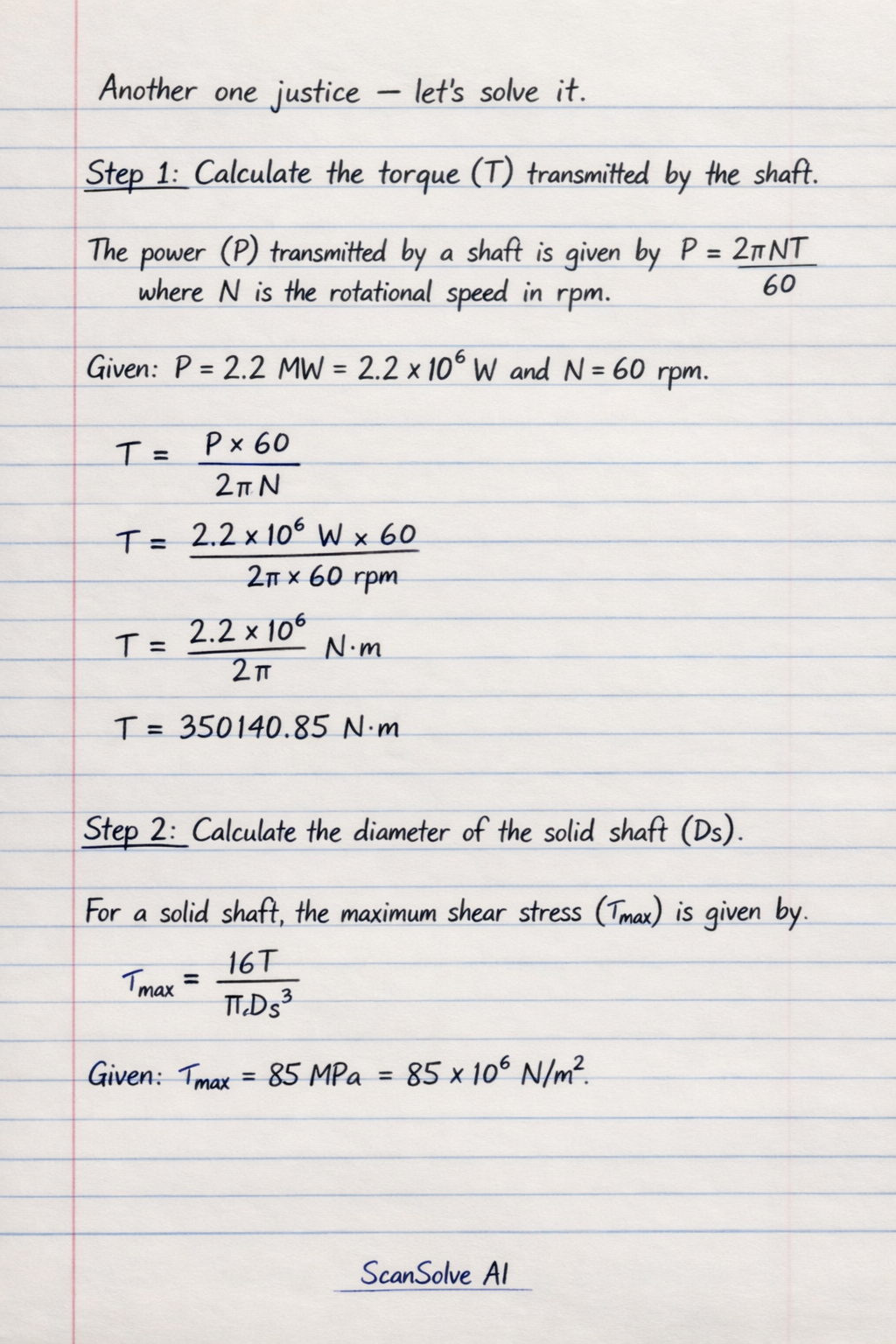
6 stepsCalculate the torque () transmitted by the shaft.
The power () transmitted by a shaft is given by , where is the rotational speed in rpm.
Given and .Calculate the diameter of the solid shaft ().
For a solid shaft, the maximum shear stress () is given by .
Given .The required diameter of the solid shaft is .
Calculate the external diameter () of the hollow shaft.
For a hollow shaft, the maximum shear stress () is given by , where is the ratio of internal to external diameter.
Given , which means .
The hollow shaft transmits the same torque and has the same allowable shear stress .First, calculate :
Now, substitute the values:
Calculate the internal diameter () of the hollow shaft.
Calculate the cross-sectional areas of the solid and hollow shafts.
The weight per meter length is proportional to the cross-sectional area for the same material.
Area of solid shaft ():Area of hollow shaft ():
Calculate the percentage saving in weight per meter length.
The percentage saving in weight per meter length is .
Still stuck on this one?
Ask a follow-up, and the answer starts from this question.
More Physics Questions
Handwritten Step-by-Step Solution
Get this as a handwritten image on WhatsApp — like a tutor wrote it for you.
Try on WhatsApp