

This physics problem tests your understanding of fundamental physical laws and their applications. The step-by-step solution below breaks down the problem using relevant equations and physical reasoning.
ScanSolve AI Answer
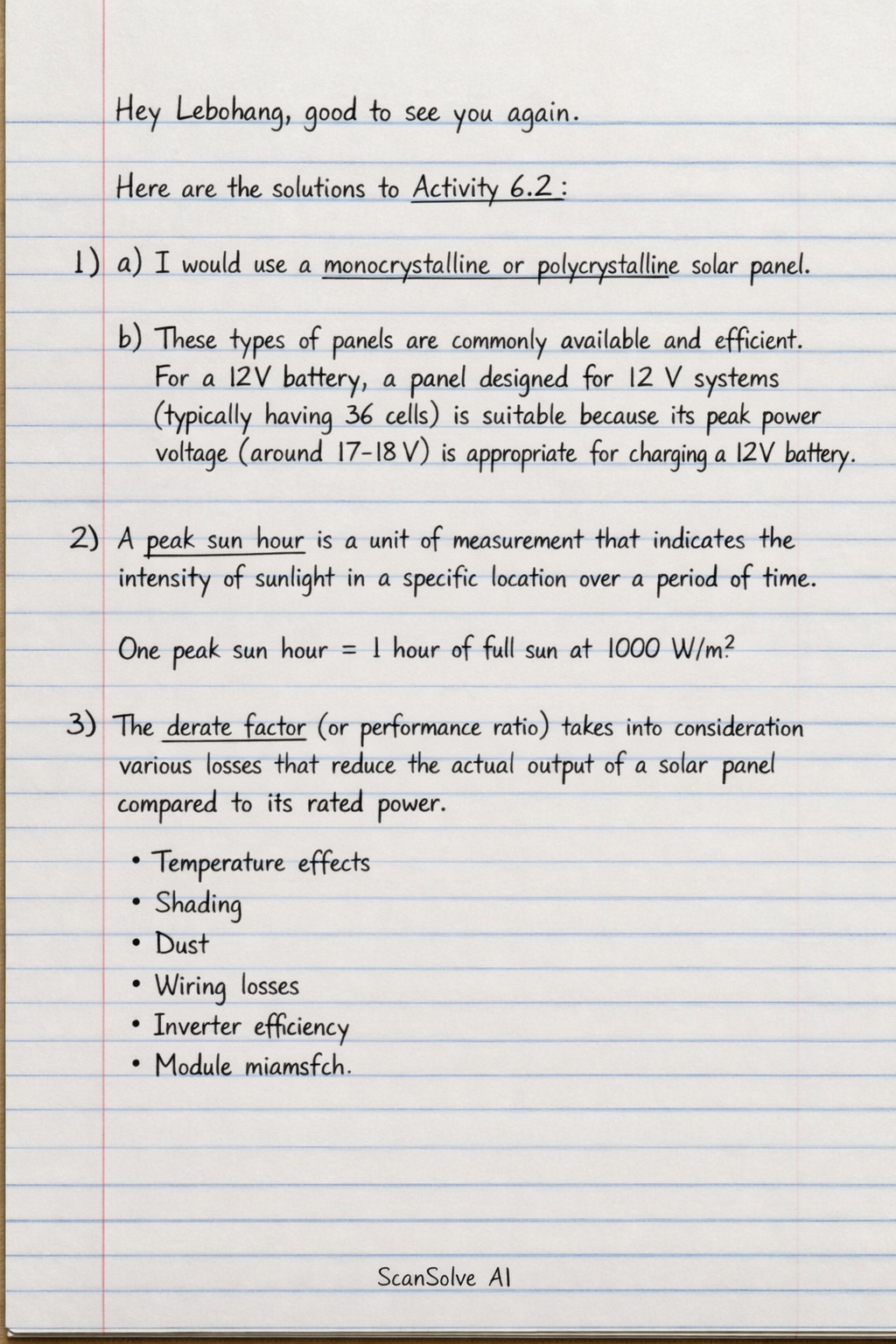
Here are the solutions to Activity 6.2: 1. a) I would use a monocrystalline or polycrystalline solar panel. b) These types of panels are commonly available and efficient. For a 12 V battery, a panel designed for 12 V systems (typically having 36 cells) is suitable because its peak power voltage (around 17-18 V) is appropriate for charging a 12 V battery. 2. A peak sun hour is a unit of measurement that indicates the intensity of sunlight in a specific location over a period of time. One peak sun hour is equivalent to one hour of full sun at an intensity of 1000 W/m^2. 3. The derate factor (or performance ratio) takes into consideration various losses that reduce the actual output of a solar panel compared to its rated power. These losses include temperature effects, shading, dust, wiring losses, inverter efficiency, and module mismatch. 4. Solar irradiance is the power per unit area received from the Sun in the form of electromagnetic radiation. It is typically measured in watts per square meter (W/m^2). 5. Solar panel insolation (or solar irradiation) is typically measured in kilowatt-hours per square meter per day (kWh/m^2/day) or joules per square meter (J/m^2). 6. The formula for the efficiency of solar conversion () is: = P_outP_in = P_outA × I where P_out is the electrical power output, P_in is the solar power input, A is the area of the solar panel, and I is the solar irradiance. 7. Step 1: Identify the given values. Rated output of solar panel (P_rated) = 4 kW Solar irradiance (daily insolation, H) = 3.5 kWh/m^2/day (This is equivalent to 3.5 peak sun hours) Assume a derate factor (PR) = 0.75 (based on the example provided in the image). Step 2: Use the formula for daily electricity output. E_daily = P_rated × H × PR Step 3: Substitute the values and calculate. E_daily = 4 kW × 3.5 h × 0.75 E_daily = 14 kWh × 0.75 E_daily = 10.5 kWh 8. Step 1: Calculate the area of the single solar cell. Length (L) = 125 mm = 0.125 m Width (W) = 125 mm = 0.125 m A_cell = L × W = 0.125 m × 0.125 m = 0.015625 m^2 Step 2: Calculate the electrical power output of the cell. Voltage (V) = 0.6 V Current (I) = 3 A P_out = V × I = 0.6 V × 3 A = 1.8 W Step 3: Calculate the solar power input to the cell. Solar insolation (I_solar) = 900 W/m^2 P_in = A_cell × I_solar = 0.015625 m^2 × 900 W/m^2 = 14.0625 W Step 4: Determine the efficiency of the solar cell. = P_outP_in × 100\% = 1.8 W14.0625 W × 100\% ≈ 0.1280 × 100\% = 12.80\% 9. Step 1: Calculate the area of a single cell. Length (L) = 125 mm = 0.125 m Width (W) = 125 mm = 0.125 m A_cell = L × W = 0.125 m × 0.125 m = 0.015625 m^2 Step 2: Calculate the power output of a single cell. Insolation (I_solar) = 800 W/m^2 Efficiency () = 13\% = 0.13 P_cell\_out = × A_cell × I_solar P_cell\_out = 0.13 × 0.015625 m^2 × 800 W/m^2 P_cell\_out = 1.625 W Step 3: Determine the current per cell, assuming a typical cell voltage. A standard silicon solar cell typically produces about 0.6 V. I_cell = P_cell\_outV_cell = 1.625 W0.6 V ≈ 2.7083 A Step 4: Calculate the number of cells required in series (N_s) to achieve the target voltage. Target voltage (V_total) = 3.8 V N_s = V_totalV_cell = 3.8 V0.6 V = 6.333 = 7 cells (We round up to ensure the target voltage is met or exceeded.) Step 5: Calculate the number of parallel strings (N_p) required to achieve the target current. Target current (I_total) = 2 A N_p = I_totalI_cell = 2 A2.7083 A = 0.738 = 1 string (One string provides enough current.) Step 6: Calculate the total number of cells. N_total = N_s × N_p = 7 cells × 1 string = 7 cells The 7 cells connected in series would produce 7 × 0.6 V = 4.2 V and 2.7083 A, which meets the requirements of 3.8 V and 2 A. The number of cells required is 7 cells. What's next? Send 'em! 📸