We read your photo as:

A mass of 40 kg is rotated by a string at a constant speed, V, in a vertical circle of 1m. If the minimum tension is 3N, Calculate, (i) Velocity (ii) Tmax (iii) Tension when the string is just horizontal

Physics

ScanSolve AI Answer

Answers

3 parts
i

3.14 m/s3.14 \, \text{m/s}

ii

787 N787 \, \text{N}

iii

395 N395 \, \text{N}

Step-by-step solution

6 steps

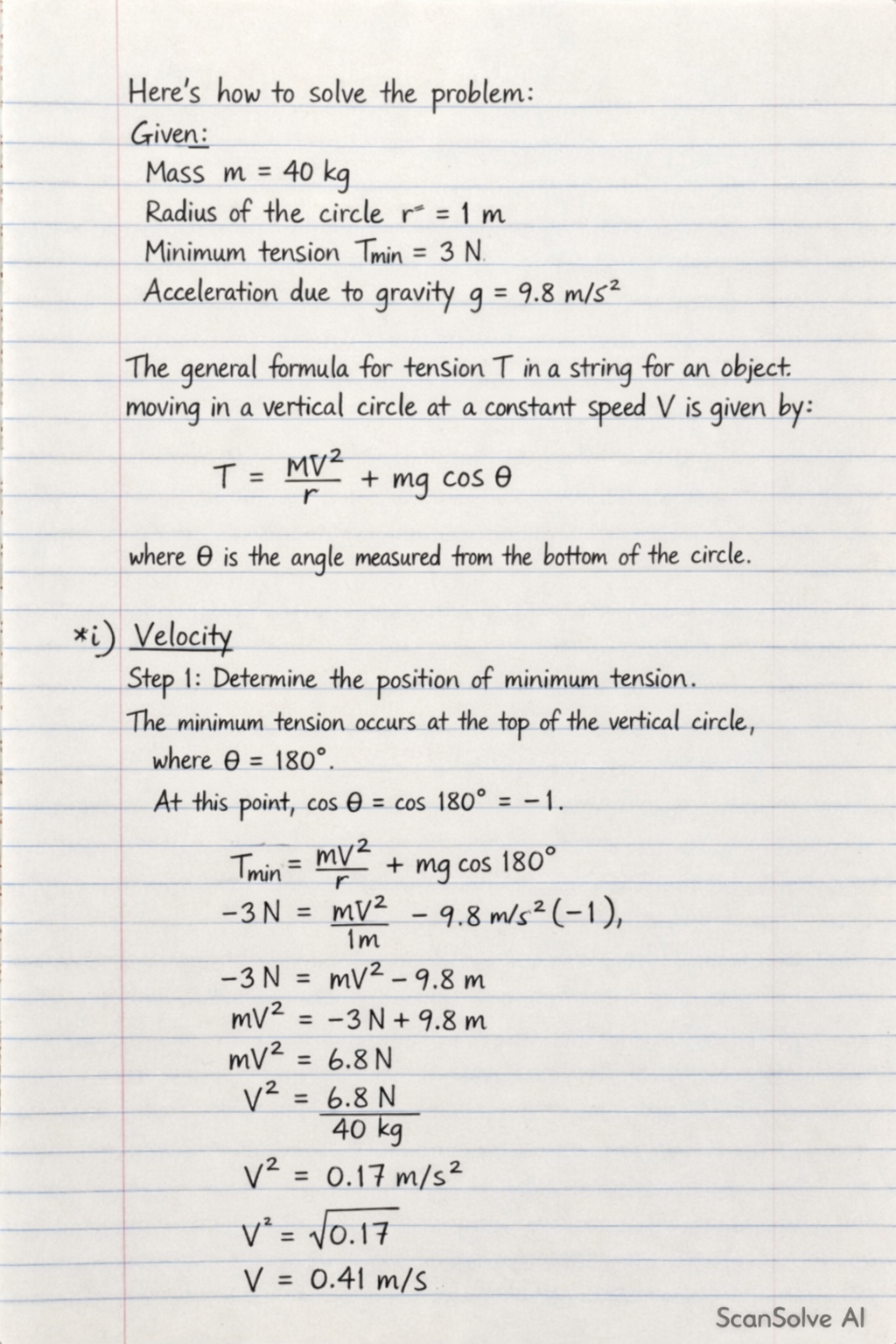
Here's how to solve the problem:

Given:
Mass m=40 kgm = 40 \, \text{kg}
Radius of the circle r=1 mr = 1 \, \text{m}
Minimum tension Tmin=3 NT_{min} = 3 \, \text{N}
Acceleration due to gravity g=9.8 m/s2g = 9.8 \, \text{m/s}^2

The general formula for tension TT in a string for an object moving in a vertical circle at a constant speed VV is given by:

T=mV2r+mgcos⁡θT = \frac{mV^2}{r} + mg \cos \theta

where θ\theta is the angle measured from the bottom of the circle.

Part i· 2 steps

Velocity

  1. Determine the position of minimum tension.

    The minimum tension occurs at the top of the vertical circle, where θ=180∘\theta = 180^\circ. At this point, cos⁡θ=cos⁡180∘=−1\cos \theta = \cos 180^\circ = -1.

  2. Use the minimum tension to find the velocity.

    Substitute Tmin=3 NT_{min} = 3 \, \text{N} and cos⁡θ=−1\cos \theta = -1 into the tension formula:

    Tmin=mV2r−mgT_{min} = \frac{mV^2}{r} - mg 3 N=(40 kg)V21 m−(40 kg)(9.8 m/s2)3 \, \text{N} = \frac{(40 \, \text{kg})V^2}{1 \, \text{m}} - (40 \, \text{kg})(9.8 \, \text{m/s}^2) 3=40V2−3923 = 40V^2 - 392 40V2=3+39240V^2 = 3 + 392 40V2=39540V^2 = 395 V2=39540V^2 = \frac{395}{40} V2=9.875 m2/s2V^2 = 9.875 \, \text{m}^2/\text{s}^2 V=9.875 m/sV = \sqrt{9.875} \, \text{m/s} V≈3.142 m/sV \approx 3.142 \, \text{m/s}

    The velocity is 3.14 m/s\boxed{3.14 \, \text{m/s}}.

Part ii

787 N787 \, \text{N}

Maximum Tension (TmaxT_{max})

  1. Determine the position of maximum tension.

    The maximum tension occurs at the bottom of the vertical circle, where θ=0∘\theta = 0^\circ. At this point, cos⁡θ=cos⁡0∘=1\cos \theta = \cos 0^\circ = 1.

  2. Calculate the maximum tension.

    Substitute V2=9.875 m2/s2V^2 = 9.875 \, \text{m}^2/\text{s}^2 and cos⁡θ=1\cos \theta = 1 into the tension formula:

    Tmax=mV2r+mgT_{max} = \frac{mV^2}{r} + mg Tmax=(40 kg)(9.875 m2/s2)1 m+(40 kg)(9.8 m/s2)T_{max} = \frac{(40 \, \text{kg})(9.875 \, \text{m}^2/\text{s}^2)}{1 \, \text{m}} + (40 \, \text{kg})(9.8 \, \text{m/s}^2) Tmax=395 N+392 NT_{max} = 395 \, \text{N} + 392 \, \text{N} Tmax=787 NT_{max} = 787 \, \text{N}

    The maximum tension is 787 N\boxed{787 \, \text{N}}.

Part iii

395 N395 \, \text{N}

Tension when the string is just horizontal

  1. Determine the position when the string is horizontal.

    When the string is horizontal, the angle θ=90∘\theta = 90^\circ (or 270∘270^\circ). At this point, cos⁡θ=cos⁡90∘=0\cos \theta = \cos 90^\circ = 0.

  2. Calculate the tension at the horizontal position.

    Substitute V2=9.875 m2/s2V^2 = 9.875 \, \text{m}^2/\text{s}^2 and cos⁡θ=0\cos \theta = 0 into the tension formula:

    Thorizontal=mV2r+mgcos⁡θT_{horizontal} = \frac{mV^2}{r} + mg \cos \theta Thorizontal=(40 kg)(9.875 m2/s2)1 m+(40 kg)(9.8 m/s2)(0)T_{horizontal} = \frac{(40 \, \text{kg})(9.875 \, \text{m}^2/\text{s}^2)}{1 \, \text{m}} + (40 \, \text{kg})(9.8 \, \text{m/s}^2)(0) Thorizontal=395 N+0 NT_{horizontal} = 395 \, \text{N} + 0 \, \text{N} Thorizontal=395 NT_{horizontal} = 395 \, \text{N}

    The tension when the string is just horizontal is 395 N\boxed{395 \, \text{N}}.

Was this helpful?

Try one yourself

A new problem that tests the same skill.

Still stuck on this one?

Ask a follow-up, and the answer starts from this question.

Got a different question?Ask your own question
Handwritten step-by-step solution preview

Handwritten Step-by-Step Solution

Get this as a handwritten image on WhatsApp — like a tutor wrote it for you.

Try on WhatsApp