
We read your photo as:
When the switch is closed, calculate: (i) the combined resistance of the circuit; (ii) the change in the current in the circuit when the 4.00 Ω resistor is disconnected.
ScanSolve AI Answer
Answers
3 partsStep-by-step solution
9 stepsPart b(i)· 2 steps
Calculate the equivalent resistance of the parallel combination of , , and .
The resistors , , and are in parallel.
Calculate the total combined resistance of the circuit.
The 6.00 resistor is in series with the parallel combination .
Part b(ii)
Calculate the initial total current in the circuit.
The voltage supply is .
Calculate the new equivalent resistance when the 4.00 resistor () is disconnected.
Now, only and are in parallel.
Calculate the new total combined resistance and the new total current.
Calculate the change in the current.
The current decreases by 0.0504 A.
Part c(i)
Determine the net voltage driving the current in the circuit.
The motorcycle battery (12.0 V) is charging the phone battery (4.6 V). The phone battery's EMF opposes the charging voltage.
Calculate the total resistance of the two filament bulbs.
Using Ohm's Law, , where .
Determine the resistance of each filament bulb.
Since the two bulbs are in series, their resistances add up.
Part c(ii)
When the phone battery is fully charged, its internal chemical reactions reach equilibrium, and its terminal voltage (or EMF) rises to match the charging voltage. This causes the net voltage across the series circuit (motorcycle battery EMF - phone battery EMF) to decrease significantly, reducing the current flowing through the circuit. Since the brightness of the bulbs depends on the current, they will dim or go off when the current becomes very low.
Still stuck on this one?
Ask a follow-up, and the answer starts from this question.
More Physics Questions
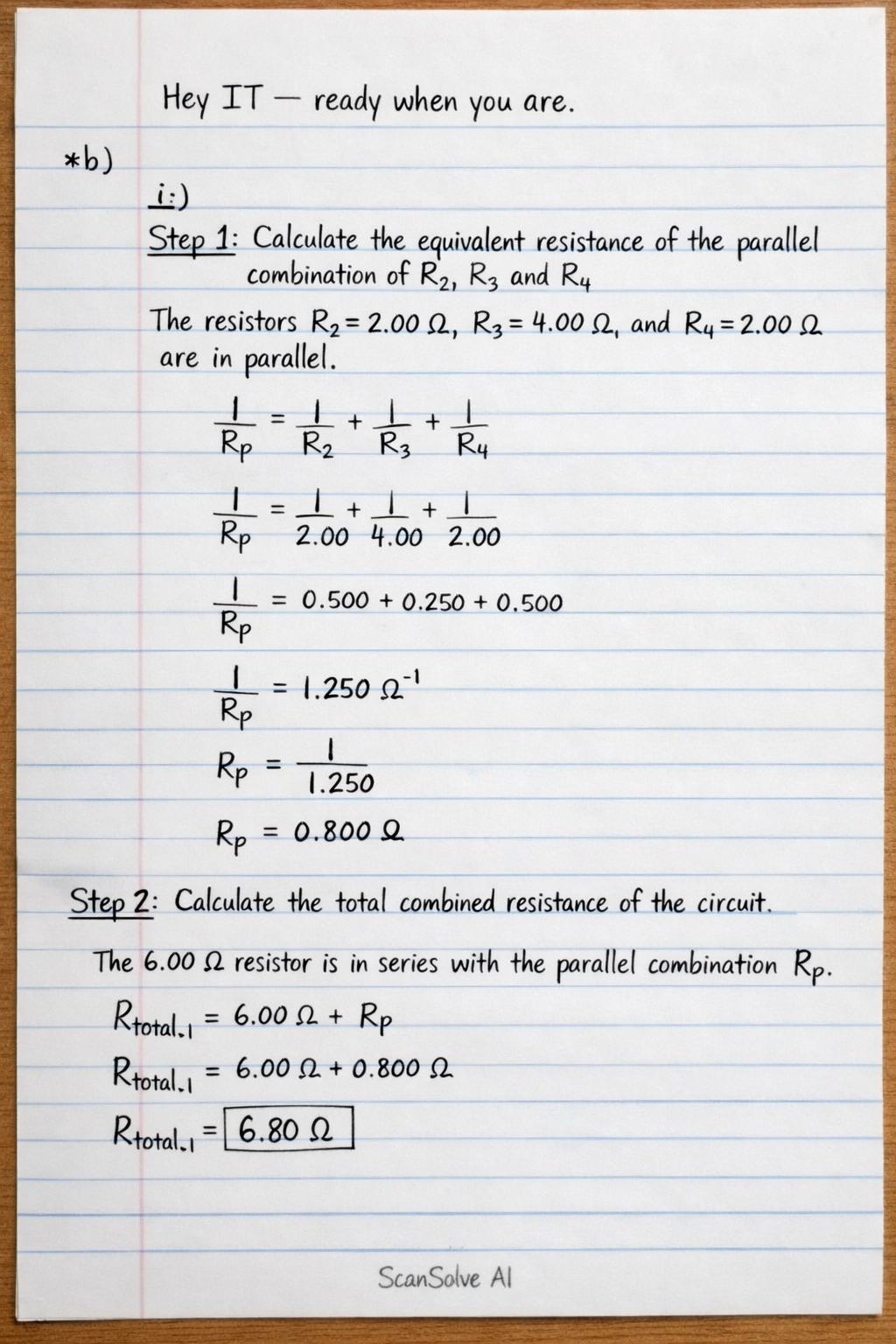
Handwritten Step-by-Step Solution
Get this as a handwritten image on WhatsApp — like a tutor wrote it for you.
Try on WhatsApp