

This physics problem tests your understanding of fundamental physical laws and their applications. The step-by-step solution below breaks down the problem using relevant equations and physical reasoning.
ScanSolve AI Answer
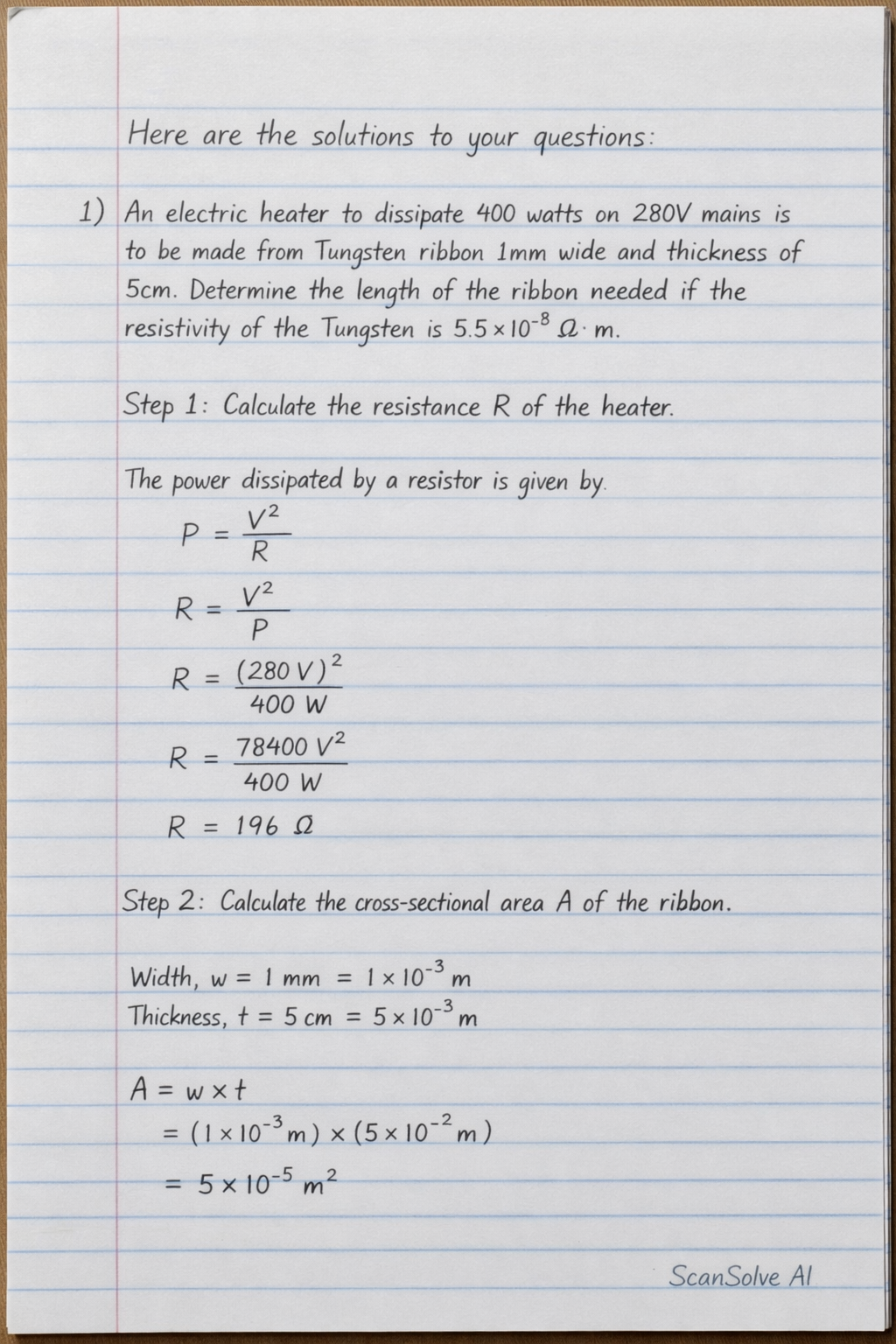
Here are the solutions to your questions: 1. An electric heater to dissipate 400 watts on 280V mains is to be made from Tungsten ribbon 1mm wide and thickness of 5cm. Determine the length of the ribbon needed if the resistivity of the Tungsten is 5.5 × 10^-8 m. Step 1: Calculate the resistance R of the heater. The power dissipated by a resistor is given by P = (V^2)/(R). R = (V^2)/(P) = (280 V)^2400 W = 78400 V^2400 W = 196 Step 2: Calculate the cross-sectional area A of the ribbon. The width w = 1 mm = 1 × 10^-3 m. The thickness t = 5 cm = 5 × 10^-2 m. A = w × t = (1 × 10^-3 m) × (5 × 10^-2 m) = 5 × 10^-5 m^2 Step 3: Calculate the length L of the ribbon. The resistance of a material is given by R = ( L)/(A). L = (RA)/() = (196 )(5 × 10^-5 m^2)5.5 × 10^-8 · m = 9.8 × 10^-3 · m^25.5 × 10^-8 · m ≈ 1.78 × 10^5 m The length of the ribbon needed is 1.78 × 10^5 m. 2. Two resistors, 2 and 6 are connected in parallel and the terminals are connected to the poles of a cell. A current of 2 A flows in the 2 resistor. Determine the current passed by the cells. Step 1: Calculate the voltage across the 2 resistor. Using Ohm's Law, V = IR. V_1 = I_1 R_1 = (2 A)(2 ) = 4 V Step 2: Determine the voltage across the 6 resistor. Since the resistors are connected in parallel, the voltage across them is the same. V_2 = V_1 = 4 V Step 3: Calculate the current through the 6 resistor. I_2 = (V_2)/(R_2) = 4 V6 = (2)/(3) A ≈ 0.667 A Step 4: Calculate the total current passed by the cells. The total current is the sum of the currents in the parallel branches. I_total = I_1 + I_2 = 2 A + (2)/(3) A = (8)/(3) A ≈ 2.67 A The current passed by the cells is 2.67 A. 3. A battery consist of two cells joined in parallel, each having emf 3 V and internal resistance 4 . What current will flow through an external resistance of 8 ? Step 1: Calculate the equivalent EMF and equivalent internal resistance for the parallel cells. For n identical cells in parallel, the equivalent EMF E_eq is equal to the EMF of a single cell, and the equivalent internal resistance r_eq is the internal resistance of one cell divided by n. E_eq = 3 V r_eq = (4 )/(2) = 2 Step 2: Calculate the total current flowing through the external resistance. Using Ohm's law for a circuit with internal resistance: I = E_eqR_ext + r_eq = 3 V8 + 2 = 3 V10 = 0.3 A The current that will flow through the external resistance is 0.3 A. 4. A battery of EMF 1.50 V has a terminal potential difference of 1.2 V when a resistor 15 is joined to it. Calculate the current flowing, the internal resistance and the terminal potential difference when resistor of 5 replaces the 15 . Step 1: Calculate the current flowing (I_1) when the 15 resistor is connected. The terminal potential difference V_T1 across the external resistor is V_T1 = I_1 R_1. I_1 = V_T1R_1 = 1.2 V15 = 0.08 A The current flowing is 0.08 A. Step 2: Calculate the internal resistance (r) of the battery. The terminal potential difference is also given by V_T = E - I r. 1.2 V = 1.50 V - (0.08 A) r (0.08 A) r = 1.50 V - 1.2 V = 0.3 V r = 0.3 V0.08 A = 3.75 The internal resistance is 3.75 . Step 3: Calculate the new current (I_2) when the 5 resistor (R_2) replaces R_1. I_2 = ER_2 + r = 1.50 V5 + 3.75 = 1.50 V8.75 ≈ 0.171 A Step 4: Calculate the new terminal potential difference (V_T2) when R_2 is connected. V_T2 = I_2 R_2 = (0.1714 A)(5 ) ≈ 0.857 V The terminal potential difference when the 5 resistor replaces the 15 resistor is 0.857 V. 5. For each of the circuit shown in figure 16.6, determine the current flowing through the battery. (Assuming "figure 16.6" refers to "Figure 2.6" in the provided image.) Circuit 1 (Left circuit in Figure 2.6) Step 1: Calculate the equivalent resistance of the parallel combination of 40 and 20 . R_p = (R_2 R_3)/(R_2 + R_3) = ((40 )(20 ))/(40 + 20 ) = (800 ^2)/(60 ) = (40)/(3) ≈ 13.33 Step 2: Calculate the total external resistance (R_ext). The 5 resistor is in series with the parallel combination. R_ext = 5 + (40)/(3) = (15)/(3) + (40)/(3) = (55)/(3) ≈ 18.33 Step 3: Calculate the total current flowing through the battery. The battery voltage is 25 V and its internal resistance is 0.5 . I = (V)/(R_ext) + r = 25 V(55)/(3) + 0.5 = 25 V(55)/(3) + (1.5)/(3) = 25 V(56.5)/(3) = (75)/(56.5) A ≈ 1.33 A The current flowing through the battery for Circuit 1 is 1.33 A. Circuit 2 (Right circuit in Figure 2.6) Step 1: Simplify the parallel combination of 4 and 20 . R_p1 = ((4 )(20 ))/(4 + 20 ) = (80 ^2)/(24 ) = (10)/(3) ≈ 3.33 Step 2: Simplify the parallel combination of 10 and 15 . R_p2 = ((10 )(15 ))/(10 + 15 ) = (150 ^2)/(25 ) = 6 Step 3: Calculate the total external resistance (R_ext). The resistors 1.5 , R_p1, 5 , and R_p2 are in series. R_ext = 1.5 + (10)/(3) + 5 + 6 = 1.5 + 3.333 + 5 + 6 = 15.833 Step 4: Calculate the total current flowing through the battery. The battery voltage is 15 V and its internal resistance is 0.4 . I = (V)/(R_ext) + r = 15 V15.833 + 0.4 = 15 V16.233 ≈ 0.924 A The current flowing through the battery for Circuit 2 is 0.924 A. 6. In the figure 2.7, find I_1, I_2 and I_3 of the switch as open and closed. Part A: Switch is Open Step 1: Apply Kirchhoff's Voltage Law (KVL) to the single loop. When the switch is open, no current flows through the 3 resistor (I_2 = 0). The circuit becomes a single series loop with the 12 V source, 6 resistor, 8 resistor, and 9 V source. I_1 and I_3 are the same current in this loop. Assuming I_1 flows clockwise: +12 V - I_1(6 ) - I_1(8 ) - 9 V = 0 3 V - I_1(14 ) = 0 I_1 = 3 V14 ≈ 0.214 A Step 2: Determine I_2 and I_3. I_2 = 0 A I_3 = I_1 = 0.214 A For the switch open: I_1 = 0.214 A, I_2 = 0 A, I_3 = 0.214 A. Part B: Switch is Closed Step 1: Apply Kirchhoff's Current Law (KCL) at node 'a'. I_1 = I_2 + I_3 (Equation 1) Step 2: Apply Kirchhoff's Voltage Law (KVL) to Loop 1 (left loop: c-a-b-c, clockwise). +12 V - I_1(6 ) - I_2(3 ) = 0 12 - 6I_1 - 3I_2 = 0 4 - 2I_1 - I_2 = 0 (Equation 2) Step 3: Apply Kirchhoff's Voltage Law (KVL) to Loop 2 (right loop: a-d-b-a, clockwise). -I_3(8 ) - 9 V + I_2(3 ) = 0 -8I_3 - 9 + 3I_2 = 0 (Equation 3) Step 4: Solve the system of equations. From Equation 2, I_2 = 4 - 2I_1. Substitute I_2 into Equation 1: I_1 = (4 - 2I_1) + I_3 I_3 = 3I_1 - 4. Substitute I_2 and I_3 into Equation 3: -8(3I_1 - 4) - 9 + 3(4 - 2I_1) = 0 -24I_1 + 32 - 9 + 12 - 6I_1 = 0 -30I_1 + 35 = 0 30I_1 = 35 I_1 = (35)/(30) A = (7)/(6) A ≈ 1.17 A Now find I_2: I_2 = 4 - 2((7)/(6)) = 4 - (7)/(3) = (12)/(3) - (7)/(3) = (5)/(3) A ≈ 1.67 A Now find I_3: I_3 = I_1 - I_2 = (7)/(6) A - (5)/(3) A = (7)/(6) A - (10)/(6) A = -(3)/(6) A = -0.5 A The negative sign for I_3 indicates that the current flows in the opposite direction to the assumed direction (i.e., from d to a). For the switch closed: I_1 = 1.17 A I_2 = 1.67 A I_3 = -0.5 A That's 2 down. 3 left today — send the next one.