We read your photo as:

A mixture is formed by adding 0.1 kg of steam at 100°C to 2 kg of water at 20°C in a copper can (0.2 kg) also at 20°C. Determine the final temperature of the mixture.

Physics

ScanSolve AI Answer

Answer

49.2 °C49.2 \text{ °C}

Step-by-step solution

5 steps

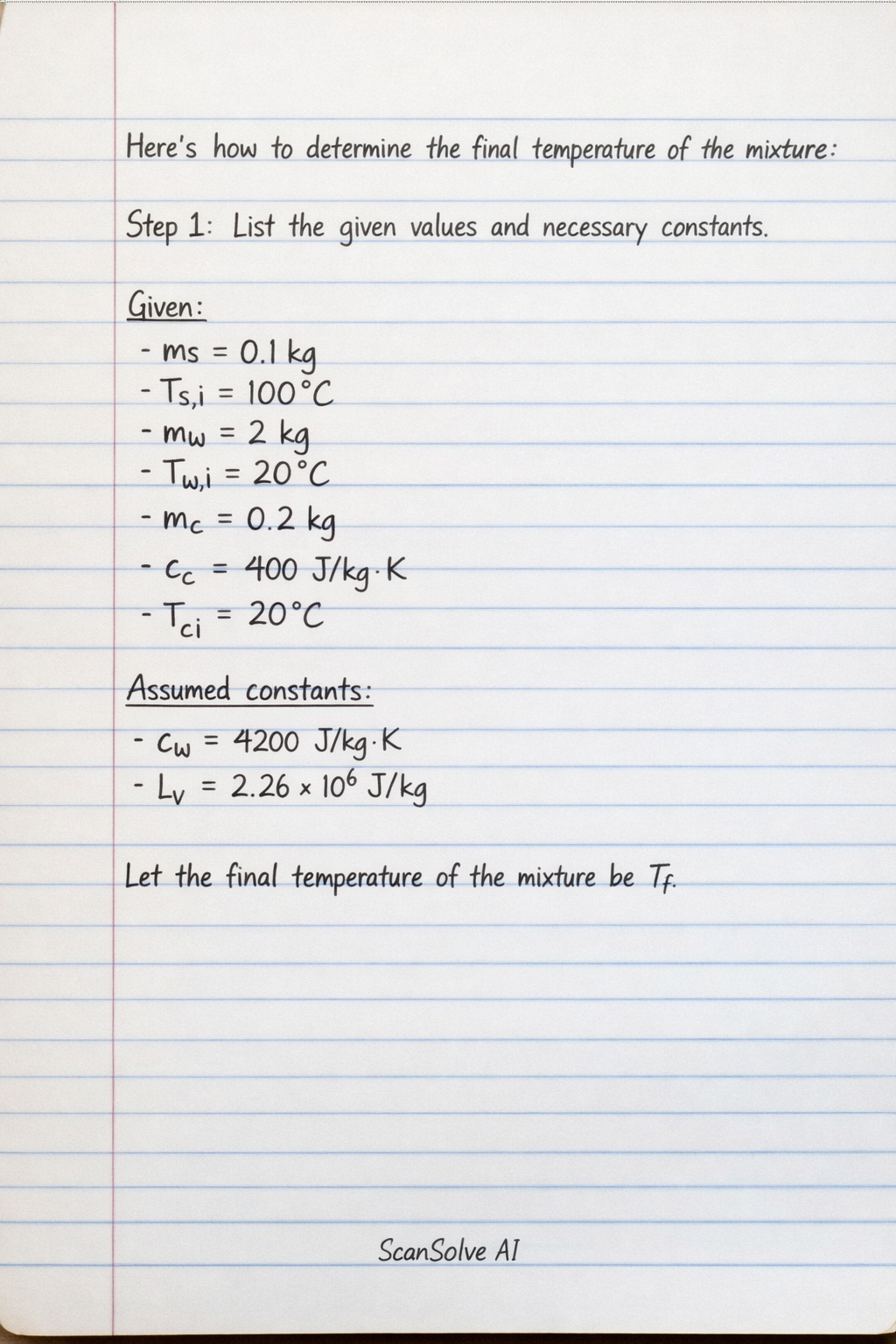
Here's how to determine the final temperature of the mixture:

  1. List the given values and necessary constants.

    Given:

    • Mass of steam (msm_s) = 0.1 kg0.1 \text{ kg}
    • Initial temperature of steam (Ts,iT_{s,i}) = 100 °C100 \text{ °C}
    • Mass of water (mwm_w) = 2 kg2 \text{ kg}
    • Initial temperature of water (Tw,iT_{w,i}) = 20 °C20 \text{ °C}
    • Mass of copper can (mcm_c) = 0.2 kg0.2 \text{ kg}
    • Specific heat capacity of copper (ccc_c) = 400 J/kgK400 \text{ J/kgK}
    • Initial temperature of copper can (Tc,iT_{c,i}) = 20 °C20 \text{ °C}

    Assumed constants:

    • Specific heat capacity of water (cwc_w) = 4200 J/kgK4200 \text{ J/kgK}
    • Specific latent heat of vaporization of steam (LvL_v) = 2.26×10⁶ J/kg2.26 \times 10^6 \text{ J/kg}

    Let the final temperature of the mixture be TfT_f.

  2. Calculate the heat lost by the steam.

    The steam first condenses at 100 °C100 \text{ °C} and then the resulting water cools from 100 °C100 \text{ °C} to TfT_f.
    Heat lost by condensation (Q1Q_1) = msLvm_s L_v
    Heat lost by cooling of condensed water (Q2Q_2) = mscw(100−Tf)m_s c_w (100 - T_f)
    Total heat lost by steam (QlostQ_{lost}):

    Qlost=Q1+Q2Q_{lost} = Q_1 + Q_2 Qlost=(0.1 kg×2.26×106 J/kg)+(0.1 kg×4200 J/kgK×(100−Tf) K)Q_{lost} = (0.1 \text{ kg} \times 2.26 \times 10^6 \text{ J/kg}) + (0.1 \text{ kg} \times 4200 \text{ J/kgK} \times (100 - T_f) \text{ K}) Qlost=226000 J+(42000−420Tf) JQ_{lost} = 226000 \text{ J} + (42000 - 420 T_f) \text{ J} Qlost=(268000−420Tf) JQ_{lost} = (268000 - 420 T_f) \text{ J}
  3. Calculate the heat gained by the water and the copper can.

    The water and the copper can both heat up from 20 °C20 \text{ °C} to TfT_f.
    Heat gained by water (Q3Q_3) = mwcw(Tf−20)m_w c_w (T_f - 20)
    Heat gained by copper can (Q4Q_4) = mccc(Tf−20)m_c c_c (T_f - 20)
    Total heat gained (QgainedQ_{gained}):

    Qgained=Q3+Q4Q_{gained} = Q_3 + Q_4 Qgained=(2 kg×4200 J/kgK×(Tf−20) K)+(0.2 kg×400 J/kgK×(Tf−20) K)Q_{gained} = (2 \text{ kg} \times 4200 \text{ J/kgK} \times (T_f - 20) \text{ K}) + (0.2 \text{ kg} \times 400 \text{ J/kgK} \times (T_f - 20) \text{ K}) Qgained=(8400(Tf−20)) J+(80(Tf−20)) JQ_{gained} = (8400 (T_f - 20)) \text{ J} + (80 (T_f - 20)) \text{ J} Qgained=(8400Tf−168000) J+(80Tf−1600) JQ_{gained} = (8400 T_f - 168000) \text{ J} + (80 T_f - 1600) \text{ J} Qgained=(8480Tf−169600) JQ_{gained} = (8480 T_f - 169600) \text{ J}
  4. Apply the principle of calorimetry.

    According to the principle of calorimetry, heat lost equals heat gained:

    Qlost=QgainedQ_{lost} = Q_{gained} 268000−420Tf=8480Tf−169600268000 - 420 T_f = 8480 T_f - 169600

    Rearrange the equation to solve for TfT_f:

    268000+169600=8480Tf+420Tf268000 + 169600 = 8480 T_f + 420 T_f 437600=8900Tf437600 = 8900 T_f Tf=4376008900T_f = \frac{437600}{8900} Tf=49.1685... °CT_f = 49.1685... \text{ °C}
  5. State the final temperature.

    Rounding to one decimal place:

    Tf≈49.2 °CT_f \approx \boxed{49.2 \text{ °C}}
Was this helpful?

Try one yourself

A new problem that tests the same skill.

Still stuck on this one?

Ask a follow-up, and the answer starts from this question.

Got a different question?Ask your own question
Handwritten step-by-step solution preview

Handwritten Step-by-Step Solution

Get this as a handwritten image on WhatsApp — like a tutor wrote it for you.

Try on WhatsApp