We read your photo as:

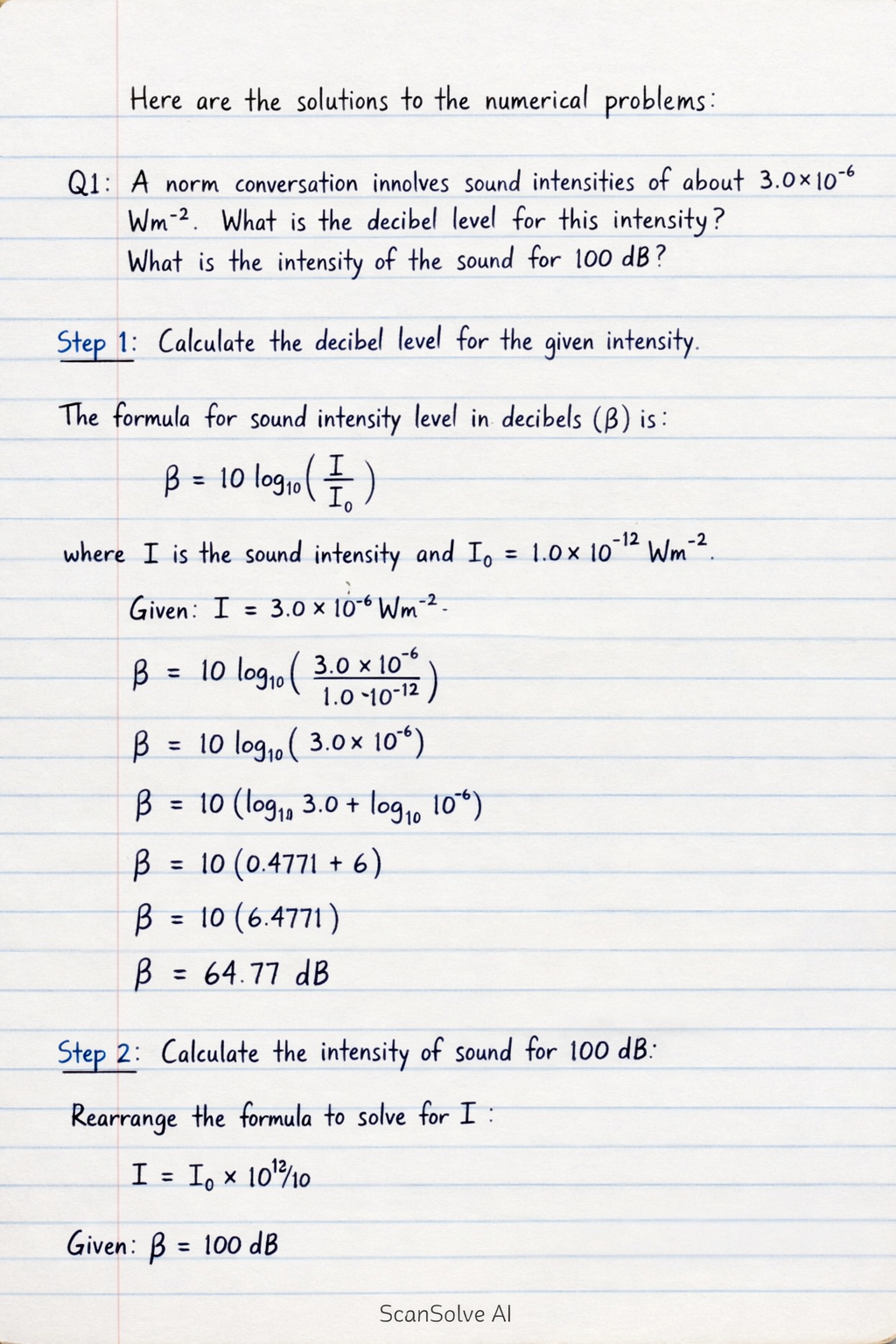
A normal conversation involves sound intensities of about 3.0 imes 10⁻⁶ ext Wm⁻². What is the decibel level for this intensity? What is the intensity of the sound for 100dB.

Physics

ScanSolve AI Answer

Step-by-step solution

9 steps

Here are the solutions to the numerical problems:

Q:1 A norm conversation involves sound intensities of about 3.0×10⁻⁶ Wm−23.0 \times 10^{-6} \text{ Wm}^{-2}. What is the decibel level for this intensity? What is the intensity of the sound for 100dB.

  1. Calculate the decibel level for the given intensity.

    The formula for sound intensity level in decibels (β\beta) is:

    β=10log⁡10(II0)\beta = 10 \log_{10} \left(\frac{I}{I_0}\right)

    where II is the sound intensity and I0I_0 is the reference intensity (1.0×10⁻¹² Wm−21.0 \times 10^{-12} \text{ Wm}^{-2}).
    Given I=3.0×10⁻⁶ Wm−2I = 3.0 \times 10^{-6} \text{ Wm}^{-2}.

    Substitute the values:

    β=10log⁡10(3.0×10⁻⁶ Wm−21.0×10⁻¹² Wm−2)\beta = 10 \log_{10} \left(\frac{3.0 \times 10^{-6} \text{ Wm}^{-2}}{1.0 \times 10^{-12} \text{ Wm}^{-2}}\right) β=10log⁡10(3.0×10⁶)\beta = 10 \log_{10} (3.0 \times 10^6) β=10(log⁡103.0+log⁡10106)\beta = 10 (\log_{10} 3.0 + \log_{10} 10^6) β=10(0.4771+6)\beta = 10 (0.4771 + 6) β=10(6.4771)\beta = 10 (6.4771) β=64.77 dB\beta = 64.77 \text{ dB}
  2. Calculate the intensity of sound for 100 dB.

    Rearrange the formula to solve for II:

    I=I0×10β/10I = I_0 \times 10^{\beta/10}

    Given β=100 dB\beta = 100 \text{ dB}.

    Substitute the values:

    I=(1.0×10⁻¹² Wm−2)×10100/10I = (1.0 \times 10^{-12} \text{ Wm}^{-2}) \times 10^{100/10} I=(1.0×10⁻¹² Wm−2)×1010I = (1.0 \times 10^{-12} \text{ Wm}^{-2}) \times 10^{10} I=1.0×10⁻² Wm−2I = 1.0 \times 10^{-2} \text{ Wm}^{-2}

    The decibel level for 3.0×10⁻⁶ Wm−23.0 \times 10^{-6} \text{ Wm}^{-2} is 64.77 dB\boxed{\text{64.77 dB}}.
    The intensity of sound for 100 dB is 1.0×10⁻² Wm−2\boxed{1.0 \times 10^{-2} \text{ Wm}^{-2}}.

    Q:2 At 100,000 how much current flows through your body if you touch your terminal of a 12 V battery? If your skin is wet, so that your resistance is only 1000 how much current would you receive from the same battery.

  3. Calculate the current when resistance is 100,000 Ω100,000 \ \Omega.

    Use Ohm's Law: I=VRI = \frac{V}{R}
    Given: V=12 VV = 12 \text{ V}, R=100,000 ΩR = 100,000 \ \Omega.

    Substitute the values:

    I=12 V100,000 ΩI = \frac{12 \text{ V}}{100,000 \ \Omega} I=0.00012 AI = 0.00012 \text{ A} I=0.12 mAI = 0.12 \text{ mA}
  4. Calculate the current when resistance is 1000 Ω1000 \ \Omega.

    Given: V=12 VV = 12 \text{ V}, R=1000 ΩR = 1000 \ \Omega.

    Substitute the values:

    I=12 V1000 ΩI = \frac{12 \text{ V}}{1000 \ \Omega} I=0.012 AI = 0.012 \text{ A} I=12 mAI = 12 \text{ mA}

    The current for 100,000 Ω100,000 \ \Omega resistance is 0.12 mA\boxed{0.12 \text{ mA}}.
    The current for 1000 Ω1000 \ \Omega resistance is 12 mA\boxed{12 \text{ mA}}.

    Q:3 At a particular temperature, the speed of sound in air is 300 ms−1300 \text{ ms}^{-1}. If the wavelength of a note is 5 cm, calculate the frequency of the sound wave. Is this frequency in the audible range of the human ear?

  5. Convert the wavelength to meters.

    Given: λ=5 cm\lambda = 5 \text{ cm}.

    5 cm=5×10⁻² m=0.05 m5 \text{ cm} = 5 \times 10^{-2} \text{ m} = 0.05 \text{ m}
  6. Calculate the frequency of the sound wave.

    The relationship between speed, frequency, and wavelength is v=fλv = f \lambda.
    Rearrange to solve for frequency f=vλf = \frac{v}{\lambda}.
    Given: v=300 ms−1v = 300 \text{ ms}^{-1}, λ=0.05 m\lambda = 0.05 \text{ m}.

    Substitute the values:

    f=300 ms−10.05 mf = \frac{300 \text{ ms}^{-1}}{0.05 \text{ m}} f=6000 Hzf = 6000 \text{ Hz}
  7. Determine if the frequency is in the audible range.

    The audible range for human hearing is typically 20 Hz20 \text{ Hz} to 20,000 Hz20,000 \text{ Hz}.
    Since 6000 Hz6000 \text{ Hz} falls within this range, it is audible.

    The frequency of the sound wave is 6000 Hz\boxed{6000 \text{ Hz}}.
    Yes, this frequency is in the audible range of the human ear.

    Q:4 By applying a potential Difference of 1p V across a conductor a current of 1.5 A passes through it. How much energy would be obtain from the current in 2 minutes?

  8. Convert potential difference and time to standard units.

    Given: Potential difference V=1 pVV = 1 \text{ pV} (picoVolt).

    1 pV=1×10⁻¹² V1 \text{ pV} = 1 \times 10^{-12} \text{ V}

    Given: Time t=2 minutest = 2 \text{ minutes}.

    2 minutes=2×60 s=120 s2 \text{ minutes} = 2 \times 60 \text{ s} = 120 \text{ s}

    Given: Current I=1.5 AI = 1.5 \text{ A}.

  9. Calculate the energy obtained.

    The formula for electrical energy (EE) is E=VItE = V I t.

    Substitute the values:

    E=(1×10⁻¹² V)×(1.5 A)×(120 s)E = (1 \times 10^{-12} \text{ V}) \times (1.5 \text{ A}) \times (120 \text{ s}) E=1.5×120×10−12 JE = 1.5 \times 120 \times 10^{-12} \text{ J} E=180×10−12 JE = 180 \times 10^{-12} \text{ J} E=1.8×10⁻¹⁰ JE = 1.8 \times 10^{-10} \text{ J}

    The energy obtained from the current in 2 minutes is 1.8×10⁻¹⁰ J\boxed{1.8 \times 10^{-10} \text{ J}}.

Was this helpful?

Still stuck on this one?

Ask a follow-up, and the answer starts from this question.

Got a different question?Ask your own question
Handwritten step-by-step solution preview

Handwritten Step-by-Step Solution

Get this as a handwritten image on WhatsApp — like a tutor wrote it for you.

Try on WhatsApp