
We read your photo as:
A particle is projected from a point O on horizontal ground with an initial speed U m/s at an angle θ to the horizontal. It passes through the point (40,10). Given that tan θ = 3/4, find U, velocity c
ScanSolve AI Answer
Step-by-step solution
10 stepsHere is the solution to the projectile motion problem:
Question 3:
A particle is projected from a point O on horizontal ground with an initial speed m/s at an angle to the horizontal. It passes through the point . Given that , find:
a) The value of .
b) The horizontal and the vertical components of the velocity when s. State, with a reason, whether the particle is rising or falling at this instance.
c) The total time for which the particle is at a height greater than 5 m.
(take )
First, let's determine and from .
Using a right-angled triangle with opposite side 3 and adjacent side 4, the hypotenuse is .
So, and .
The equations of motion for a projectile are:
Horizontal displacement:
Vertical displacement:
a) The value of .
The particle passes through the point .
Substitute , , , , and into the equations:
Use the horizontal displacement equation.
Use the vertical displacement equation.
Substitute from (1) into (2).
Substitute s back into equation (1) to find .
The value of is .
b) The horizontal and the vertical components of the velocity when s. State, with a reason, whether the particle is rising or falling at this instance.
The velocity components are given by:
Horizontal velocity:
Vertical velocity:Calculate the horizontal velocity component at s.
Calculate the vertical velocity component at s.
Determine if the particle is rising or falling.
Since the vertical component of velocity is negative, the particle is moving downwards.
The horizontal component of velocity is .
The vertical component of velocity is .
The particle is falling because its vertical velocity component is negative.c) The total time for which the particle is at a height greater than 5 m.
We need to find the times when m and then calculate the duration between these times.
Using the vertical displacement equation:
Substitute , , , and :Rearrange the equation into a quadratic form.
Divide by 5:
Solve the quadratic equation for using the quadratic formula .
Here, , , .
The two times when the particle is at a height of 5 m are:
Calculate the total time for which the particle is at a height greater than 5 m.
This is the difference between and .
The total time for which the particle is at a height greater than 5 m is .
Still stuck on this one?
Ask a follow-up, and the answer starts from this question.
More Physics Questions
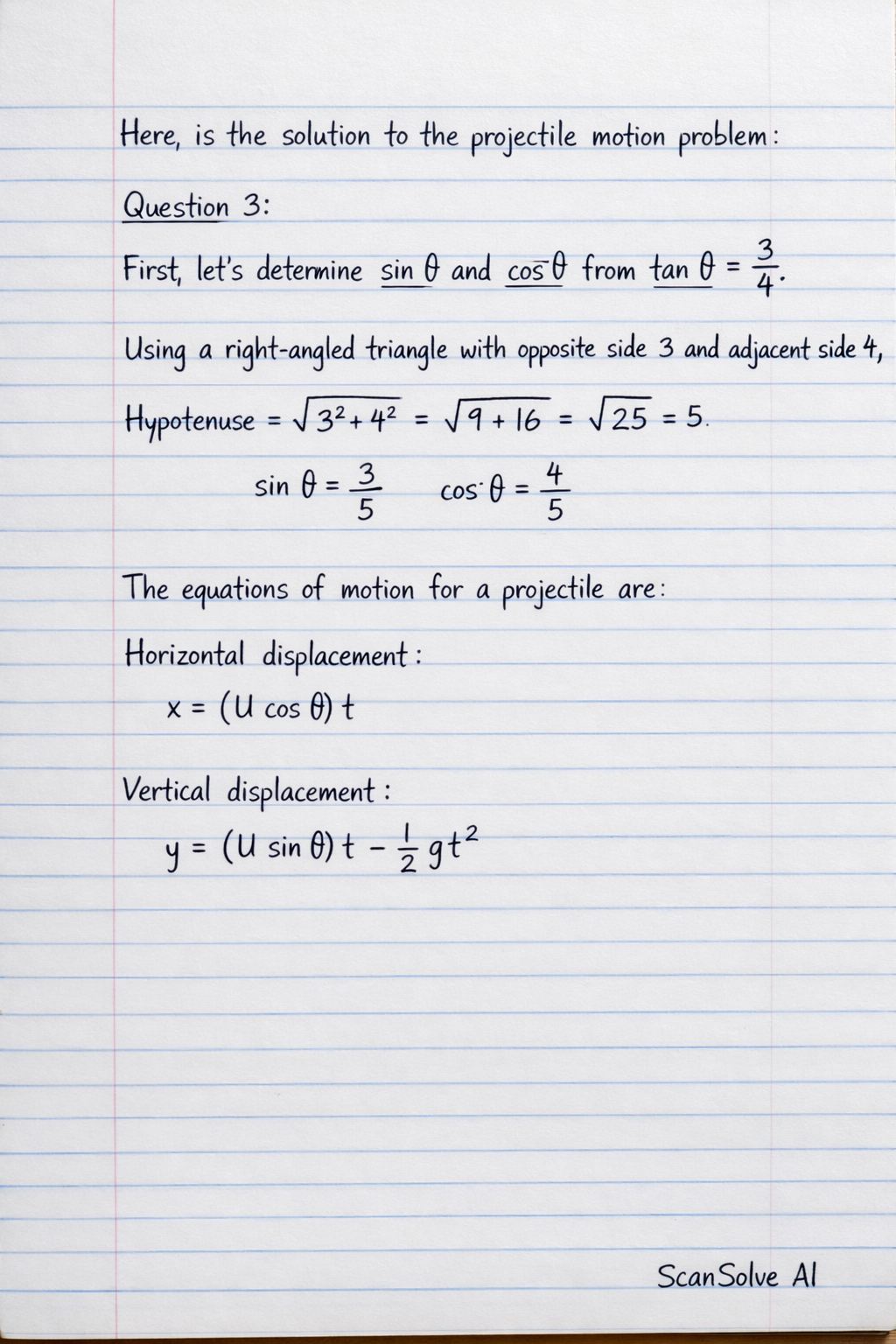
Handwritten Step-by-Step Solution
Get this as a handwritten image on WhatsApp — like a tutor wrote it for you.
Try on WhatsApp