
We read your photo as:
A particle moves with acceleration a = (4−t) ext m/s2. Its initial velocity is v0 = 3 ext m/s. Find its velocity, displacement, and time to attain maximum velocity.
ScanSolve AI Answer
Step 1: Understand the given information.
The acceleration of the particle is given by .
The initial velocity (at ) is .
a) (i) Express the velocity in terms of .
Velocity is the integral of acceleration with respect to time: .
To find the constant of integration , use the initial condition: when , .
Substitute back into the velocity equation:
The velocity in terms of is .
a) (ii) Find the velocity of the particle after 3 seconds.
Substitute into the velocity equation:
The velocity after 3 seconds is .
b) (i) Calculate the time taken to attain maximum velocity.
Maximum velocity occurs when the acceleration is zero ().
Set :
The time taken to attain maximum velocity is .
b) (ii) Calculate the displacement of the particle by the time it attains the maximum velocity.
Displacement is the integral of velocity with respect to time: .
We use the velocity equation .
Assume initial displacement is zero: when , .
So, the displacement equation is:
The particle attains maximum velocity at s. Substitute into the displacement equation:
To combine these, find a common denominator:
The displacement of the particle by the time it attains maximum velocity is or .
Still stuck on this one?
Ask a follow-up, and the answer starts from this question.
More Physics Questions
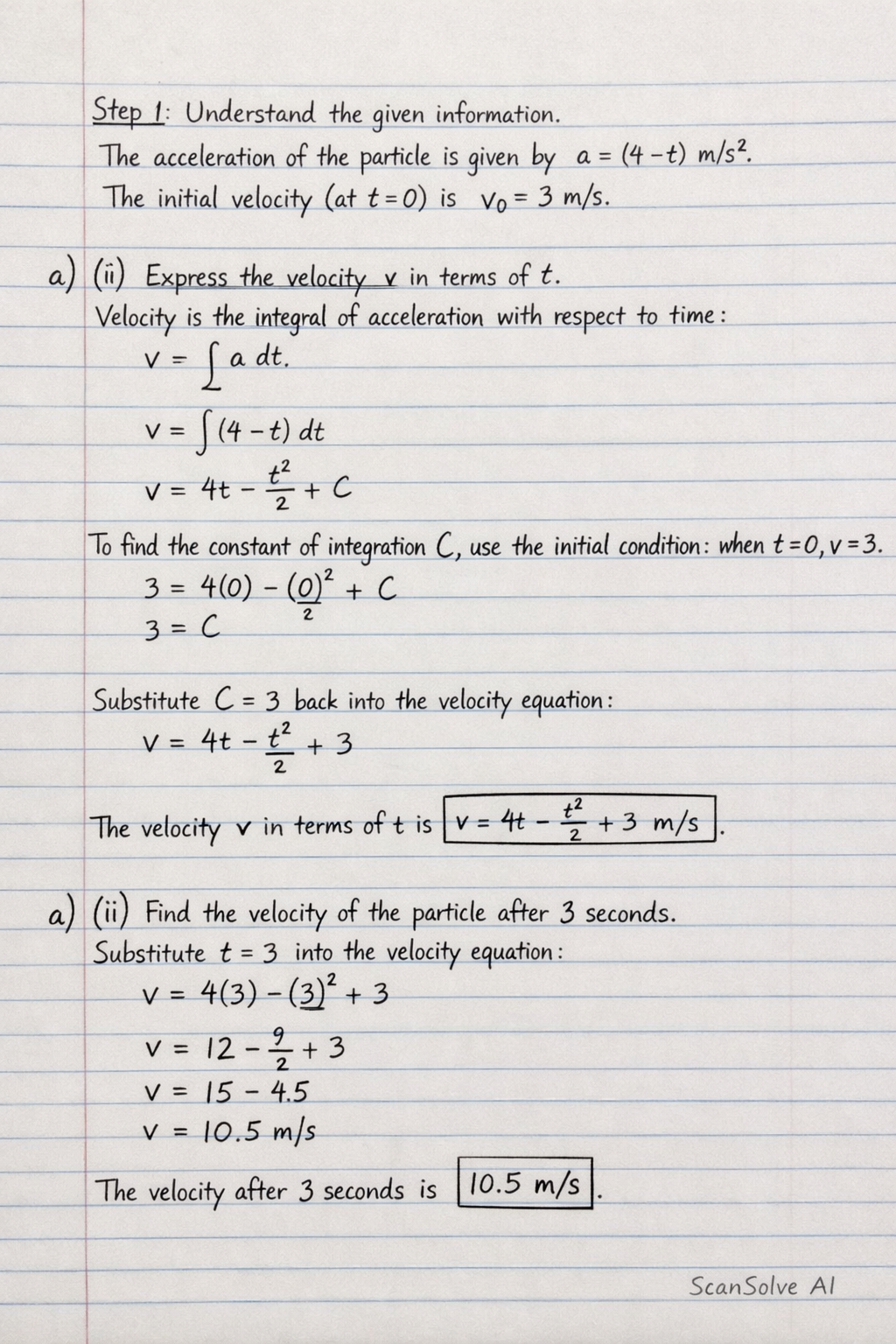
Handwritten Step-by-Step Solution
Get this as a handwritten image on WhatsApp — like a tutor wrote it for you.
Try on WhatsApp