
We read your photo as:
A photovoltaic plate with a power output of 30 mW cm⁻² and an efficiency of 40%. i) Determine the amount of solar energy falling on it per unit time. ii) How many such plates can supply energy directl
ScanSolve AI Answer
Step-by-step solution
7 stepsHere are the solutions to your questions:
8. a.
-
Figure 10 shows a photovoltaic plate with a power output of and an efficiency of 40%.
- i) Determine the amount of solar energy falling on it per unit time.
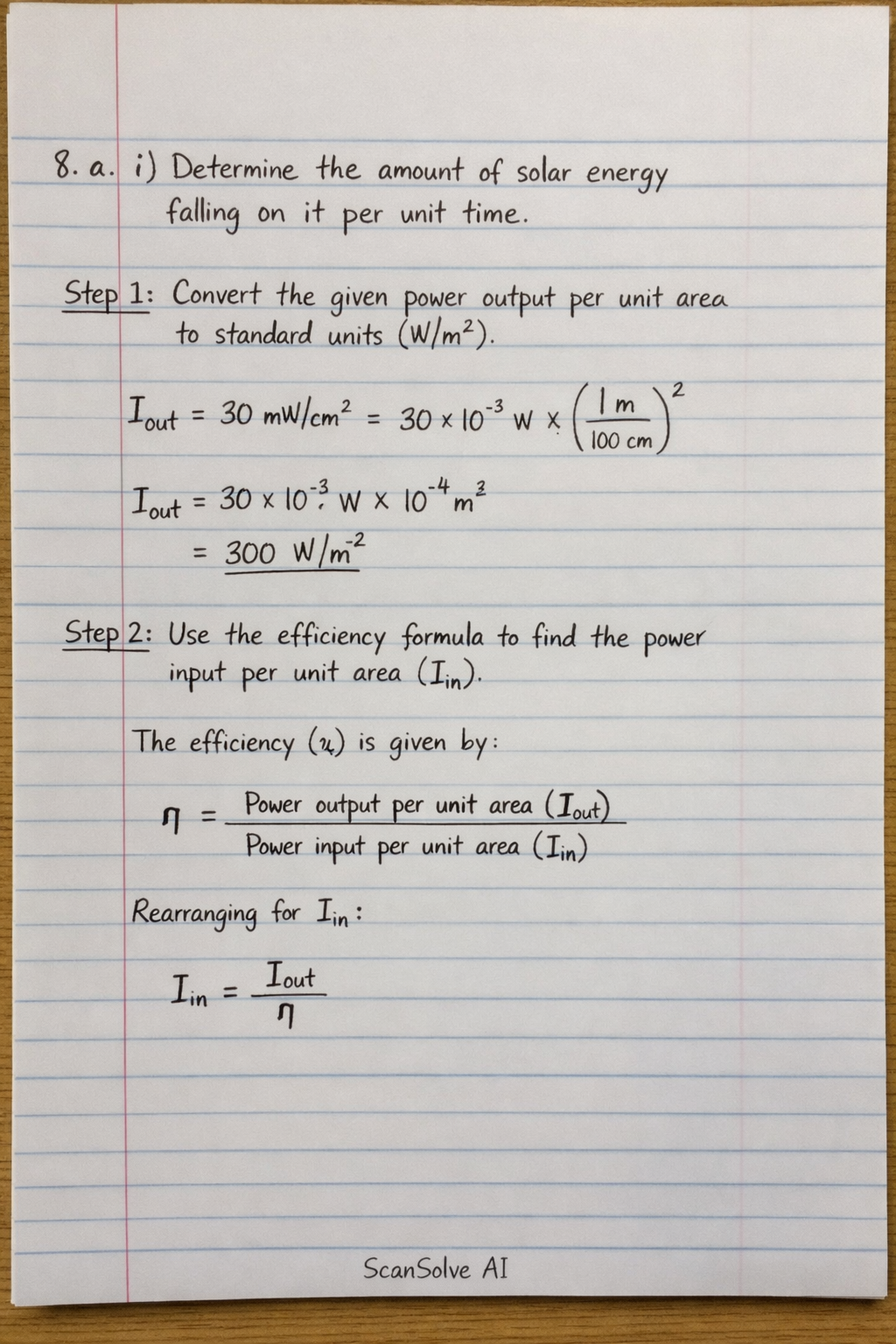
Convert the given power output per unit area to standard units (Wm⁻²).
$$ I_{out} = 30 \text{ mW cm}^{-2} = 30 \times 10^{-3} \text{ W} \times \left(\frac{1 \text{ m}}{100 \text{ cm}}\right)^2 $$ $$ I_{out} = 30 \times 10^{-3} \text{ W} \times \frac{10^4}{\text{ m}^2} = 300 \text{ Wm}^{-2} $$Use the efficiency formula to find the power input per unit area ().
The efficiency ($\eta$) is given by: $$ \eta = \frac{\text{Power output per unit area} (I_{out})}{\text{Power input per unit area} (I_{in})} $$ Rearranging for $I_{in}$: $$ I_{in} = \frac{I_{out}}{\eta} $$Substitute the values and calculate.
Given $\eta = 40\% = 0.40$. $$ I_{in} = \frac{300 \text{ Wm}^{-2}}{0.40} $$ $$ I_{in} = 750 \text{ Wm}^{-2} $$ The amount of solar energy falling on it per unit time (per unit area) is $\boxed{\text{750 Wm}^{-2}}$. * ii) How many such plates can supply energy directly to a 3 horse power electric pump switched on for 20 minutes if the intensity of solar radiation is assumed constant within this time and $1 \text{ hp} = 800 \text{ W}$?Calculate the total power required by the electric pump.
Given pump power = 3 hp. $$ P_{pump} = 3 \text{ hp} \times 800 \text{ W/hp} $$ $$ P_{pump} = 2400 \text{ W} $$Calculate the surface area of one photovoltaic plate from the figure.
$$ A_{plate} = 1.5 \text{ m} \times 1.0 \text{ m} $$ $$ A_{plate} = 1.5 \text{ m}^2 $$Calculate the total power output of one photovoltaic plate.
Using the power output per unit area $I_{out} = 300 \text{ Wm}^{-2}$ from part (i). $$ P_{out,plate} = I_{out} \times A_{plate} $$ $$ P_{out,plate} = 300 \text{ Wm}^{-2} \times 1.5 \text{ m}^2 $$ $$ P_{out,plate} = 450 \text{ W} $$Determine the number of plates required.
$$ N = \frac{\text{Total power required by pump}}{\text{Power output of one plate}} $$ $$ N = \frac{2400 \text{ W}}{450 \text{ W}} $$ $$ N = 5.333... $$ Since you cannot use a fraction of a plate, you must round up to ensure the pump receives sufficient power. The number of plates required is $\boxed{\text{6 plates}}$.8. b.
-
Explain why solar energy is referred to as being:
-
i) Environmentally friendly: Solar energy is environmentally friendly because its generation process does not produce greenhouse gas emissions or other pollutants that contribute to air pollution, acid rain, or climate change. It utilizes a clean, natural resource.
-
ii) Functional: Solar energy is functional because it can be directly converted into usable forms of energy, primarily electricity (via
-
-
Still stuck on this one?
Ask a follow-up, and the answer starts from this question.
More Physics Questions
Handwritten Step-by-Step Solution
Get this as a handwritten image on WhatsApp — like a tutor wrote it for you.
Try on WhatsApp