
We read your photo as:
A parallel plate capacitor has a plate area of 120 cm², a plate separation of 1.8 cm, and a potential difference of 52 V. A dielectric slab of thickness 0.6 mm and dielectric constant 3 is inserted be
ScanSolve AI Answer
Answers
2 partsStep-by-step solution
6 steps12:
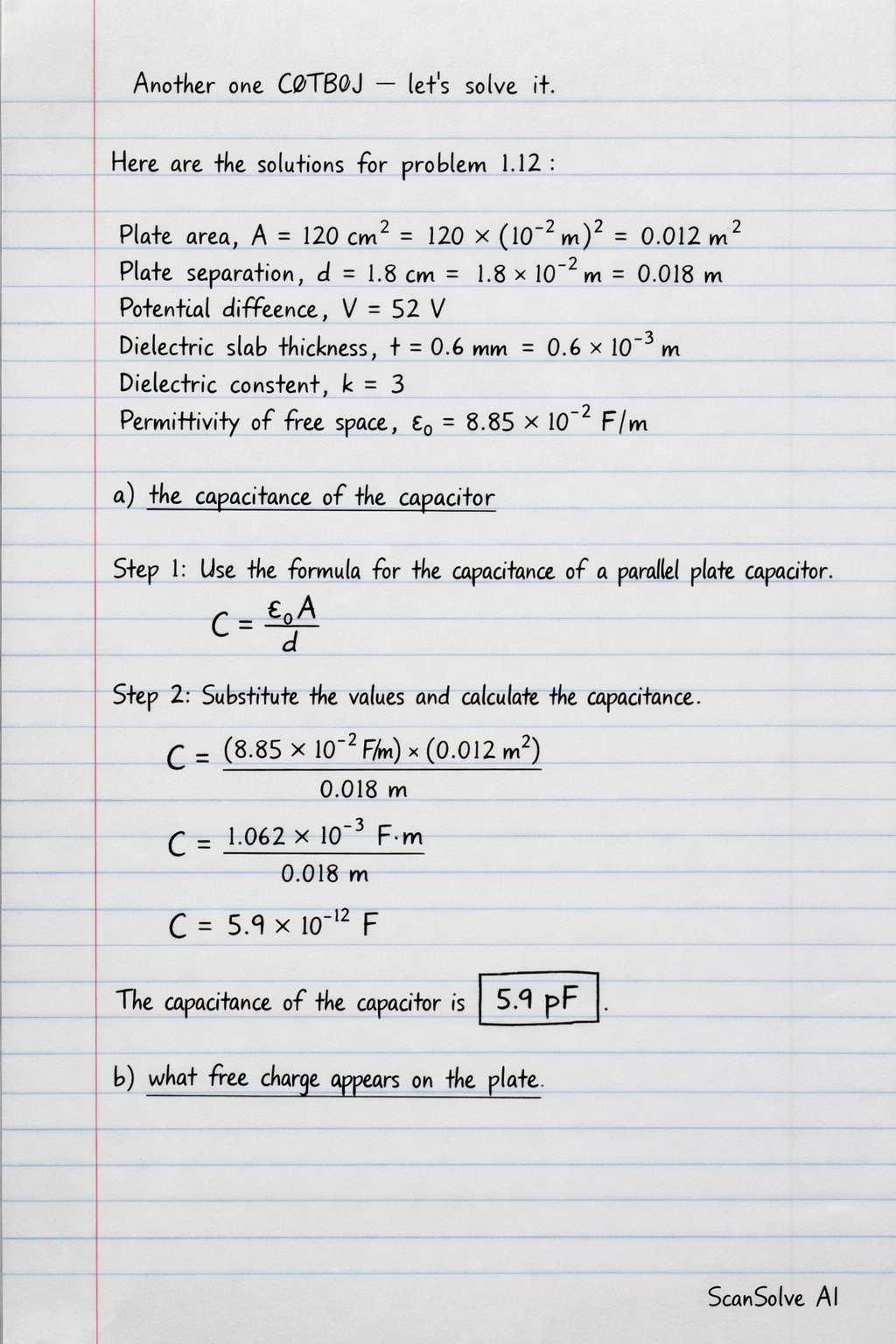
First, convert all given values to SI units:
Plate area,
Plate separation,
Potential difference,
Dielectric slab thickness,
Dielectric constant,
Permittivity of free space,
Part a· 2 steps
the capacitance of the capacitor
Use the formula for the capacitance of a parallel plate capacitor.
Substitute the values and calculate the capacitance.
The capacitance of the capacitor is .
Part b
what free charge appears on the plate
Use the relationship between charge, capacitance, and voltage.
Substitute the capacitance from part (a) and the given voltage.
The free charge on the plate is .
c) If the battery was disconnected and a dielectric slab of thickness was inserted between the plates, what is the electric field in the gap between the plates and the dielectric slab if
When the battery is disconnected, the charge on the plates remains constant.
The electric field in the air gap (the region without the dielectric) is determined by this constant charge density.
The electric field in the air gap is given by . This is equivalent to the initial electric field before the dielectric was inserted, .Calculate the electric field in the gap using the initial voltage and plate separation.
The electric field in the gap between the plates and the dielectric slab is .
Part d
what is the electric field in the dielectric slab.
Try one yourself
A new problem that tests the same skill.
Still stuck on this one?
Ask a follow-up, and the answer starts from this question.
More Physics Questions
Handwritten Step-by-Step Solution
Get this as a handwritten image on WhatsApp — like a tutor wrote it for you.
Try on WhatsApp