
We read your photo as:
A point P is in equilibrium under the action of four forces. Three of the forces are 2 N at 45 degrees to the left of the vertical, 1 N at 45 degrees to the right of the vertical, and F1 N horizontall
Physics
ScanSolve AI Answer
Answer
Step-by-step solution
4 stepsIdentify all forces and their components.
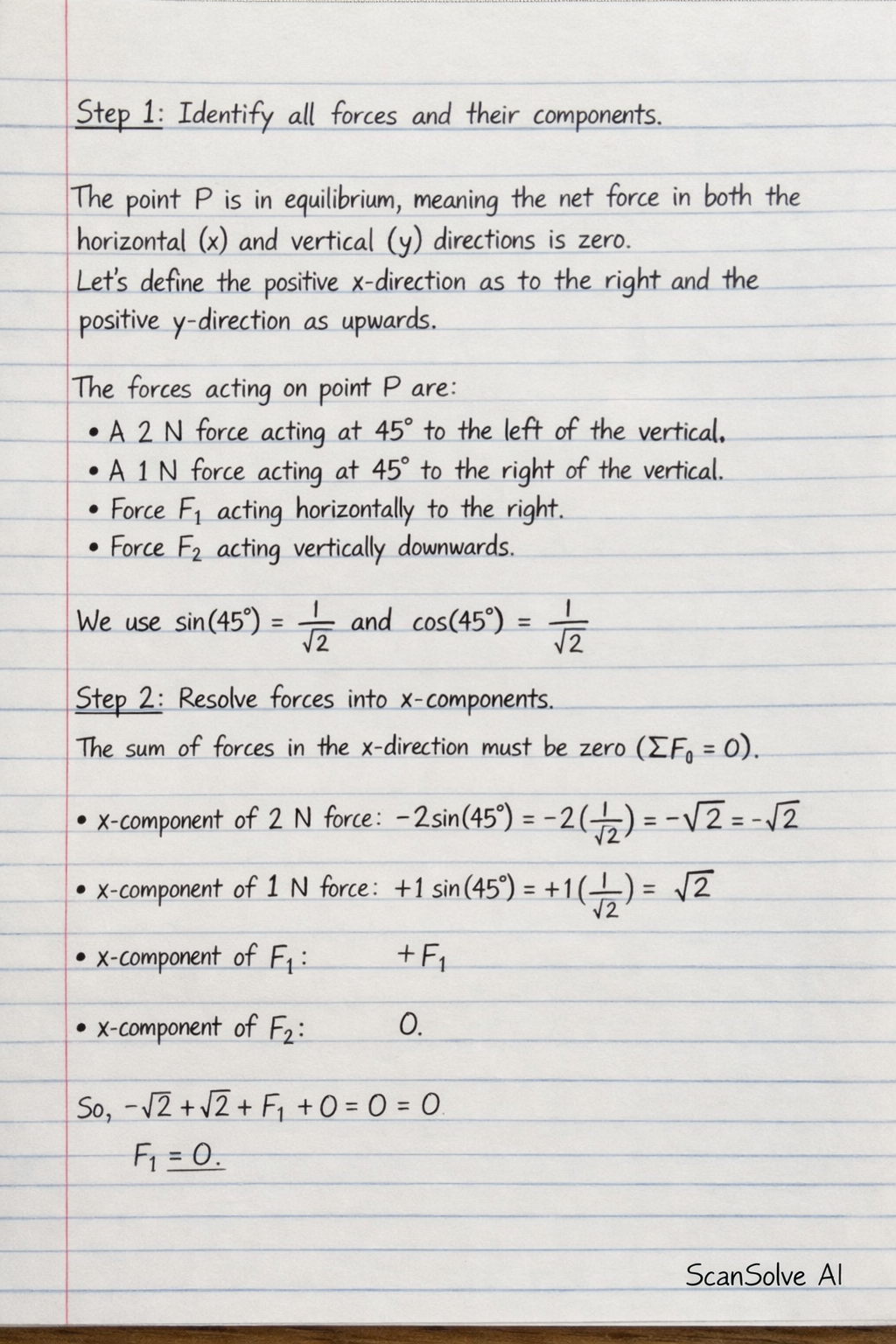
The point P is in equilibrium, meaning the net force in both the horizontal (x) and vertical (y) directions is zero.
Let's define the positive x-direction as to the right and the positive y-direction as upwards.The forces acting on point P are:
- A 2 N force acting at to the left of the vertical.
- A 1 N force acting at to the right of the vertical.
- Force acting horizontally to the right.
- Force acting vertically downwards.
We use and .
Resolve forces into x-components.
The sum of forces in the x-direction must be zero ().
- x-component of 2 N force: (negative because it's to the left).
- x-component of 1 N force: (positive because it's to the right).
- x-component of : (positive because it's to the right).
- x-component of : 0.
Resolve forces into y-components.
The sum of forces in the y-direction must be zero ().
- y-component of 2 N force: (positive because it's upwards).
- y-component of 1 N force: (positive because it's upwards).
- y-component of : 0.
- y-component of : (negative because it's downwards).
Compare with options.
We found N and N.
This matches option (a).The final answer is .
Was this helpful?
Try one yourself
A new problem that tests the same skill.
Still stuck on this one?
Ask a follow-up, and the answer starts from this question.
Got a different question?Ask your own question
More Physics Questions
QThe four forces in the diagram are in equilibrium. Find the force F and cos θ.QA system has three forces acting on it: 3N upwards, 5N to the right, and 6N at 45 degrees upwards…QThree forces act on a point object. Force 1 has magnitude 30 N at 45 degrees. Force 2 has magnitude…QTwo forces, 3 N due North and 4 N due East, act on an object. Calculate the resultant force and the…QThree forces are acting on a body. Two of the forces are 10 N due East and 5 N at 60 degrees…
Browse by topic:Mechanics
Handwritten Step-by-Step Solution
Get this as a handwritten image on WhatsApp — like a tutor wrote it for you.
Try on WhatsApp