A projectile is launched with velocity at an angle . At the peak of its trajectory, the gravitational field strength instantly changes from to . What is the new total range of the projectile? (Requires breaking the motion into two distinct, connected stages).
This physics problem tests your understanding of fundamental physical laws and their applications. The step-by-step solution below breaks down the problem using relevant equations and physical reasoning.
ScanSolve AI Answer
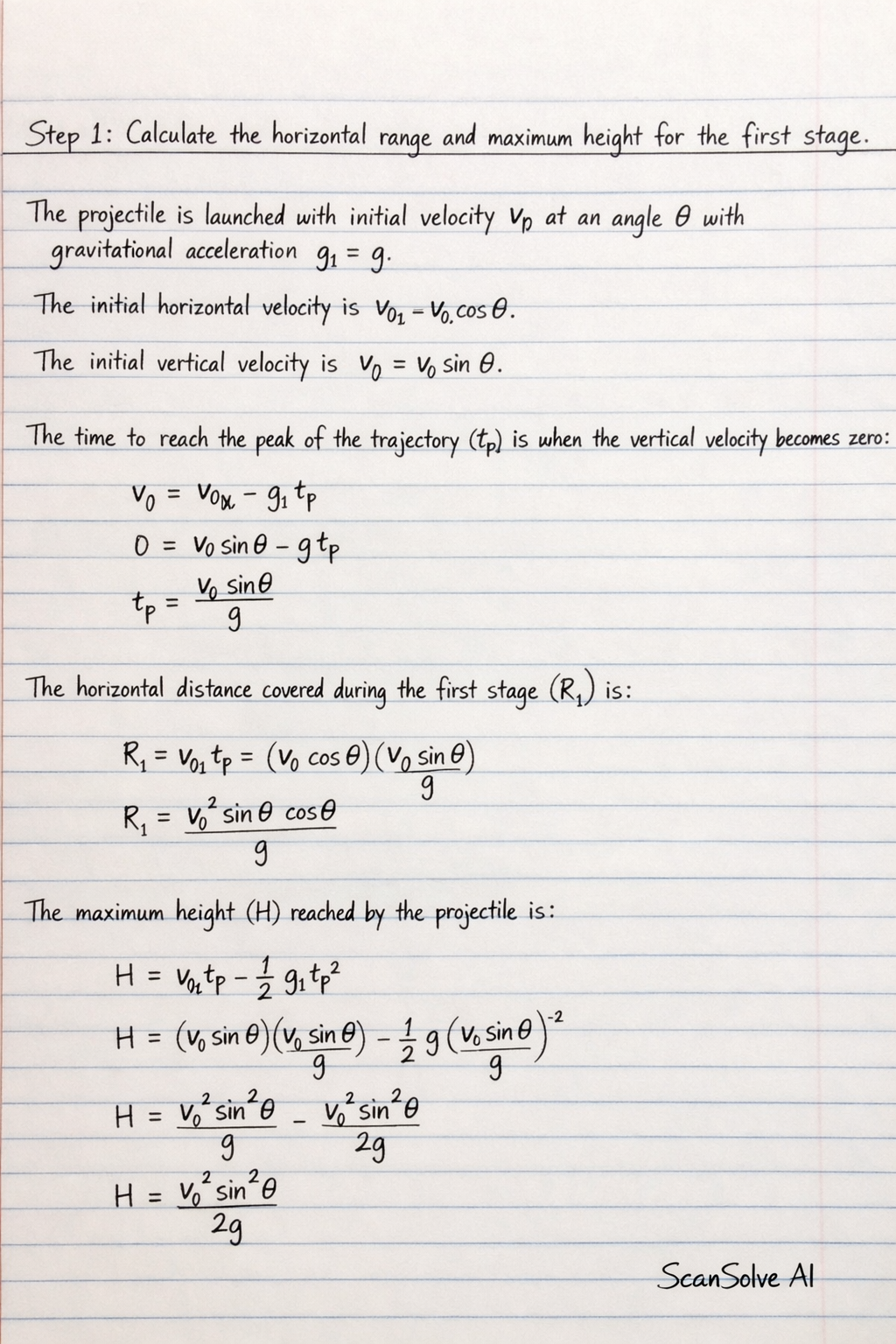
Step 1: Calculate the horizontal range and maximum height for the first stage.
The projectile is launched with initial velocity $v_0$ at an angle $\theta$ with gravitational acceleration $g_1 = g$.
The initial horizontal velocity is $v_{0x} = v_0 \cos \theta$.
The initial vertical velocity is $v_{0y} = v_0 \sin \theta$.
The time to reach the peak of the trajectory ($t_p$) is when the vertical velocity becomes zero:
$$v_y = v_{0y} - g_1 t_p$$
$$0 = v_0 \sin \theta - g t_p$$
$$t_p = \frac{v_0 \sin \theta}{g}$$
The horizontal distance covered during the first stage ($R_1$) is:
$$R_1 = v_{0x} t_p = (v_0 \cos \theta) \left(\frac{v_0 \sin \theta}{g}\right)$$
$$R_1 = \frac{v_0^2 \sin \theta \cos \theta}{g}$$
The maximum height ($H$) reached by the projectile is:
$$H = v_{0y} t_p - \frac{1}{2} g_1 t_p^2$$
$$H = (v_0 \sin \theta) \left(\frac{v_0 \sin \theta}{g}\right) - \frac{1}{2} g \left(\frac{v_0 \sin \theta}{g}\right)^2$$
$$H = \frac{v_0^2 \sin^2 \theta}{g} - \frac{v_0^2 \sin^2 \theta}{2g}$$
$$H = \frac{v_0^2 \sin^2 \theta}{2g}$$
Step 2: Calculate the horizontal range for the second stage.
At the peak, the projectile's vertical velocity is $0$, and its horizontal velocity remains $v_{0x} = v_0 \cos \theta$. The gravitational field strength changes to $g_2 = 2g$. The projectile falls from height $H$.
The time to fall from height $H$ to the ground ($t_f$) is given by:
$$H = \frac{1}{2} g_2 t_f^2$$
$$H = \frac{1}{2} (2g) t_f^2$$
$$H = g t_f^2$$
$$t_f = \sqrt{\frac{H}{g}}$$
Substitute the expression for $H$:
$$t_f = \sqrt{\frac{1}{g} \left(\frac{v_0^2 \sin^2 \theta}{2g}\right)}$$
$$t_f = \sqrt{\frac{v_0^2 \sin^2 \theta}{2g^2}}$$
$$t_f = \frac{v_0 \sin \theta}{g \sqrt{2}}$$
The horizontal distance covered during the second stage ($R_2$) is:
$$R_2 = v_{0x} t_f = (v_0 \cos \theta) \left(\frac{v_0 \sin \theta}{g \sqrt{2}}\right)$$
$$R_2 = \frac{v_0^2 \sin \theta \cos \theta}{g \sqrt{2}}$$
Step 3: Calculate the total range.
The total range ($R_{total}$) is the sum of the horizontal distances from both stages:
$$R_{total} = R_1 + R_2$$
$$R_{total} = \frac{v_0^2 \sin \theta \cos \theta}{g} + \frac{v_0^2 \sin \theta \cos \theta}{g \sqrt{2}}$$
Factor out common terms:
$$R_{total} = \frac{v_0^2 \sin \theta \cos \theta}{g} \left(1 + \frac{1}{\sqrt{2}}\right)$$
Using the trigonometric identity $\sin(2\theta) = 2 \sin \theta \cos \theta$, we can write $\sin \theta \cos \theta = \frac{1}{2} \sin(2\theta)$:
$$R_{total} = \frac{v_0^2}{g} \left(\frac{1}{2} \sin(2\theta)\right) \left(1 + \frac{1}{\sqrt{2}}\right)$$
$$R_{total} = \frac{v_0^2 \sin(2\theta)}{2g} \left(1 + \frac{1}{\sqrt{2}}\right)$$
The new total range of the projectile is:
$$\boxed{\frac{v_0^2 \sin(2\theta)}{2g} \left(1 + \frac{1}{\sqrt{2}}\right)}$$
Question
A projectile is launched with velocity at an angle . At the peak of its trajectory, the gravitational field strength instantly changes from to . What is the new total range of the projectile? (Requires breaking the motion into two distinct, connected stages).
|Physics
Answer
Step 1: Calculate the horizontal range and maximum height for the first stage.
The projectile is launched with initial velocity v0 at an angle θ with gravitational acceleration g1=g.
The initial horizontal velocity is v0x=v0cosθ.
The initial vertical velocity is v0y=v0sinθ.
The time to reach the peak of the trajectory (tp) is when the vertical velocity becomes zero:
vy=v0y−g1tp0=v0sinθ−gtptp=gv0sinθ
The horizontal distance covered during the first stage (R1) is:
R1=v0xtp=(v0cosθ)(gv0sinθ)R1=gv02sinθcosθ
The maximum height (H) reached by the projectile is:
H=v0ytp−21g1tp2H=(v0sinθ)(gv0sinθ)−21g(gv0sinθ)2H=gv02sin2θ−2gv02sin2θH=2gv02sin2θ
Step 2: Calculate the horizontal range for the second stage.
At the peak, the projectile's vertical velocity is 0, and its horizontal velocity remains v0x=v0cosθ. The gravitational field strength changes to g2=2g. The projectile falls from height H.
The time to fall from height H to the ground (tf) is given by:
H=21g2tf2H=21(2g)tf2H=gtf2tf=gH
Substitute the expression for H:
tf=g1(2gv02sin2θ)tf=2g2v02sin2θtf=g2v0sinθ
The horizontal distance covered during the second stage (R2) is:
R2=v0xtf=(v0cosθ)(g2v0sinθ)R2=g2v02sinθcosθ
Step 3: Calculate the total range.
The total range (Rtotal) is the sum of the horizontal distances from both stages:
Rtotal=R1+R2Rtotal=gv02sinθcosθ+g2v02sinθcosθ
Factor out common terms:
Rtotal=gv02sinθcosθ(1+21)
Using the trigonometric identity sin(2θ)=2sinθcosθ, we can write sinθcosθ=21sin(2θ):
Rtotal=gv02(21sin(2θ))(1+21)Rtotal=2gv02sin(2θ)(1+21)
The new total range of the projectile is:
2gv02sin(2θ)(1+21)
Need help with your own homework?
Get instant step-by-step solutions to any question. Free to start.