
We read your photo as:
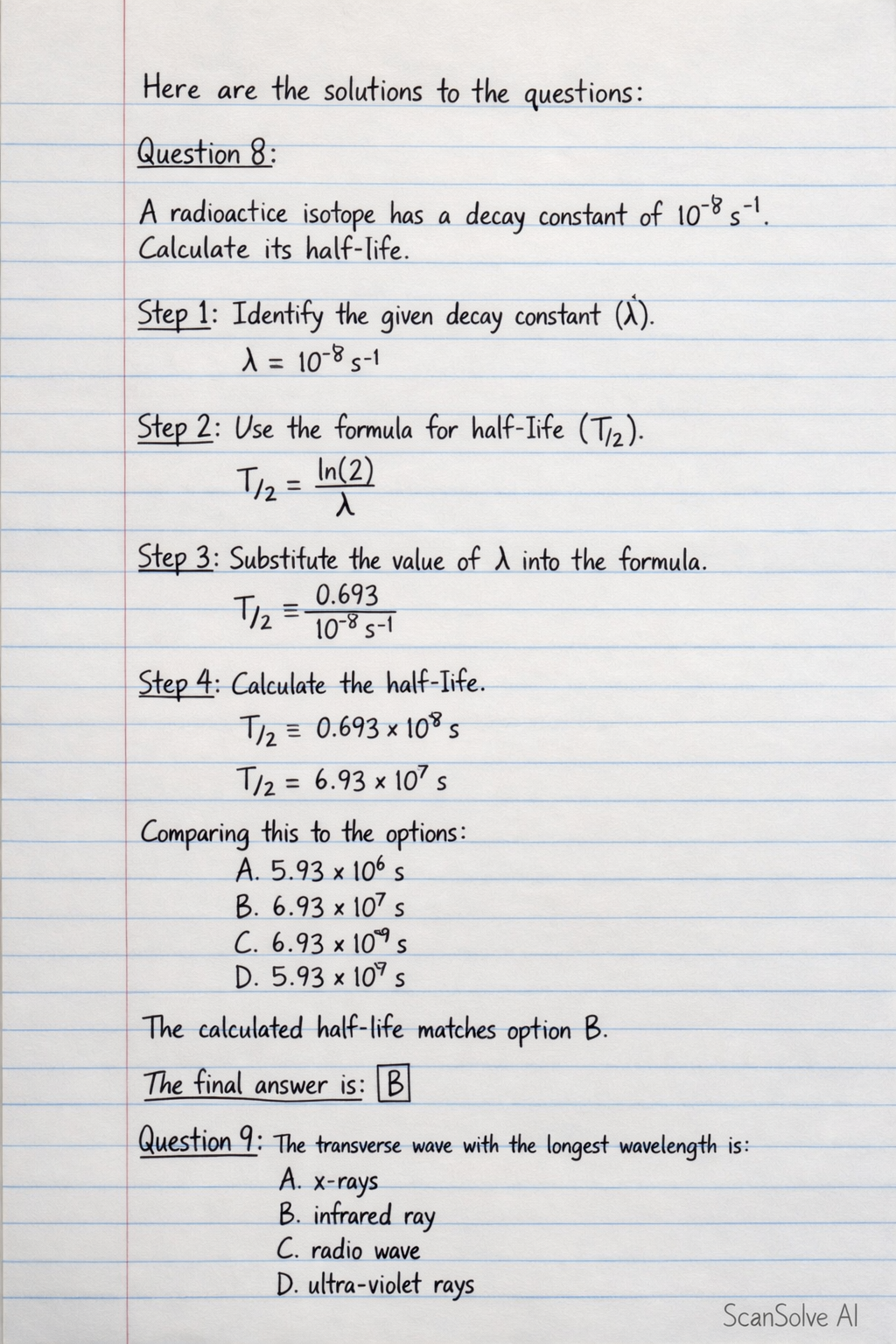
A radioactive isotope has a decay constant of 10⁻⁸ s⁻¹. Calculate its half-life.
ScanSolve AI Answer
Answers
3 partsStep-by-step solution
7 stepsHere are the solutions to the questions:
Part 8· 4 steps
A radioactive isotope has a decay constant of . Calculate its half-life.
Identify the given decay constant ().
Use the formula for half-life ().
Substitute the value of into the formula.
Calculate the half-life.
Comparing this to the options:
A.
B.
C.
D.The calculated half-life matches option B.
The final answer is
Part 9
The transverse wave with the longest wavelength is:
A. x-rays
B. infrared ray
C. radio wave
D. ultra-violent rays (ultraviolet rays)
The electromagnetic spectrum arranges waves by wavelength (or frequency/energy). In order of increasing wavelength, the spectrum is:
Gamma rays < X-rays < Ultraviolet rays < Visible light < Infrared rays < Microwaves < Radio waves.
From this order, radio waves have the longest wavelength among the given options.
The final answer is
Part 10
When decays to , it emits:
Write the nuclear decay equation.
Let be the number of alpha particles () and be the number of beta particles ().
Conserve the mass number (superscript).
This means one alpha particle is emitted.
Conserve the atomic number (subscript).
Substitute :
This means no beta particles are emitted.
Therefore, the decay process emits one alpha particle.
Comparing this to the options:
A. two alpha and two beta particles.
B. a beta particle
C. one alpha and (assuming this means "one alpha particle")Based on the calculation, one alpha particle is emitted.
The final answer is
Try one yourself
A new problem that tests the same skill.
Still stuck on this one?
Ask a follow-up, and the answer starts from this question.
More Physics Questions
Handwritten Step-by-Step Solution
Get this as a handwritten image on WhatsApp — like a tutor wrote it for you.
Try on WhatsApp