
We read your photo as:
A rectangular coil of 150 turns, initially 5 cm by 8 cm, changes its dimensions to 7 cm by 11 cm in 0.15 s. If the magnetic field is 25 T and is 30 degrees to the plane of the coil, what is the induce
ScanSolve AI Answer
Answers
2 partsStep-by-step solution
7 stepsHere's the solution for Question 3:
Part a· 5 steps
Induced emf
Identify given values and convert units.
Number of loops,
Initial length,
Initial width,
Final length,
Final width,
Time interval,
Magnetic field strength,
Angle relative to the plane of the coil .Calculate initial and final areas, and the change in area.
Initial area:
Final area:
Change in area:
Determine the angle for magnetic flux calculation.
The angle in the magnetic flux formula is the angle between the magnetic field vector and the normal to the coil's plane. Since the magnetic field is relative to the plane of the coil, the angle with the normal is:
Calculate the change in magnetic flux.
The change in magnetic flux is due to the change in area:
Calculate the induced emf using Faraday's Law.
Faraday's Law of Induction states:
The magnitude of the induced emf is:
Part b
Energy dissipated in the circuit
Calculate the power dissipated.
Given the total internal resistance, .
The power dissipated in the circuit is given by:Calculate the total energy dissipated.
The energy dissipated over the time interval is:
Rounding to four significant figures:
Try one yourself
A new problem that tests the same skill.
Still stuck on this one?
Ask a follow-up, and the answer starts from this question.
More Physics Questions
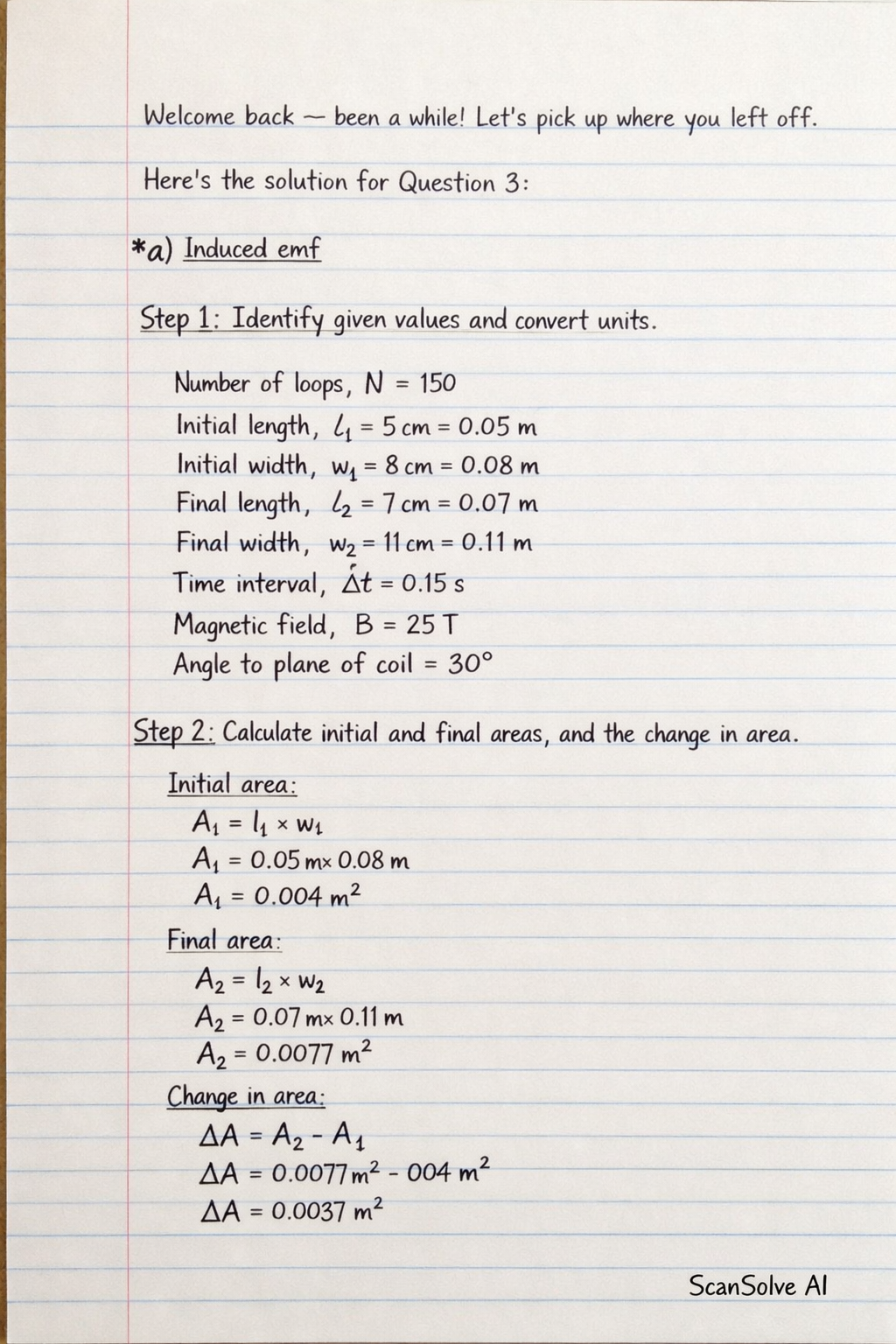
Handwritten Step-by-Step Solution
Get this as a handwritten image on WhatsApp — like a tutor wrote it for you.
Try on WhatsApp