
We read your photo as:
A rigid, well-insulated, sealed steel vessel of internal volume 0.30 m³ contains 1.20 kg of wet steam at an initial pressure of 8.5 bar and a dryness fraction of 0.85. The vessel is subsequently cooled until its pressure falls to 2 bar.
ScanSolve AI Answer
Answers
3 partsStep-by-step solution
10 stepsPart a· 3 steps
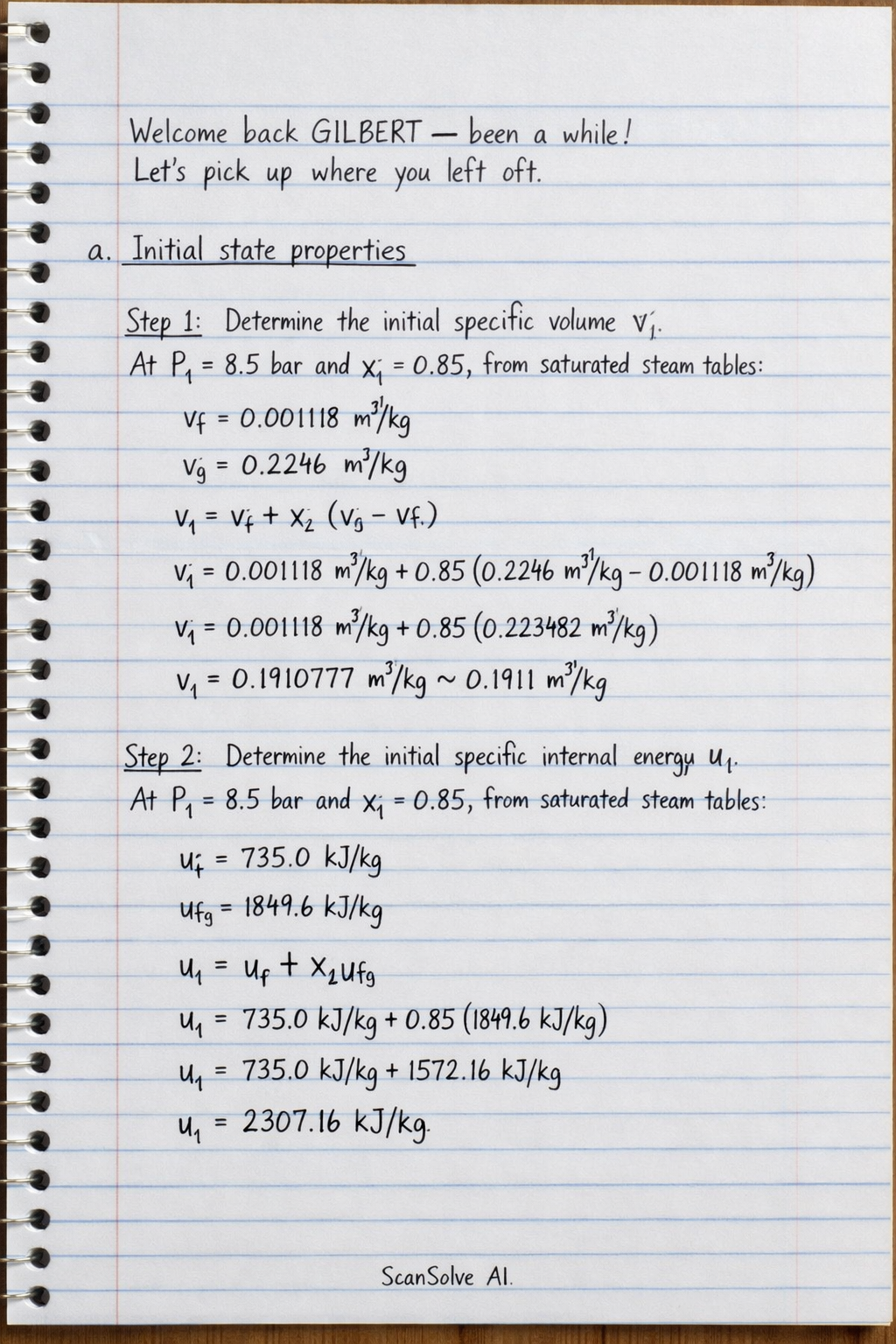
Initial state properties
Determine the initial specific volume .
At and , from saturated steam tables:
Determine the initial specific internal energy .
At and , from saturated steam tables:
Determine the total internal energy .
Given mass .
The initial specific volume is , the initial specific internal energy is , and the total internal energy is .
Part b
Final state properties
Establish the specific volume at the final state .
Since the vessel is rigid and sealed, the total volume and mass remain constant. Therefore, the specific volume remains constant.
Determine the final dryness fraction .
At , from saturated steam tables:
Determine the final specific internal energy .
At , from saturated steam tables:
Identify the phase region.
At , and .
Since (), the steam is in the wet vapor region.
The specific volume at the final state is , the final dryness fraction is , and the final specific internal energy is . The phase region is wet vapor.
Part c
Heat transfer during cooling
Apply the First Law of Thermodynamics.
For a closed system with a rigid vessel, work . The First Law simplifies to .
Calculate the total internal energy at the final state .
Calculate the heat transfer .
The negative sign indicates that heat is rejected by the steam.
The heat transfer during cooling is . Heat is rejected by the steam, as indicated by the negative sign, meaning energy is leaving the system.
Part d
P-v diagram and explanation
(Imagine a P-v diagram with a saturation dome.
Point 1: Located within the saturation dome at and .
Point 2: Located vertically below Point 1, also within the saturation dome, at and .
A vertical line connects Point 1 to Point 2, representing the constant specific volume process.)
Pressure and temperature can change even though the vessel volume remains constant because the system is undergoing a phase change (from wet steam at higher pressure/temperature to wet steam at lower pressure/temperature) due to heat rejection. As heat is removed, the internal energy of the steam decreases. In the saturation region, pressure and temperature are directly related; a decrease in internal energy at constant volume leads to a decrease in both pressure and temperature as some vapor condenses into liquid.
Part e
Evaluation of ideal gas assumption
Treating steam as an ideal gas is incorrect because steam, especially when it is a wet vapor mixture, does not behave as an ideal gas. The ideal gas law assumes negligible molecular volume and intermolecular forces, which are not valid for water vapor, particularly near saturation conditions or during phase changes. The constant-volume ideal-gas relation () is based on these flawed assumptions for steam and would yield inaccurate results. Steam tables are the more appropriate property source because they are derived from experimental data and accurately account for the real behavior of water and steam across all phases, including the complex interactions during phase transitions.
Try one yourself
A new problem that tests the same skill.
Still stuck on this one?
Ask a follow-up, and the answer starts from this question.
More Physics Questions
Handwritten Step-by-Step Solution
Get this as a handwritten image on WhatsApp — like a tutor wrote it for you.
Try on WhatsApp