
We read your photo as:
A rocket is launched vertically upwards. Its speed-time graph is shown below. What does the gradient of the graph represent? What is the acceleration at point B? Evaluate the student's answer: gradien
ScanSolve AI Answer
a)
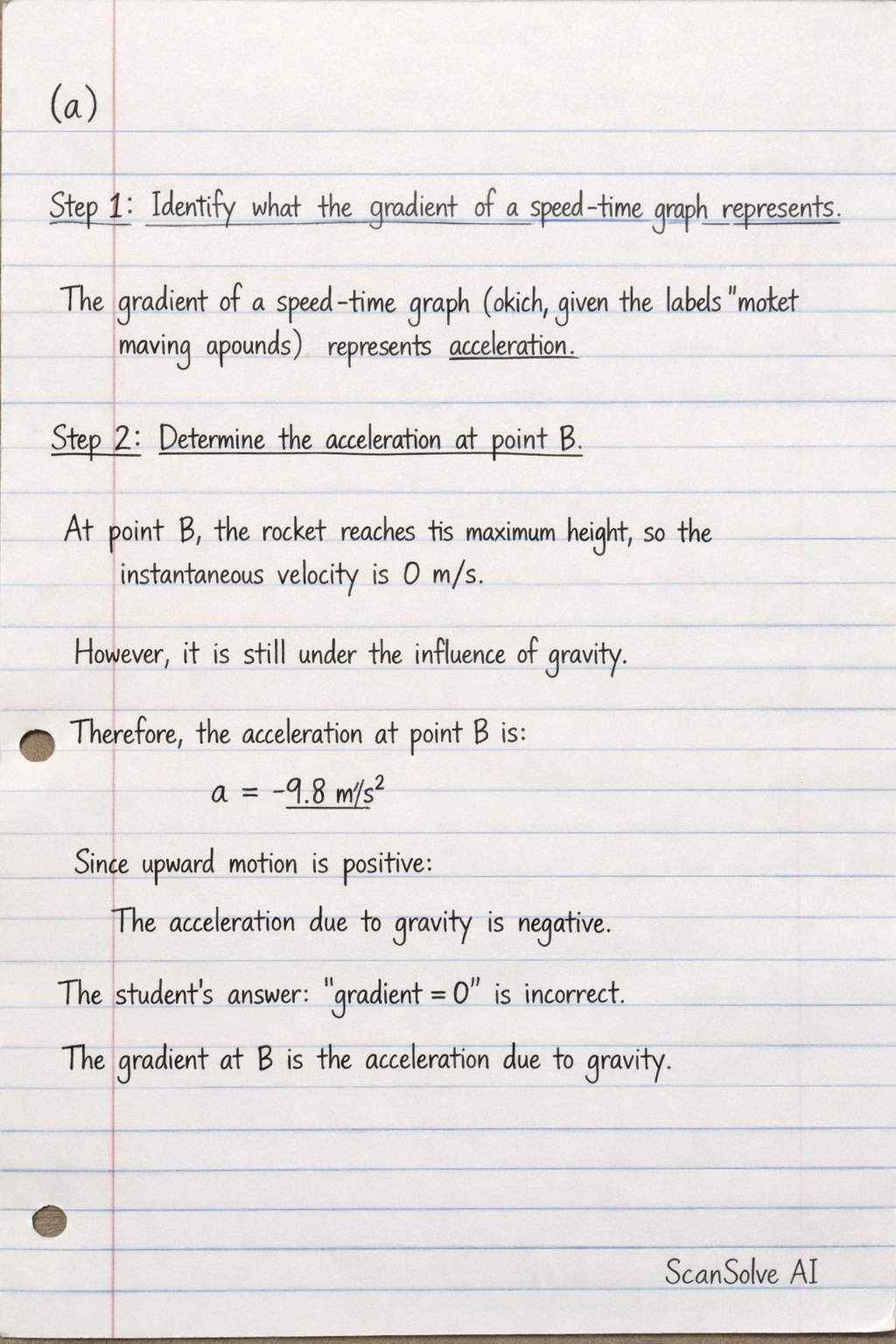
(i) Step 1: Identify what the gradient of a speed-time graph represents.
The gradient of a speed-time graph (which, given the labels "rocket moving upwards" and "rocket moving downwards", is effectively a velocity-time graph) represents acceleration.
Step 2: Determine the acceleration at point B.
At point B, the rocket reaches its maximum height, meaning its instantaneous vertical velocity is zero. However, it is still under the influence of gravity. Therefore, the acceleration at point B is the acceleration due to gravity, acting downwards. Since upward motion is considered positive, the acceleration due to gravity is a negative value.
The student's answer "gradient = 0" is incorrect.
The gradient at B is the acceleration due to gravity.
Still stuck on this one?
Ask a follow-up, and the answer starts from this question.
More Physics Questions
Handwritten Step-by-Step Solution
Get this as a handwritten image on WhatsApp — like a tutor wrote it for you.
Try on WhatsApp