
We read your photo as:
A rocket is launched vertically upwards. It burns its fuel in 10 seconds, reaching a maximum height at 30 seconds. After that, it continues to move upwards for another 20 seconds before starting to fa
ScanSolve AI Answer
Answer
Step-by-step solution
5 stepsPart a(i)· 1 step
Step 1: Identify what the gradient of a speed-time graph represents.
The gradient of a speed-time graph (which is a velocity-time graph in this context due to the "upwards" and "downwards" labels) represents acceleration.
Determine the acceleration at point B.
At point B, the rocket reaches its maximum height, meaning its instantaneous vertical velocity is zero. However, it is still under the influence of gravity. Since upward motion is considered positive, the acceleration due to gravity acts downwards.
The gradient at B is (or approximately ).
Part a(ii)· 1 step
Step 1: Explain the forces acting on the rocket at point B.
At point B, the rocket has run out of fuel (at A) and is at its maximum height. It is momentarily stationary in the vertical direction, but the only significant force acting on it is gravity.
Relate the force to acceleration.
Since gravity is the only significant force, the rocket's acceleration is the acceleration due to gravity.
Part b· 2 steps
Step 1: State what the area under a speed-time graph represents.
The area under a speed-time graph (or velocity-time graph) represents the displacement.
Describe the shaded areas.
The shaded area above the time axis (from 0 to B) represents the total upward displacement of the rocket. The shaded area below the time axis (from B to E) represents the total downward displacement of the rocket.
Explain the relationship based on the rocket's motion.
The rocket starts from the ground and returns to the ground at point E. This means its net displacement from its starting point to its end point is zero. Therefore, the magnitude of the upward displacement must be equal to the magnitude of the downward displacement.
The magnitude of the shaded area above the time axis is equal to the magnitude of the shaded area below the time axis. This is because the total displacement of the rocket from launch to landing is zero.
Part c· 1 step
Step 1: Analyze the effect of opening a parachute at point B.
At point B, the rocket's speed is zero. When a parachute opens, it significantly increases air resistance. As the rocket falls, its speed will increase, but the increased air resistance will cause it to reach a lower terminal velocity much faster than without a parachute.
Describe the characteristics of the new graph from B.
The graph should start at B (speed = 0) and move into the "rocket moving downwards" region (negative velocity). The curve should initially be less steep than the original B-C curve, indicating a smaller acceleration due to the parachute's drag. It should then flatten out to a constant, small negative velocity (terminal velocity), which is much smaller in magnitude than the speed reached at E in the original graph. The time taken to reach the ground will be longer than the original time to E.
Try one yourself
A new problem that tests the same skill.
Still stuck on this one?
Ask a follow-up, and the answer starts from this question.
More Physics Questions
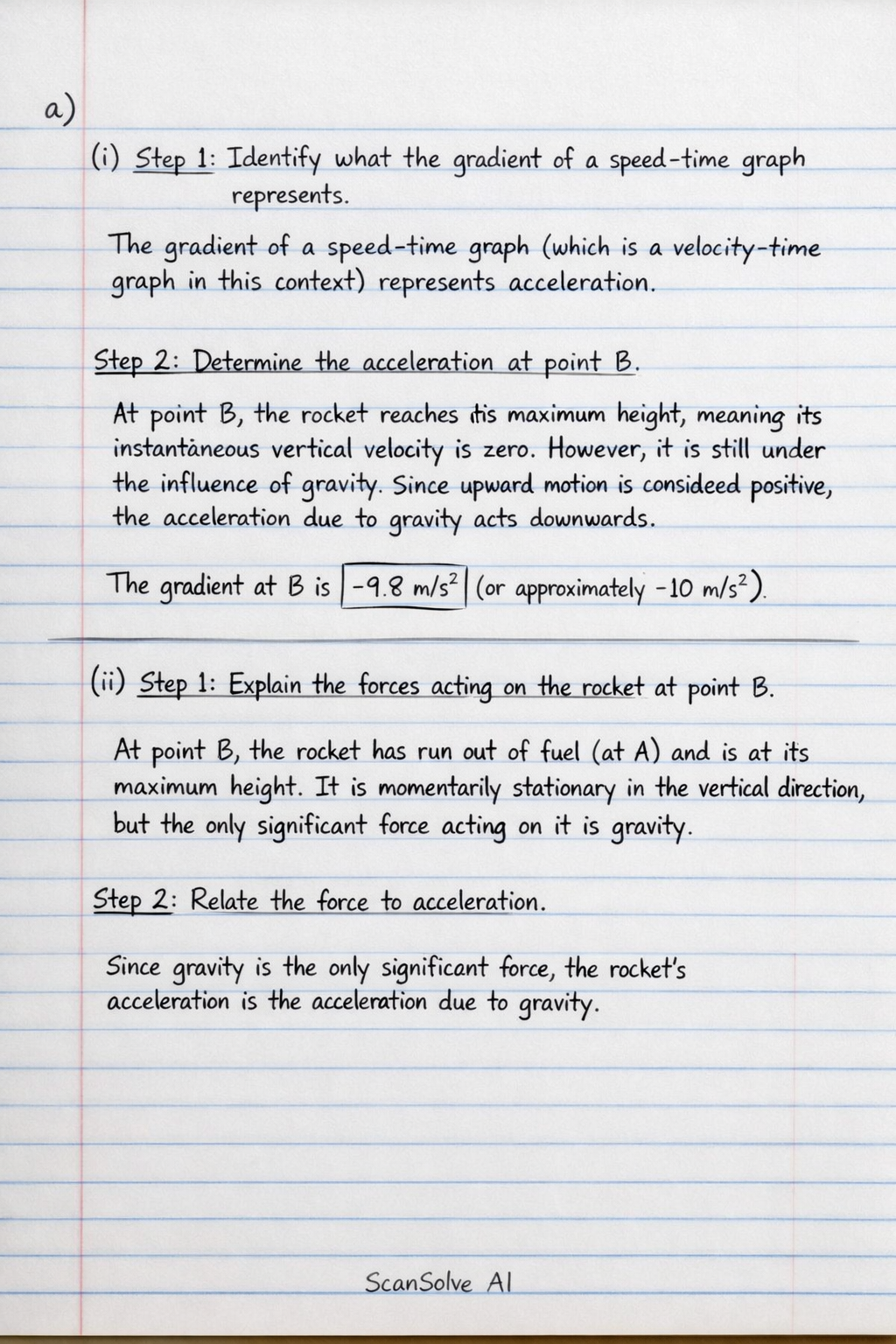
Handwritten Step-by-Step Solution
Get this as a handwritten image on WhatsApp — like a tutor wrote it for you.
Try on WhatsApp