
We read your photo as:
Q2a.) Define the following in relation to a thermodynamic system. I. Adiabatic ii. Homogeneous iii. Heterogeneous iv. Macroscopic v. Microscopic b.) List and explain the thermodynamic properties of a system and give examples of each .
ScanSolve AI Answer
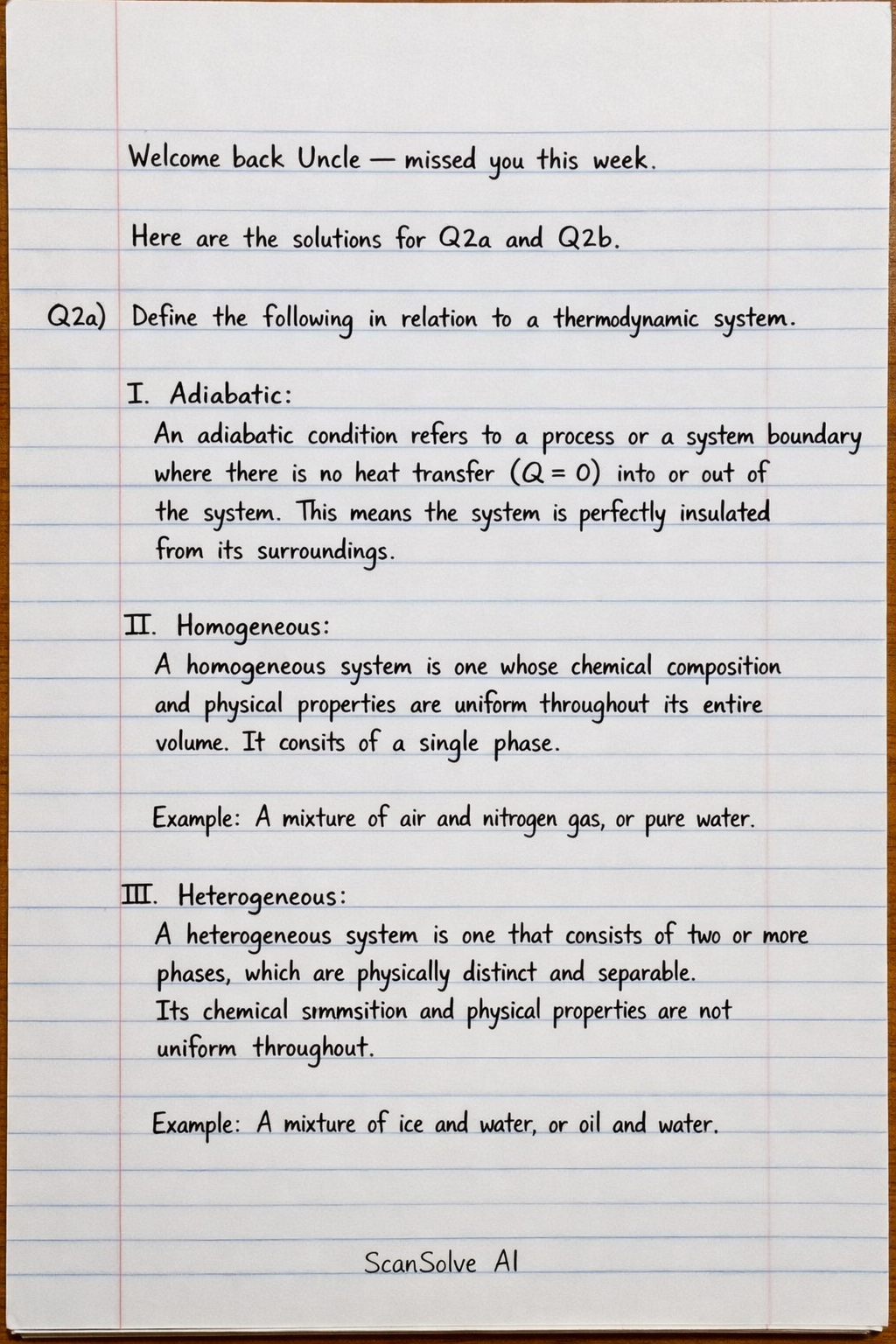
Here are the solutions for Q2a and Q2b.
Q2a). Define the following in relation to a thermodynamic system.
I. Adiabatic:
An adiabatic condition refers to a process or a system boundary where there is no heat transfer () into or out of the system. This means the system is perfectly insulated from its surroundings.
II. Homogeneous:
A homogeneous system is one whose chemical composition and physical properties are uniform throughout its entire volume. It consists of a single phase.
Example: A mixture of air and nitrogen gas, or pure water.
III. Heterogeneous:
A heterogeneous system is one that consists of two or more phases, which are physically distinct and separable. Its chemical composition and physical properties are not uniform throughout.
Example: A mixture of ice and water, or oil and water.
IV. Macroscopic:
Macroscopic properties are those that describe the overall behavior of a system without considering the individual behavior of its constituent particles. These properties are observable and measurable at a large scale.
Example: Pressure, temperature, volume, and density.
V. Microscopic:
Microscopic properties describe the behavior of individual molecules, atoms, or subatomic particles within a system. These properties are not directly observable but are inferred from macroscopic behavior.
Example: Velocity of individual molecules, kinetic energy of a single atom, or intermolecular forces.
Q2b). List and explain the thermodynamic properties of a system and give examples of each.
Thermodynamic properties are characteristics of a system that can be used to describe its state. They are generally classified into two main types:
-
Intensive Properties: Intensive properties are those that are independent of the amount or size of the system. They describe the quality or state of the substance regardless of how much of it is present. Examples:
- Temperature (): A measure of the average kinetic energy of the particles in a system.
- Pressure (): Force exerted per unit area.
- Density (): Mass per unit volume.
- Specific Volume (): Volume per unit mass.
-
Extensive Properties: Extensive properties are those that depend on the amount or size of the system. Their value is proportional to the mass or extent of the system. Examples:
- Mass (): The quantity of matter in a system.
- Volume (): The space occupied by the system.
- Internal Energy (): The total energy contained within the system.
- Enthalpy (): The total heat content of a system ().
Still stuck on this one?
Ask a follow-up, and the answer starts from this question.
More Physics Questions
Handwritten Step-by-Step Solution
Get this as a handwritten image on WhatsApp — like a tutor wrote it for you.
Try on WhatsApp