
We read your photo as:
A worker accidentally drops a hammer of a mass of 1 kg from point X, which is at the edge of a flat roof of a building that is 35 m tall. Y is a point on the ground where the hammer lands, as shown in the diagram below. Ignore the effects of air resistance.
ScanSolve AI Answer
Answers
2 partsStep-by-step solution
6 stepsPart 5.1
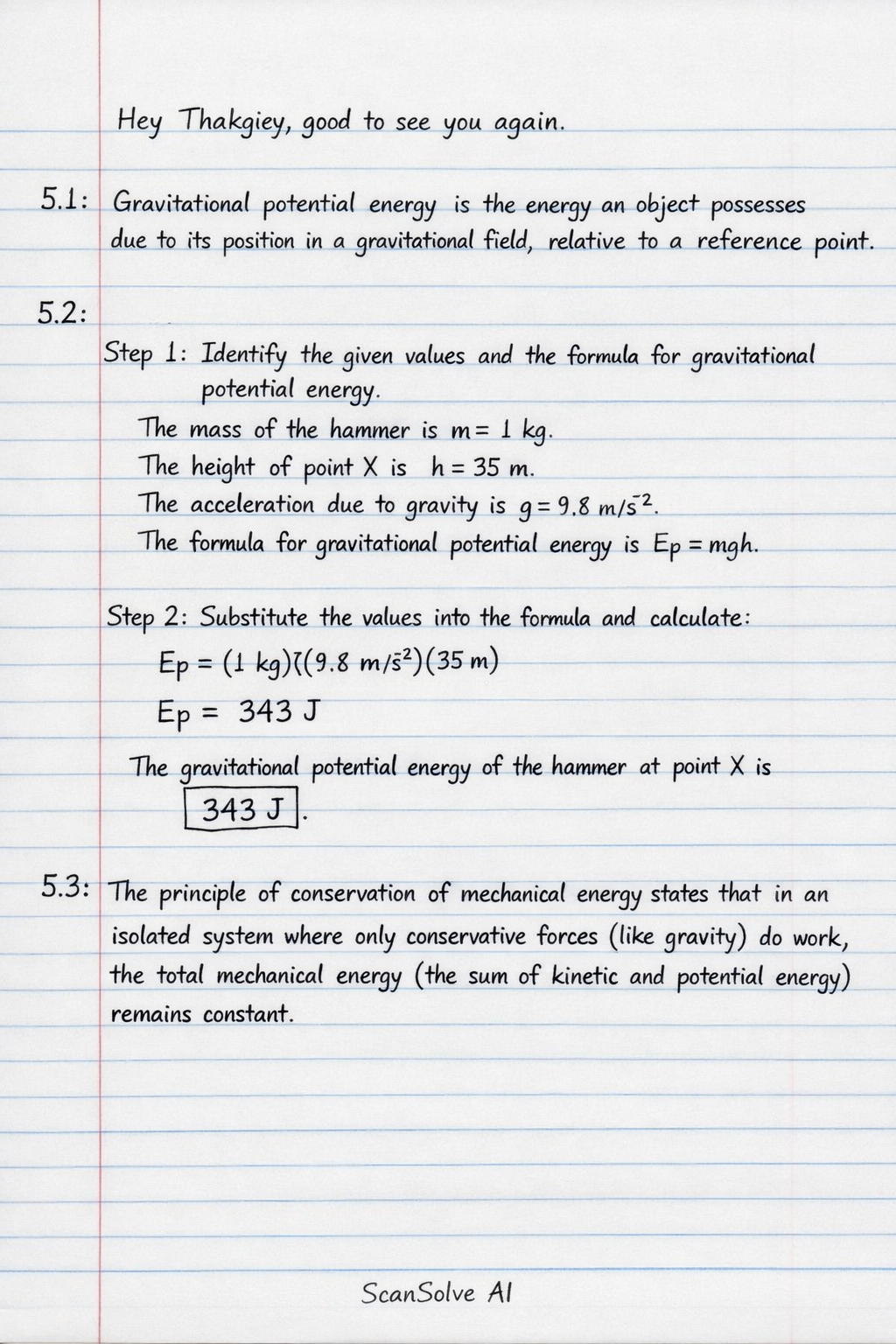
Gravitational potential energy is the energy an object possesses due to its position in a gravitational field, relative to a reference point.
Part 5.2
Identify the given values and the formula for gravitational potential energy.
The mass of the hammer is .
The height of point X is .
The acceleration due to gravity is .
The formula for gravitational potential energy is .Substitute the values into the formula and calculate.
The gravitational potential energy of the hammer at point X is .
5.3: The principle of conservation of mechanical energy states that in an isolated system where only conservative forces (like gravity) do work, the total mechanical energy (the sum of kinetic and potential energy) remains constant.
Part 5.4
Apply the principle of conservation of mechanical energy.
Since air resistance is ignored, mechanical energy is conserved.
Total mechanical energy at X = Total mechanical energy at YDetermine the energy components at point X.
At point X, the hammer is dropped, so its initial velocity is .
The height is .So, .
Determine the energy components at point Y.
At point Y, the hammer is on the ground, so its height is .
Let the speed at point Y be .Equate the total mechanical energies and solve for .
The speed of the hammer at the instant it strikes the ground at point Y is .
Try one yourself
A new problem that tests the same skill.
Still stuck on this one?
Ask a follow-up, and the answer starts from this question.
More Physics Questions
Handwritten Step-by-Step Solution
Get this as a handwritten image on WhatsApp — like a tutor wrote it for you.
Try on WhatsApp