
We read your photo as:
Q5a.) State the first law of Thermodynamics and represent it with an Equation. b.) Give two(2) significance of the first law. c.) Give one application of the law above. d.) Give two limitations of the first law.
ScanSolve AI Answer
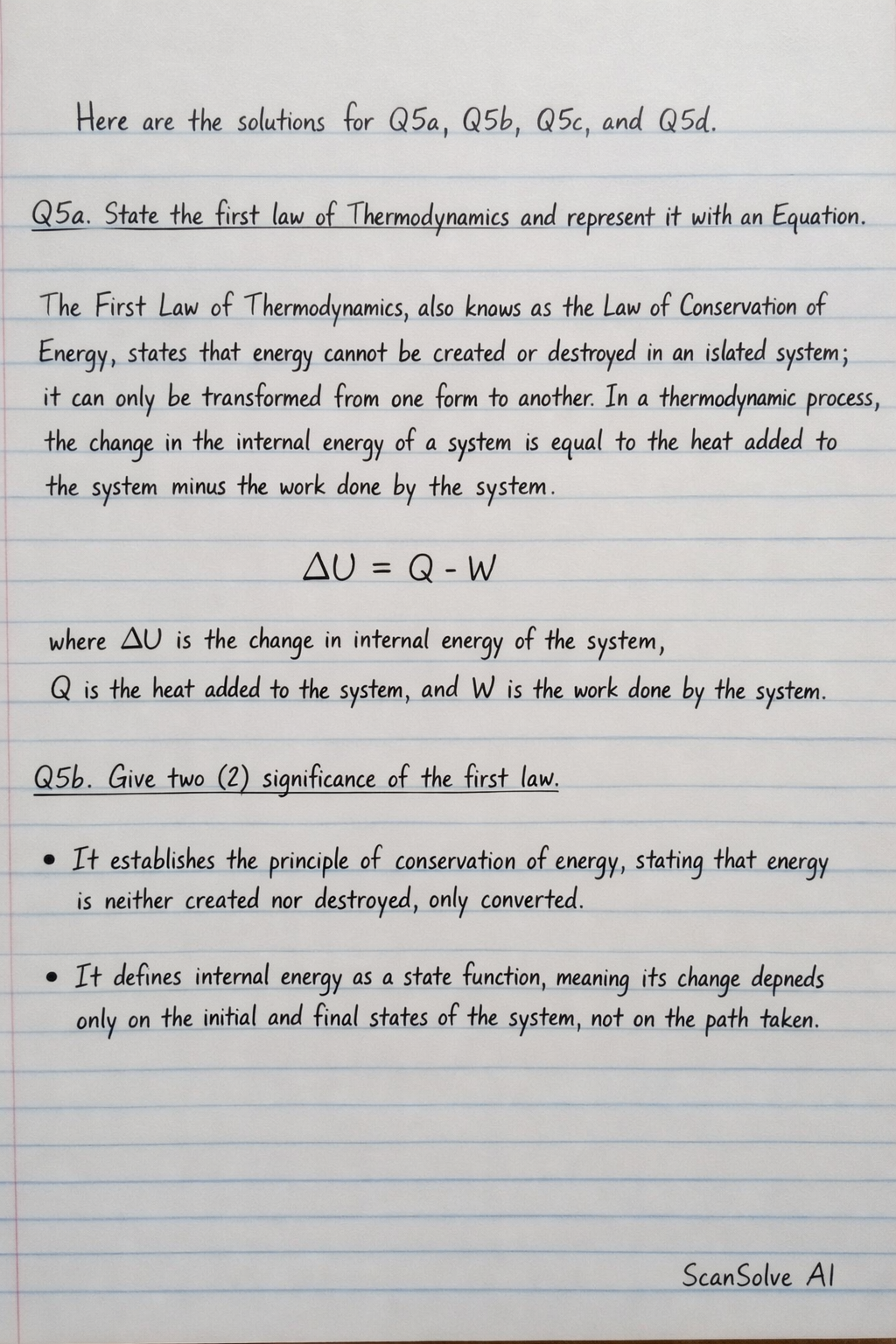
Here are the solutions for Q5a, Q5b, Q5c, and Q5d.
Q5a. State the first law of Thermodynamics and represent it with an Equation.
The First Law of Thermodynamics, also known as the Law of Conservation of Energy, states that energy cannot be created or destroyed in an isolated system; it can only be transformed from one form to another. In a thermodynamic process, the change in the internal energy of a system is equal to the heat added to the system minus the work done by the system.
where is the change in internal energy of the system, is the heat added to the system, and is the work done by the system.
Q5b. Give two (2) significance of the first law.
- It establishes the principle of conservation of energy, stating that energy is neither created nor destroyed, only converted.
- It defines internal energy as a state function, meaning its change depends only on the initial and final states of the system, not on the path taken.
Q5c. Give one application of the law above.
The First Law of Thermodynamics is fundamental to the operation and analysis of heat engines (like internal combustion engines and steam turbines) and refrigerators/heat pumps, as it governs the energy balance in these systems.
Q5d. Give two limitations of the first law.
- It does not provide any information about the direction in which a process can occur spontaneously. For example, it doesn't explain why heat flows from hot to cold, but not vice-versa.
- It does not provide any information about the feasibility or extent to which a process can occur. It allows for processes that conserve energy but are never observed in nature.
Still stuck on this one?
Ask a follow-up, and the answer starts from this question.
More Physics Questions
Handwritten Step-by-Step Solution
Get this as a handwritten image on WhatsApp — like a tutor wrote it for you.
Try on WhatsApp