
We read your photo as:
Q4A. Explain the first law of thermodynamics B. Differentiate between open and closed thermodynamic systems C. Give an example of a closed system and explain energy exchanges involved D. Explain why ships made of steel float on water
ScanSolve AI Answer
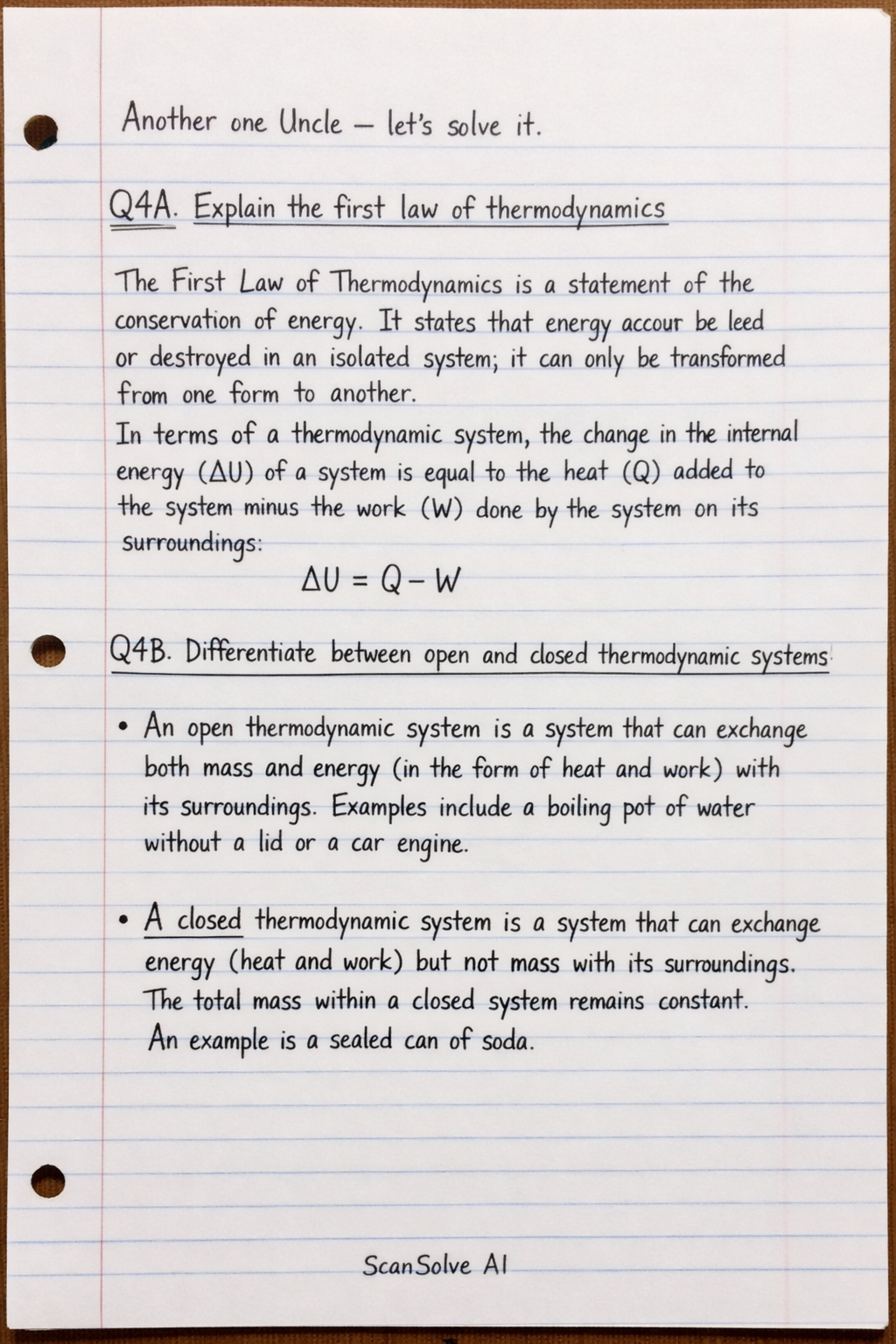
Q4A. Explain the first law of thermodynamics
The First Law of Thermodynamics is a statement of the conservation of energy. It states that energy cannot be created or destroyed in an isolated system; it can only be transformed from one form to another. In terms of a thermodynamic system, the change in the internal energy () of a system is equal to the heat () added to the system minus the work () done by the system on its surroundings: .
Q4B. Differentiate between open and closed thermodynamic systems
- An open thermodynamic system is a system that can exchange both mass and energy (in the form of heat and work) with its surroundings. Examples include a boiling pot of water without a lid or a car engine.
- A closed thermodynamic system is a system that can exchange energy (heat and work) but not mass with its surroundings. The total mass within a closed system remains constant. An example is a sealed can of soda.
Q4C. Give an example of a closed system and explain energy exchanges involved
An example of a closed system is a sealed piston-cylinder assembly containing a gas.
- Energy Exchange (Heat): If the cylinder is placed on a hot plate, heat can be transferred from the hot plate to the gas inside the cylinder, increasing its internal energy. Conversely, if the cylinder is cooled, heat can be transferred from the gas to the surroundings.
- Energy Exchange (Work): If the piston moves upwards, the gas inside does work on the piston (and thus on the surroundings). If an external force pushes the piston downwards, work is done on the gas by the surroundings.
- No Mass Exchange: The gas molecules cannot escape the cylinder, and no new gas can enter, so there is no exchange of mass with the surroundings.
Q4D. Explain why ships made of steel float on water
Ships made of steel float on water due to Archimedes' Principle. Although steel is much denser than water, a ship's hull is designed to displace a large volume of water. The ship's overall structure, including the air-filled compartments within its hull, means that its average density (total mass of the ship divided by the total volume it occupies below the waterline) is less than the density of water. According to Archimedes' Principle, the buoyant force acting upwards on the ship is equal to the weight of the water it displaces. As long as this buoyant force is greater than or equal to the total weight of the ship, the ship will float.
Q5A. What is thermal conductivity
Thermal conductivity () is a material property that quantifies its ability to conduct heat. It represents the rate at which heat energy is transferred through a unit thickness of the material per unit area per unit temperature difference. Materials with high thermal conductivity (like metals) transfer heat efficiently, while those with low thermal conductivity (like insulation materials) are poor heat conductors.
Q5B. Define heat transfer and describe its three modes.
Heat transfer is the process by which thermal energy moves from a region of higher temperature to a region of lower temperature. Its three primary modes are:
- Conduction: The transfer of heat through direct contact between particles of a substance, without any bulk movement of the material itself. It occurs primarily in solids, where vibrating atoms or molecules transfer energy to adjacent particles.
- Convection: The transfer of heat through the movement of fluids (liquids or gases). This occurs when warmer, less dense fluid rises and cooler, denser fluid sinks, creating convection currents that carry heat.
- Radiation: The transfer of heat through electromagnetic waves. Unlike conduction and convection, radiation does not require a medium and can occur through a vacuum. All objects above absolute zero emit thermal radiation.
Q5C. Define the following I. Density. ii. Specific weight. iii. Specific gravity.
- i. Density (): Density is defined as the mass per unit volume of a substance. Its SI unit is kilograms per cubic meter ().
- ii. Specific weight (): Specific weight is defined as the weight per unit volume of a substance. It is also the product of density and the acceleration due to gravity (). Its SI unit is Newtons per cubic meter ().
- iii. Specific gravity (SG): Specific gravity is a dimensionless ratio of the density of a substance to the density of a reference substance (usually water at for liquids and solids, or air for gases).
Still stuck on this one?
Ask a follow-up, and the answer starts from this question.
More Physics Questions
Handwritten Step-by-Step Solution
Get this as a handwritten image on WhatsApp — like a tutor wrote it for you.
Try on WhatsApp