
We read your photo as:
Q2A. Explain the concept of viscosity. B. Describe how temperature affects the viscosity of fluids C. Differentiate between laminar and turbulent fluid flow D. Determine whether the flow is laminar or turbulent. E. State Bernoulli's equation for in-compressible flow.
ScanSolve AI Answer
Q2A. Explain the concept of viscosity.
Viscosity is a fundamental property of fluids that quantifies their resistance to flow or deformation under shear stress. It represents the internal friction between adjacent layers of a fluid as they move relative to each other. A fluid with high viscosity (like honey) flows slowly, while a fluid with low viscosity (like water) flows easily.
Q2B. Describe how temperature affects the viscosity of fluids.
The effect of temperature on viscosity differs between liquids and gases:
- For Liquids: As temperature increases, the viscosity of liquids generally decreases. This is because increased thermal energy weakens the intermolecular cohesive forces, allowing the molecules to move past each other more easily.
- For Gases: As temperature increases, the viscosity of gases generally increases. This is due to the increased kinetic energy of gas molecules, leading to more frequent and energetic collisions between them, which enhances the momentum transfer and thus the resistance to flow.
Q2C. Differentiate between laminar and turbulent fluid flow.
- Laminar Flow: This is characterized by smooth, orderly, and predictable fluid motion where fluid particles move in parallel layers without significant mixing between them. It typically occurs at low fluid velocities and is associated with low Reynolds Numbers.
- Turbulent Flow: This is characterized by chaotic, irregular, and unpredictable fluid motion with significant mixing and eddies. Fluid particles move in random and fluctuating paths. It typically occurs at high fluid velocities and is associated with high Reynolds Numbers.
Q2D. Determine whether the flow is laminar or turbulent.
From the previous calculation in Q1E, the Reynolds Number () was determined to be 150000.
For flow in a pipe:
- If , the flow is generally considered laminar.
- If , the flow is in a transitional regime.
- If , the flow is generally considered turbulent.
Since , which is significantly greater than 4000, the flow is turbulent.
Q2E. State Bernoulli's equation for in-compressible flow.
Bernoulli's equation for incompressible, steady, and inviscid flow along a streamline is given by:
Where:
- is the static pressure of the fluid.
- is the density of the fluid.
- is the velocity of the fluid.
- is the acceleration due to gravity.
- is the elevation head (height above a reference datum).
Each term in the equation represents a form of energy per unit weight (head):
- is the pressure head.
- is the velocity head (kinetic energy head).
- is the elevation head (potential energy head).
Still stuck on this one?
Ask a follow-up, and the answer starts from this question.
More Physics Questions
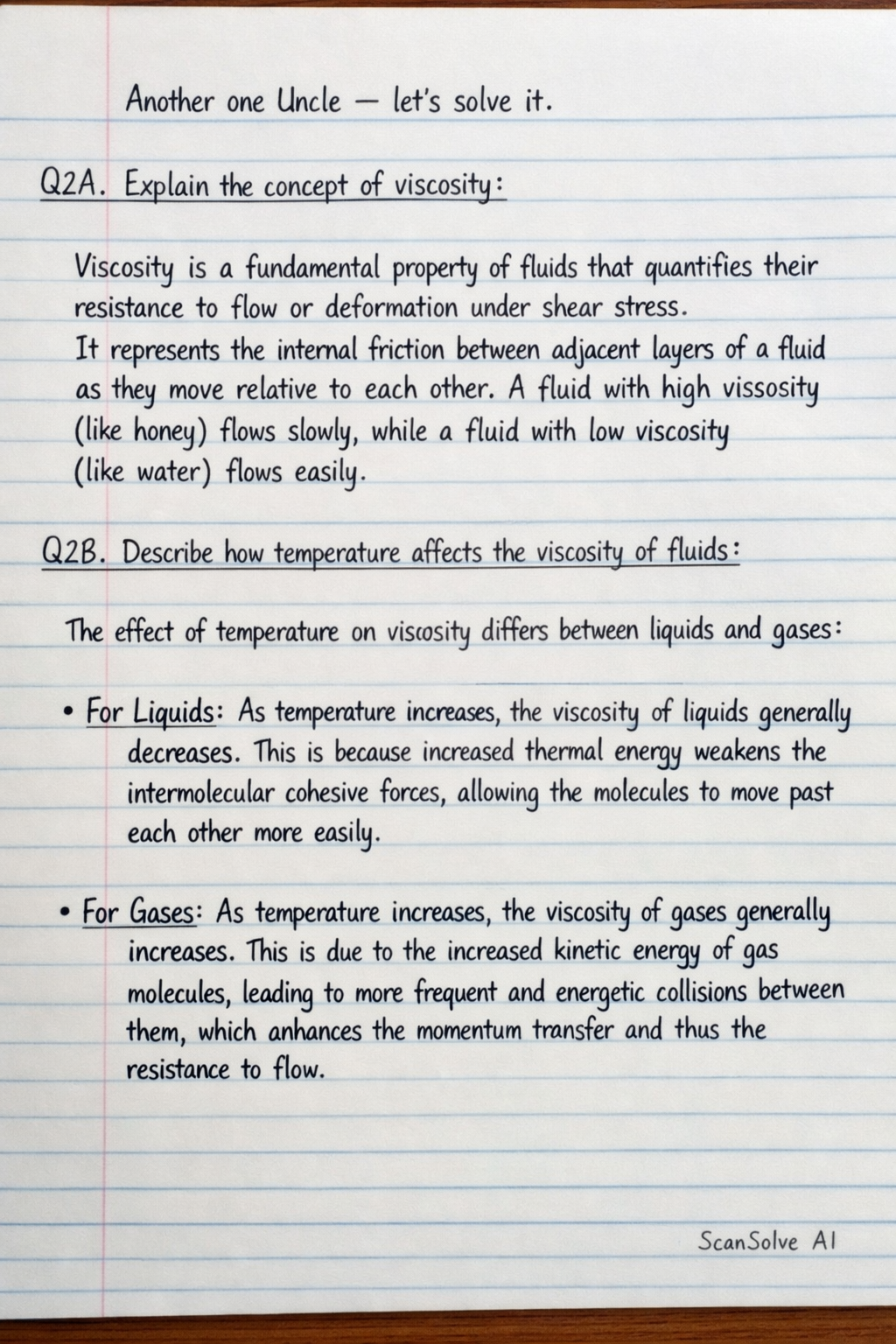
Handwritten Step-by-Step Solution
Get this as a handwritten image on WhatsApp — like a tutor wrote it for you.
Try on WhatsApp