
We read your photo as:
1 Calculate h, the change in its vertical height. 4.2 Analyse the equation and calculation that you used to answer Question 4.1 and explain whether you needed to know the mass of the trolley to do the calculation.
ScanSolve AI Answer
Answers
2 partsStep-by-step solution
11 stepsHere are the calculations for the questions:
Question 4: A trolley of mass rolls down an inclined plane. The trolley on the inclined plane has an initial velocity of . When it reaches the bottom its velocity is .
Part 4.1· 3 steps
Calculate , the change in its vertical height.
Apply the principle of conservation of mechanical energy.
Let the initial height be and the final height be .
Substitute the given values (, , , , , ).
Simplify and solve for .
The change in vertical height is .
Part 4.2
Analyse the equation and calculation that you used to answer Question 4.1 and explain whether you needed to know the mass of the trolley to do the calculation.
The equation used is the conservation of mechanical energy: . If we divide every term by the mass , the equation becomes . This shows that the mass cancels out. Therefore, you did not need to know the mass of the trolley to calculate the change in vertical height.
Part 4.3
Given the same situation and the same initial and final velocities, would the change in vertical height be the same for a trolley?
Yes, the change in vertical height would be the same for a trolley. As explained in 4.2, the mass cancels out in the conservation of mechanical energy equation when calculating height change based on velocity changes.
Question 5: Figure 8 shows a pendulum bob of mass that is above its lowest point and has a speed of . Calculate its speed when it is above its lowest point.
Convert units to SI units.
Apply the principle of conservation of mechanical energy.
Substitute the known values (, , , , ).
Simplify and solve for .
Calculate .
The speed of the pendulum bob when it is above its lowest point is .
Question 6: Figure 9 shows a roller coaster of mass rolling down a section of track. At point A its speed is and its height above the lowest point on the track is . Point B is above the lowest point. Show by calculation whether the roller coaster has sufficient mechanical energy to reach point B. (Assume that no energy is lost in overcoming friction.)
Calculate the total mechanical energy () of the roller coaster at point A.
Calculate the gravitational potential energy () required for the roller coaster to reach point B.
Compare the mechanical energy at point A with the potential energy required to reach point B.
Since and , and , the roller coaster has sufficient mechanical energy to reach point B. It will have kinetic energy remaining at point B.
The roller coaster has sufficient mechanical energy to reach point B.
Try one yourself
A new problem that tests the same skill.
Still stuck on this one?
Ask a follow-up, and the answer starts from this question.
More Physics Questions
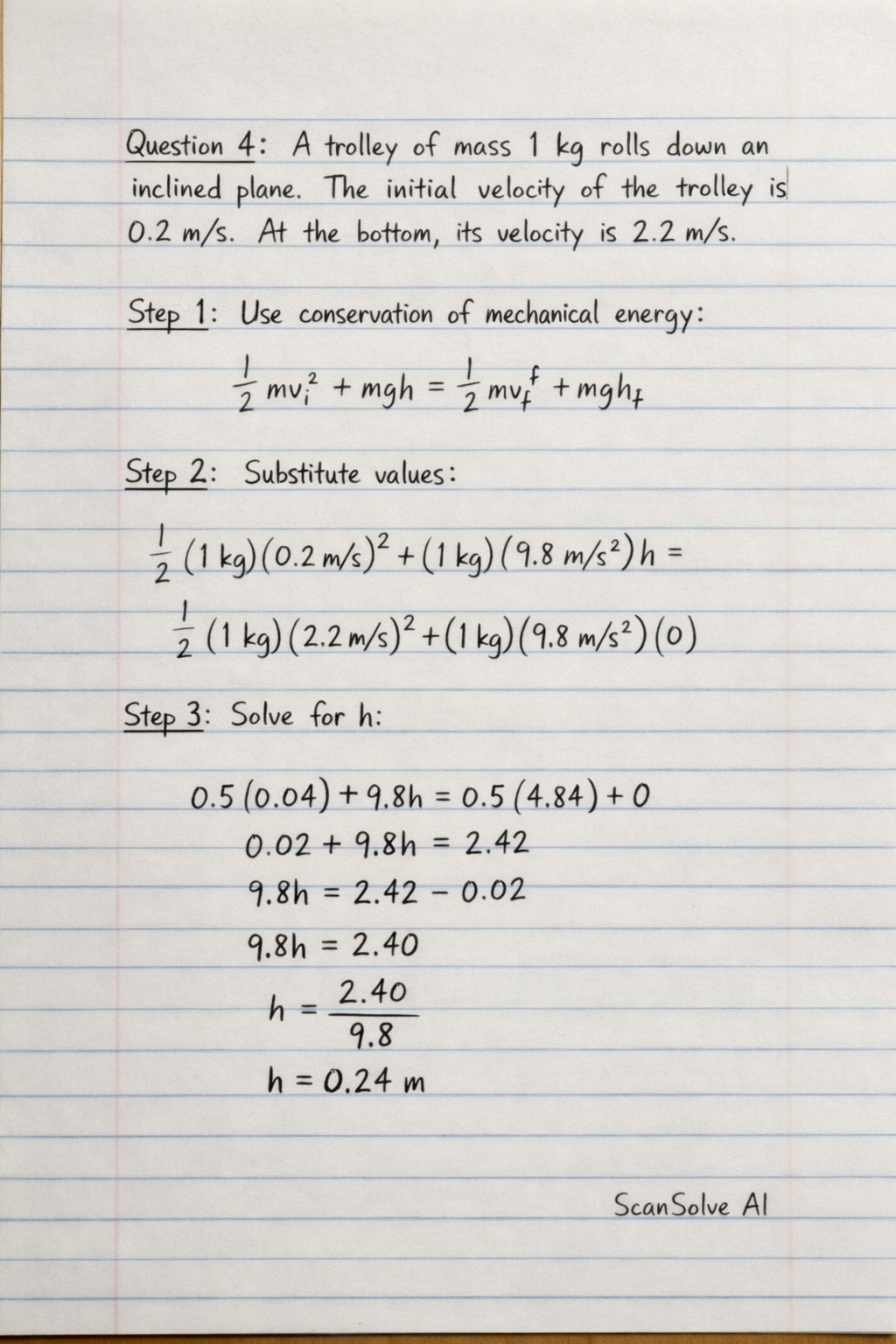
Handwritten Step-by-Step Solution
Get this as a handwritten image on WhatsApp — like a tutor wrote it for you.
Try on WhatsApp