
We read your photo as:
If a Column has been design with a cross sectional area of 120,000 mm² is subject to an axial load of 2,500 KN and a diameter of the steel to be 25mm determine the steel stress in both the steel and concrete if the elastic modulus of the steel and concrete are 200 KN/mm² and 21 KN/mm² respectively
ScanSolve AI Answer
Answer
Step-by-step solution
5 stepsTo determine the stress in both the steel stud and the concrete, we will use the principles of composite sections under axial load. The key is that both materials experience the same strain, and the total load is shared between them.
Given:
Total cross-sectional area of column,
Axial load,
Diameter of steel bar,
Elastic modulus of steel,
Elastic modulus of concrete,
Assumption: The problem implies a single steel reinforcing bar (stud) with a diameter of .
Calculate the cross-sectional area of the steel stud ().
The area of a circular bar is given by .
Calculate the cross-sectional area of the concrete ().
The total area of the column is the sum of the steel area and the concrete area.
Calculate the modular ratio ().
The modular ratio is the ratio of the elastic moduli of steel to concrete.
Determine the stress in the concrete ().
For a composite section under axial load, the total load is distributed between the concrete and steel. The strain in both materials is equal ().
We know that , so and .
This implies .
The total load .
Substitute :Now, solve for :
Substitute the values:
Determine the stress in the steel stud ().
Using the relationship :
The stresses are:
Stress in concrete:
Stress in steel stud:
Try one yourself
A new problem that tests the same skill.
Still stuck on this one?
Ask a follow-up, and the answer starts from this question.
More Physics Questions
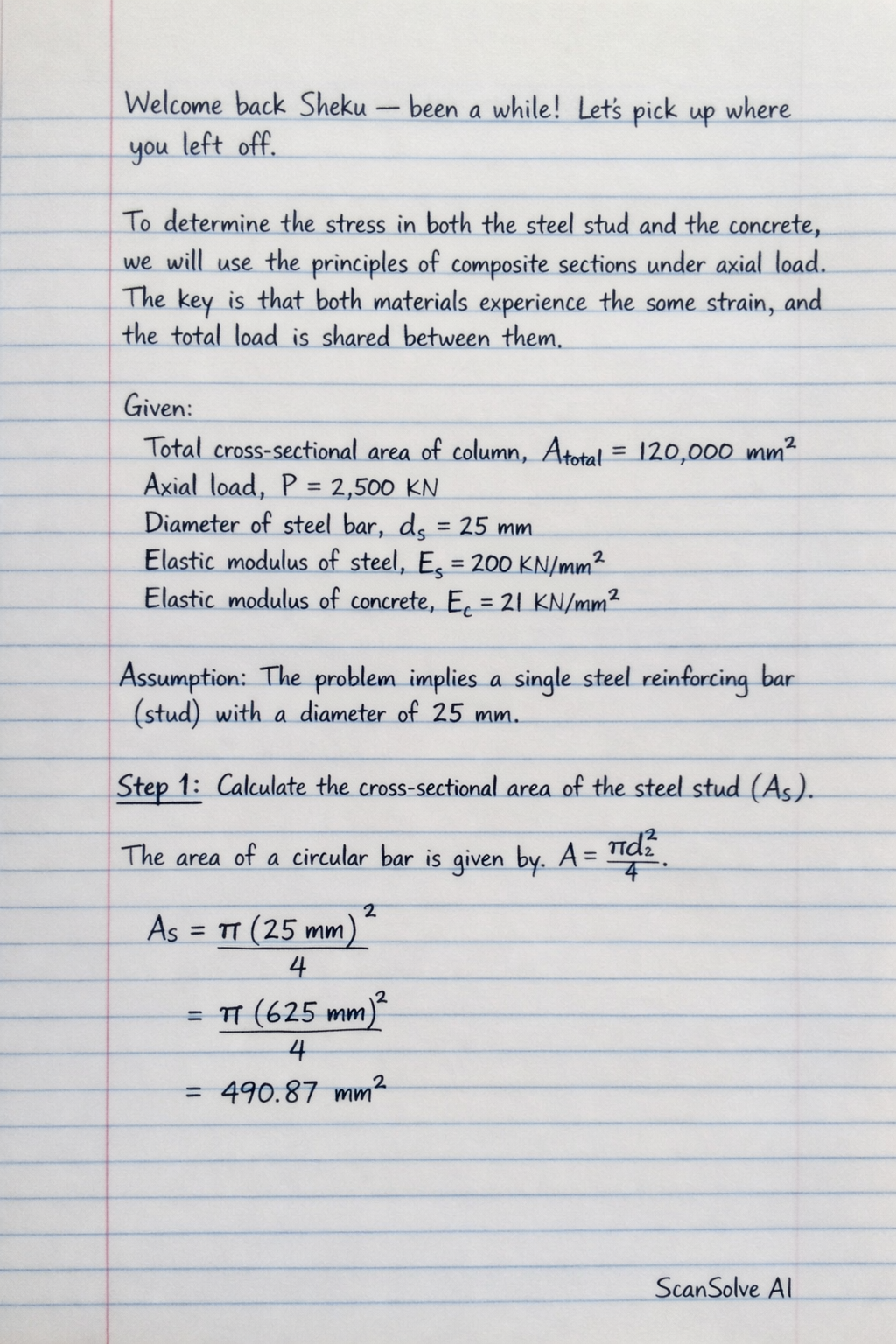
Handwritten Step-by-Step Solution
Get this as a handwritten image on WhatsApp — like a tutor wrote it for you.
Try on WhatsApp