
We read your photo as:
5.3 Will this system give a mechanical advantage? How do you know?
ScanSolve AI Answer
Step-by-step solution
4 stepsDetermine the direction of rotation for the driven gear.
When two gears mesh directly, they rotate in opposite directions. If the driver gear turns clockwise, the driven gear will turn counter-clockwise.
Count the number of teeth on each gear.
From the image:
- Driver gear (small gear) has 6 teeth.
- Driven gear (large gear) has 18 teeth.
Calculate the number of revolutions for the driver gear.
The relationship between the number of teeth and revolutions for meshed gears is:
Let be the revolutions of the driver gear and be the revolutions of the driven gear.
Let be the number of teeth on the driver gear and be the number of teeth on the driven gear.
We have and . We want to find when .The driver gear needs to turn 3 revolutions.
Determine if the system provides a mechanical advantage and explain why.
The system consists of a small driver gear connected to a large driven gear. This configuration reduces the output speed but increases the output turning force (torque). The problem statement also explicitly mentions: "A small driver gear connected to a large driven gear will change a fast turning speed into a slower turning speed." and "This system gives a mechanical advantage." The reminder box defines mechanical advantage as the turning force at the output axle being greater than the turning force at the input axle. Since the driven gear is larger than the driver gear, it will produce a greater turning force.
Still stuck on this one?
Ask a follow-up, and the answer starts from this question.
More Physics Questions
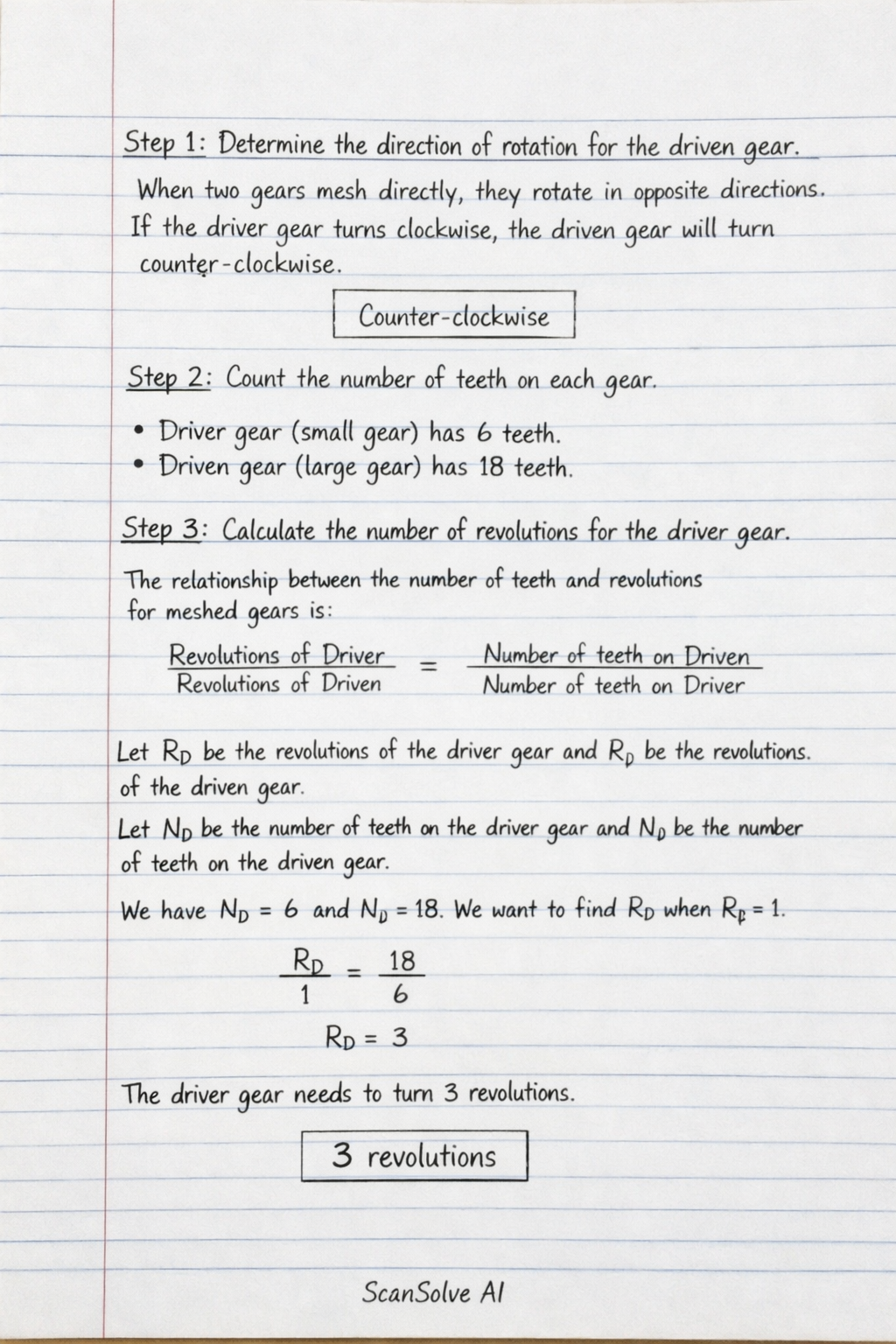
Handwritten Step-by-Step Solution
Get this as a handwritten image on WhatsApp — like a tutor wrote it for you.
Try on WhatsApp