
We read your photo as:
3.3 Do you think geartrain B will provide a speed advantage? Explain your answer. 1.3.4 Explain how the bevel gears work.
Physics
ScanSolve AI Answer
Here are the answers to the questions:
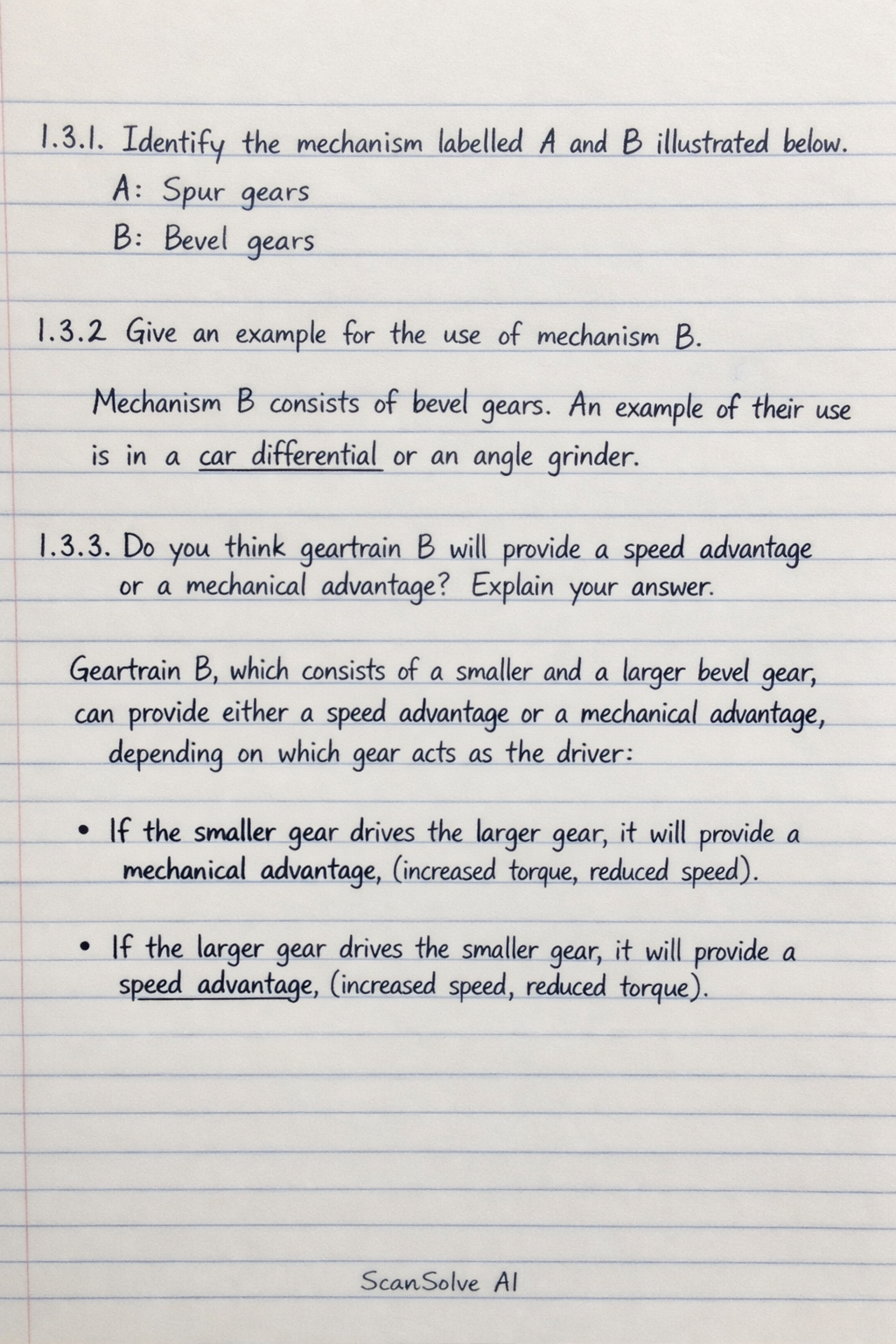
1.3.1 Identify the mechanism labelled A and B illustrated below.
- A: Spur gears
- B: Bevel gears
1.3.2 Give an example for the use of mechanism B.
- Mechanism B consists of bevel gears. An example of their use is in a car differential or an angle grinder.
1.3.3 Do you think geartrain B will provide a speed advantage or a mechanical advantage? Explain your answer.
- Geartrain B, which consists of a smaller and a larger bevel gear, can provide either a speed advantage or a mechanical advantage, depending on which gear acts as the driver.
- If the smaller gear drives the larger gear, it will provide a mechanical advantage (increased torque, reduced speed).
- If the larger gear drives the smaller gear, it will provide a speed advantage (increased speed, reduced torque).
1.3.4 Explain how the bevel gears work.
- Bevel gears are conical gears with teeth cut on their angled surfaces. They are designed to transmit power and motion between shafts that intersect, typically at a angle. When one bevel gear rotates, its teeth mesh with the teeth of the other bevel gear, causing the second gear to rotate and changing the direction of the rotational motion.
Was this helpful?
Still stuck on this one?
Ask a follow-up, and the answer starts from this question.
Got a different question?Ask your own question
More Physics Questions
QExplain how the bevel gears work.Q5.3 Will this system give a mechanical advantage? How do you know?QIn a given gear system, a driven gear with 30 teeth has a speed of 100rev/min, drives the driven…QExplain the direction of rotation for meshing gears and the role and effect of idler gears in a gear…Q2.3 What type of gear train is shown in the photograph? 1.2.4 A camera tripod uses which type of…
Handwritten Step-by-Step Solution
Get this as a handwritten image on WhatsApp — like a tutor wrote it for you.
Try on WhatsApp