
We read your photo as:
Explain how the bevel gears work.
ScanSolve AI Answer
Step-by-step solution
7 stepsAnswer question 1.2.2.
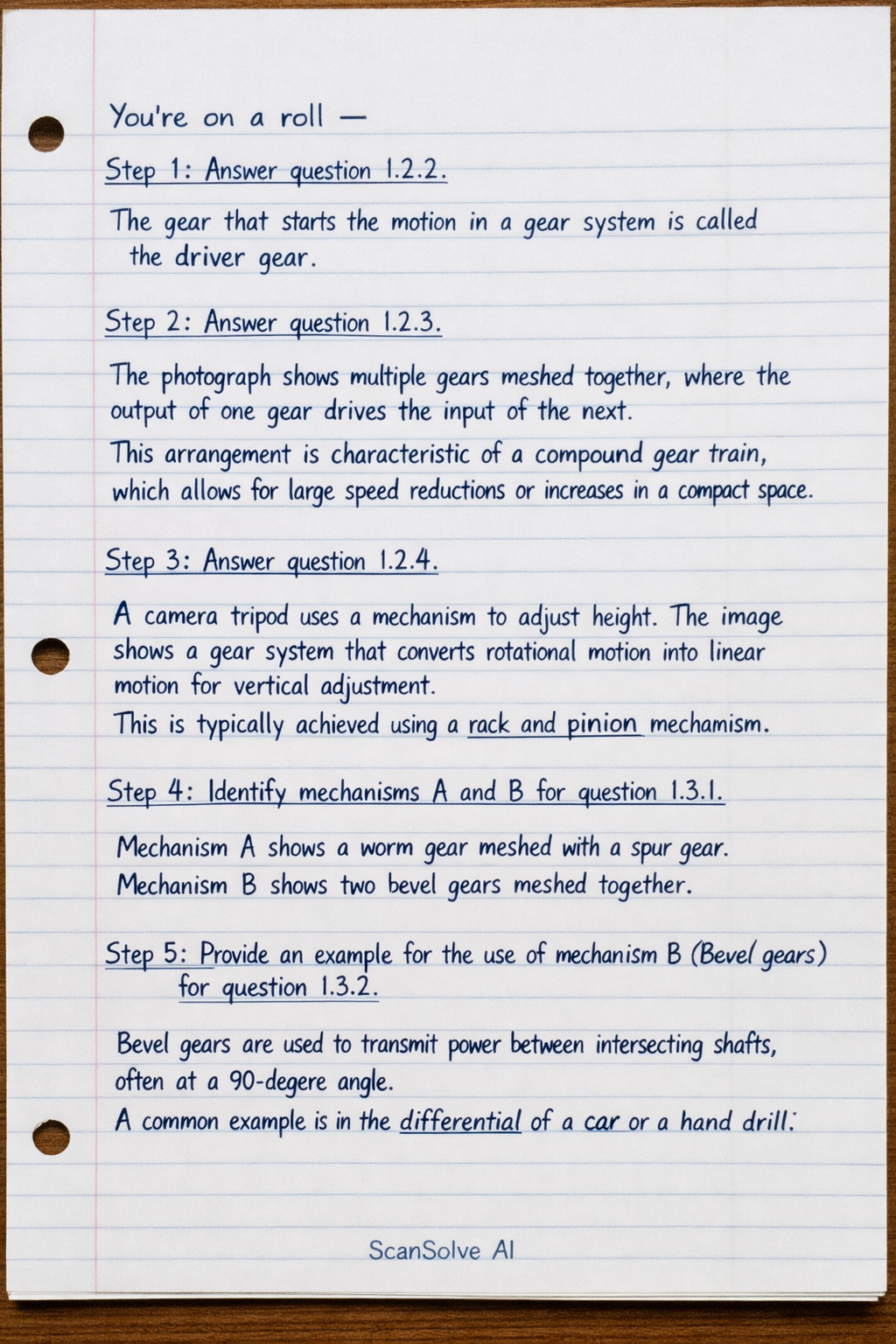
The gear that starts the motion in a gear system is called the driver gear.
Answer question 1.2.3.
The photograph shows multiple gears meshed together, where the output of one gear drives the input of the next. This arrangement is characteristic of a compound gear train, which allows for large speed reductions or increases in a compact space.
Answer question 1.2.4.
A camera tripod uses a mechanism to adjust height. The image shows a gear system that converts rotational motion into linear motion for vertical adjustment. This is typically achieved using a rack and pinion mechanism.
Identify mechanisms A and B for question 1.3.1.
Mechanism A shows a worm gear meshed with a spur gear. Mechanism B shows two bevel gears meshed together.
Provide an example for the use of mechanism B (Bevel gears) for question 1.3.2.
Bevel gears are used to transmit power between intersecting shafts, often at a 90-degree angle. A common example is in the differential of a car or a hand drill.
Determine if gear train B provides a speed or mechanical advantage and explain for question 1.3.3.
Gear train B consists of two bevel gears of different sizes. The smaller gear drives the larger gear. When a smaller gear drives a larger gear, the output speed decreases, but the output torque (mechanical advantage) increases. Therefore, it provides a mechanical advantage.
Explain how bevel gears work for question 1.3.4.
Bevel gears have conical shapes with teeth cut along their surfaces. They are designed to mesh at an angle, typically 90 degrees, to transmit power and motion between shafts that intersect. The angle of the teeth allows for smooth engagement and power transfer between non-parallel shafts.
1.2.2 The gear that starts the motion in a gear system is called the ... gear.
A. Starter
B. Idler
C. Driver
D. Driven1.2.3 What type of gear train is shown in the photograph?
A. Simple
B. Compound
C. Bevel
D. Rack and pinion1.2.4 A camera tripod uses which type of gears for the height adjustment mechanism?
A. Rack and pinion
B. Bevel
C. Helical
D. Worm gear1.3 Mechanisms are often used for control of motion. A variety of mechanisms are shown below.
1.3.1 Identify the mechanism labelled A and B illustrated below.
A: Worm gear and spur gear
B: Bevel gears1.3.2 Give an example for the use of mechanism B.
Differential of a car / Hand drill1.3.3 Do you think gear train B will provide a speed advantage or a mechanical advantage? Explain your answer.
Mechanical advantage.
The smaller gear is driving the larger gear, which will result in a decrease in speed but an increase in torque (mechanical advantage).1.3.4 Explain how the bevel gears work.
Bevel gears are conical gears with teeth cut on their surfaces. They are used to transmit power between shafts that intersect, typically at a 90-degree angle. When one bevel gear rotates, its teeth mesh with the teeth of the other bevel gear, causing it to rotate and change the direction of motion.
Still stuck on this one?
Ask a follow-up, and the answer starts from this question.
More Physics Questions
Handwritten Step-by-Step Solution
Get this as a handwritten image on WhatsApp — like a tutor wrote it for you.
Try on WhatsApp