
We read your photo as:
A single plate clutch - effective on both is required to transmit 25 KW at 3000 RPM. Determine outer and inner radii of the coefficient of friction 0.285 The ratio of/r = 1.25. If the max pressure will exceed 0.1N/m² also determine the axial thrust. Assume the theory of uniform wear.
ScanSolve AI Answer
Step-by-step solution
8 stepslet's solve this clutch problem.
The problem asks to determine the outer and inner radii of a single plate clutch, and the axial thrust, given the power transmitted, rotational speed, coefficient of friction, ratio of radii, and maximum pressure, under the assumption of uniform wear.
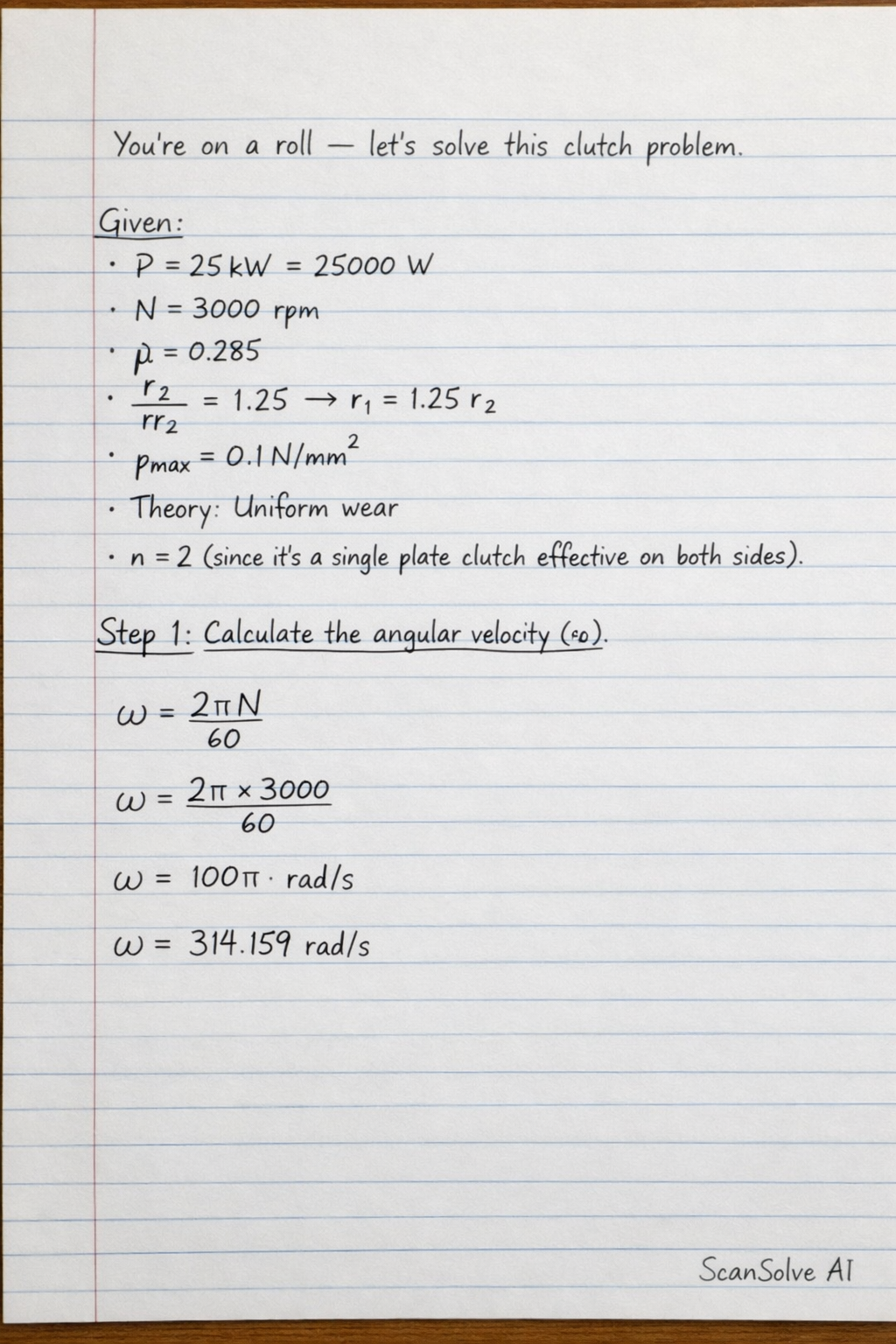
Given:
- Power transmitted,
- Rotational speed,
- Coefficient of friction,
- Ratio of outer to inner radius,
- Maximum pressure,
- Theory: Uniform wear
- Number of friction surfaces, (since it's a single plate clutch effective on both sides)
Calculate the angular velocity ().
Calculate the total torque transmitted ().
Convert to N·mm:
Determine the torque per friction surface ().
Since there are friction surfaces:
Apply the uniform wear theory to find the constant C.
Under uniform wear, the product of pressure and radius is constant: .
The maximum pressure () occurs at the inner radius ().Given :
Formulate the torque equation for one friction surface under uniform wear.
The torque transmitted by one friction surface under uniform wear is given by:
Substitute and :
Solve for the inner radius ().
Substitute and :
The inner radius is .
Calculate the outer radius ().
The outer radius is .
Calculate the axial thrust (F) provided by the spring.
First, find the constant C:
The total axial force (thrust) is given by:
The axial thrust is .
Still stuck on this one?
Ask a follow-up, and the answer starts from this question.
More Physics Questions
Handwritten Step-by-Step Solution
Get this as a handwritten image on WhatsApp — like a tutor wrote it for you.
Try on WhatsApp