
We read your photo as:
A spring has natural length 2 cm. When a mass of 5 g is attached, its length is 3.5 cm. What is the extension of the spring?
ScanSolve AI Answer
This answer stops before the end.
It was cut off when it was first written. Ask ScanSolve this question again for the full working.
Step 1: State Hooke's Law.
Hooke's Law states that the extension of a spring is directly proportional to the applied force, provided the elastic limit is not exceeded. Mathematically, this is expressed as , where is the force, is the spring constant, and is the extension.
b) Step 1: Identify the natural length and extension for the second spring.
From the diagram, we assume the first spring (length with mass) represents the natural length () of the spring, so . The label on the first spring is likely indicating the type of spring or is extraneous if it's the natural length.
For the second spring, a mass of is attached, and the total length is .
The extension () is the total length minus the natural length:
Still stuck on this one?
Ask a follow-up, and the answer starts from this question.
More Physics Questions
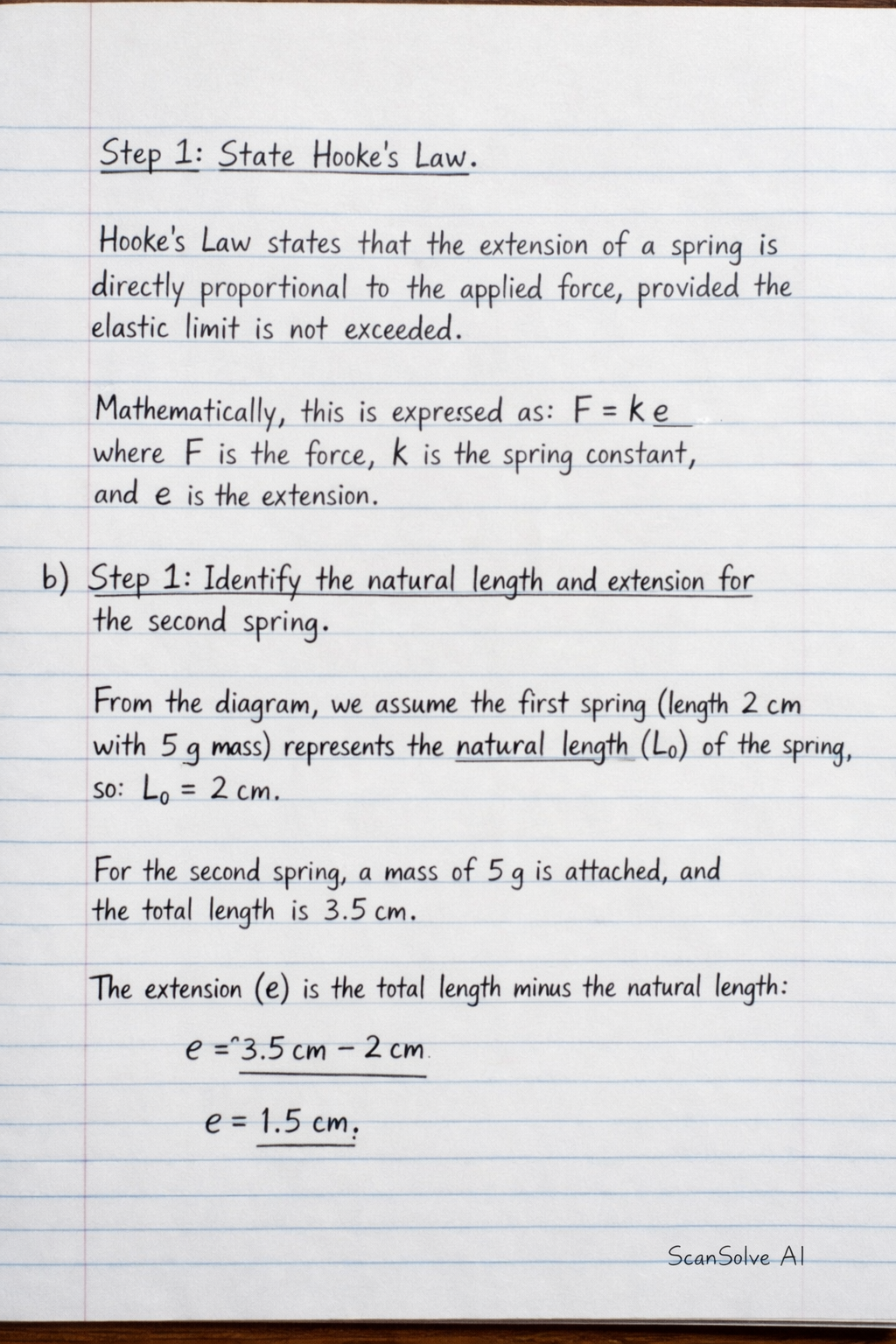
Handwritten Step-by-Step Solution
Get this as a handwritten image on WhatsApp — like a tutor wrote it for you.
Try on WhatsApp