
We read your photo as:
A stone weighs 80 N in air and 50 N in water. Calculate its apparent loss of weight and relative density.
ScanSolve AI Answer
Step-by-step solution
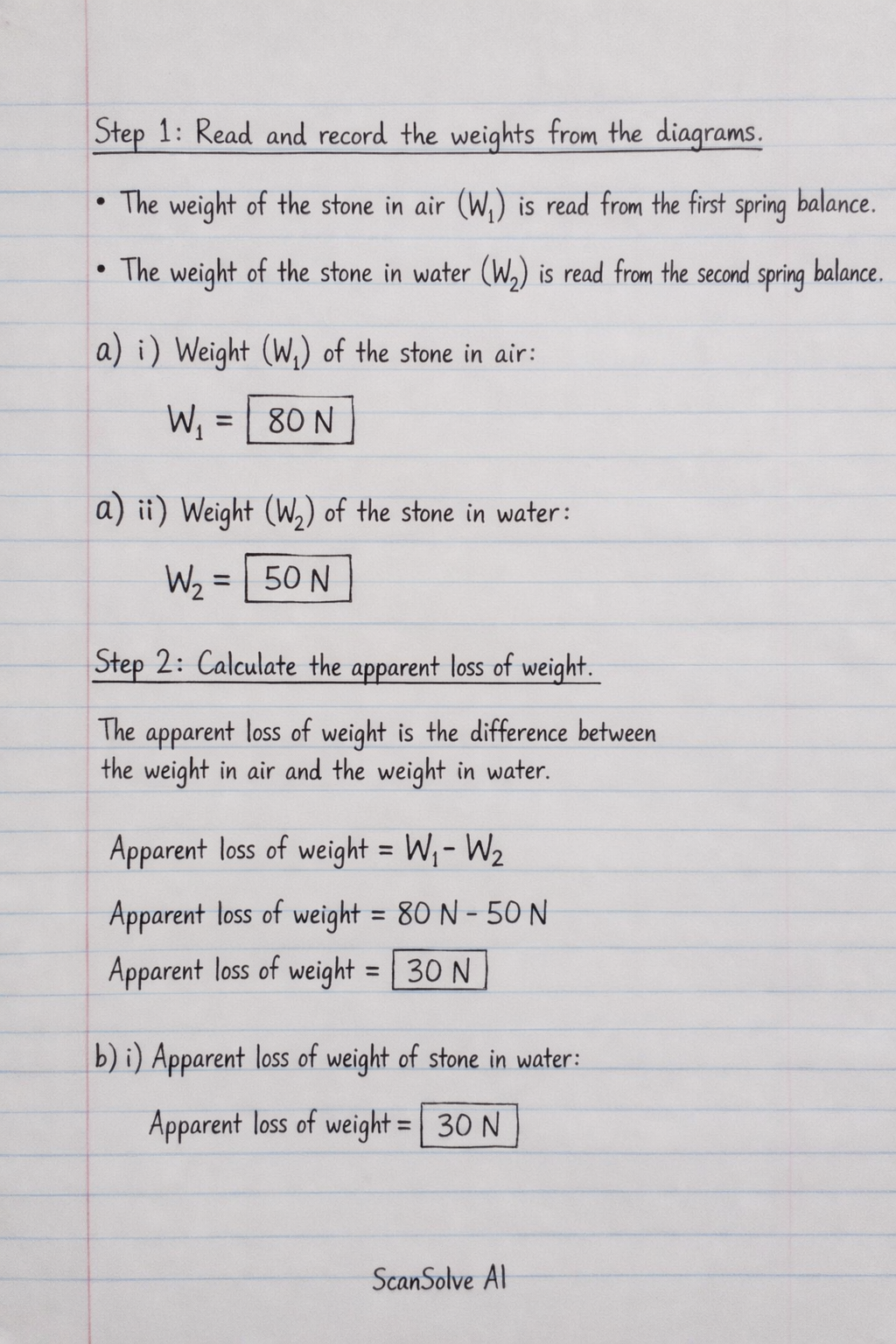
4 stepsRead and record the weights from the diagrams.
- The weight of the stone in air () is read from the first spring balance.
- The weight of the stone in water () is read from the second spring balance.
a) i) Weight () of the stone in air:
a) ii) Weight () of the stone in water:
Calculate the apparent loss of weight.
The apparent loss of weight is the difference between the weight in air and the weight in water.
b) i) Apparent loss of weight of stone in water:
Calculate the relative density.
Relative density is the ratio of the weight of the substance in air to the apparent loss of weight in water (which is equal to the weight of the displaced water).
b) ii) Relative density:
Explain the apparent loss of weight.
c) The apparent loss of weight of the stone when submerged in water is due to the upthrust (or buoyant force) exerted by the water. According to Archimedes' principle, this upthrust is equal to the weight of the water displaced by the stone.
Still stuck on this one?
Ask a follow-up, and the answer starts from this question.
More Physics Questions
Handwritten Step-by-Step Solution
Get this as a handwritten image on WhatsApp — like a tutor wrote it for you.
Try on WhatsApp