
We read your photo as:
A student is performing an experiment with a helical spring and collecting data for the period T and mass m. They need to plot a graph of T2 vs m, determine the slope and intercept, and calculate the
ScanSolve AI Answer
Answer
Step-by-step solution
5 stepsOkay, Pretty~Nelly, let's break down this experiment on the helical spring.
Address Question 8 (Plotting the graph)
I cannot plot a graph directly. However, if you were to plot the graph, you would use the experimental data with values on the y-axis and corresponding values on the x-axis. The resulting graph should be a straight line.
Determine the slope, , and the value of (Question 9)
The given equation for the period of a mass-spring system is:
This equation is in the form of a straight line , where , .
The slope of the graph, , would be determined from your plotted graph using two points and :Once you have the numerical value for from your graph, you can find the spring constant :
The physical significance of is the spring constant (or force constant) of the helical spring. It measures the stiffness of the spring, indicating the force required to extend or compress the spring by a unit length. Its unit is Newtons per meter ().
Determine the intercept, , and calculate (Question 10)
The intercept is the value of when . This can be read directly from your plotted graph where the line crosses the (y-axis).
From the equation, the intercept is .
Once you have the numerical values for and from your graph, you can calculate :Substituting the expressions for and :
Physical significance of (Question 11)
As derived in Step 3, .
The physical significance of (or ) is the effective mass of the spring. In an oscillating mass-spring system, the spring itself has mass, and a portion of this mass contributes to the total oscillating mass. This effective mass is typically one-third of the actual mass of the spring.State any precautions taken (Question 12)
- Ensure the oscillations are purely vertical and not swinging sideways.
- Avoid parallax error when reading the stopwatch and the mass values.
- Ensure the spring is not stretched beyond its elastic limit to maintain Hooke's Law.
- Take multiple readings for the time of a large number of oscillations (e.g., 10 or 20) to minimize the human reaction time error in starting and stopping the stopwatch.
- Start and stop the stopwatch when the mass is at the same point in its oscillation (e.g., highest point, lowest point, or passing through the equilibrium position in the same direction).
Try one yourself
A new problem that tests the same skill.
Still stuck on this one?
Ask a follow-up, and the answer starts from this question.
More Physics Questions
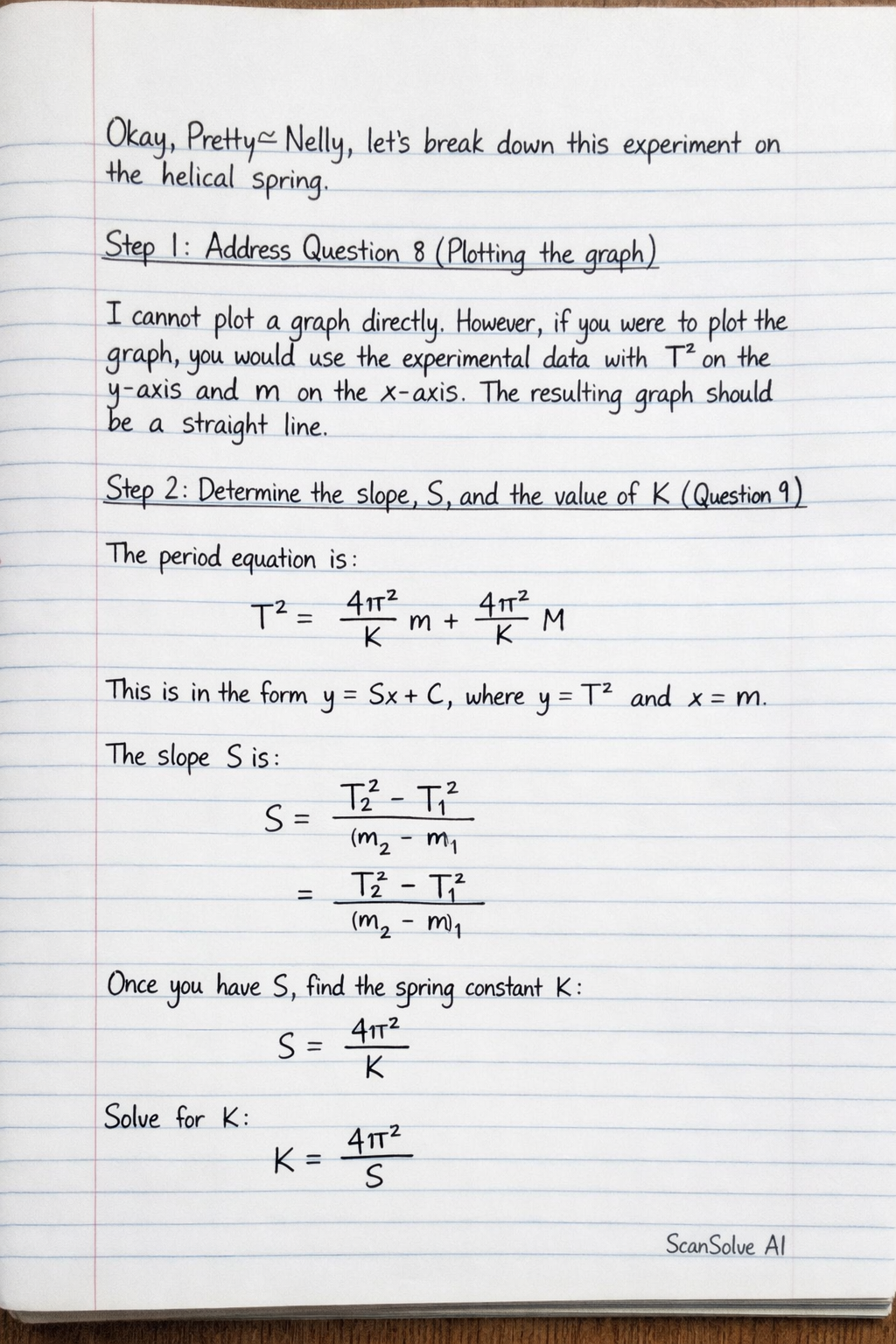
Handwritten Step-by-Step Solution
Get this as a handwritten image on WhatsApp — like a tutor wrote it for you.
Try on WhatsApp