
We read your photo as:
A) The magnetic flux pattern for a bar magnet consists of magnetic field lines that emerge from the North pole and enter the South pole outside the magnet, forming continuous closed loops. Insid
ScanSolve AI Answer
Here is the solution to question 3:
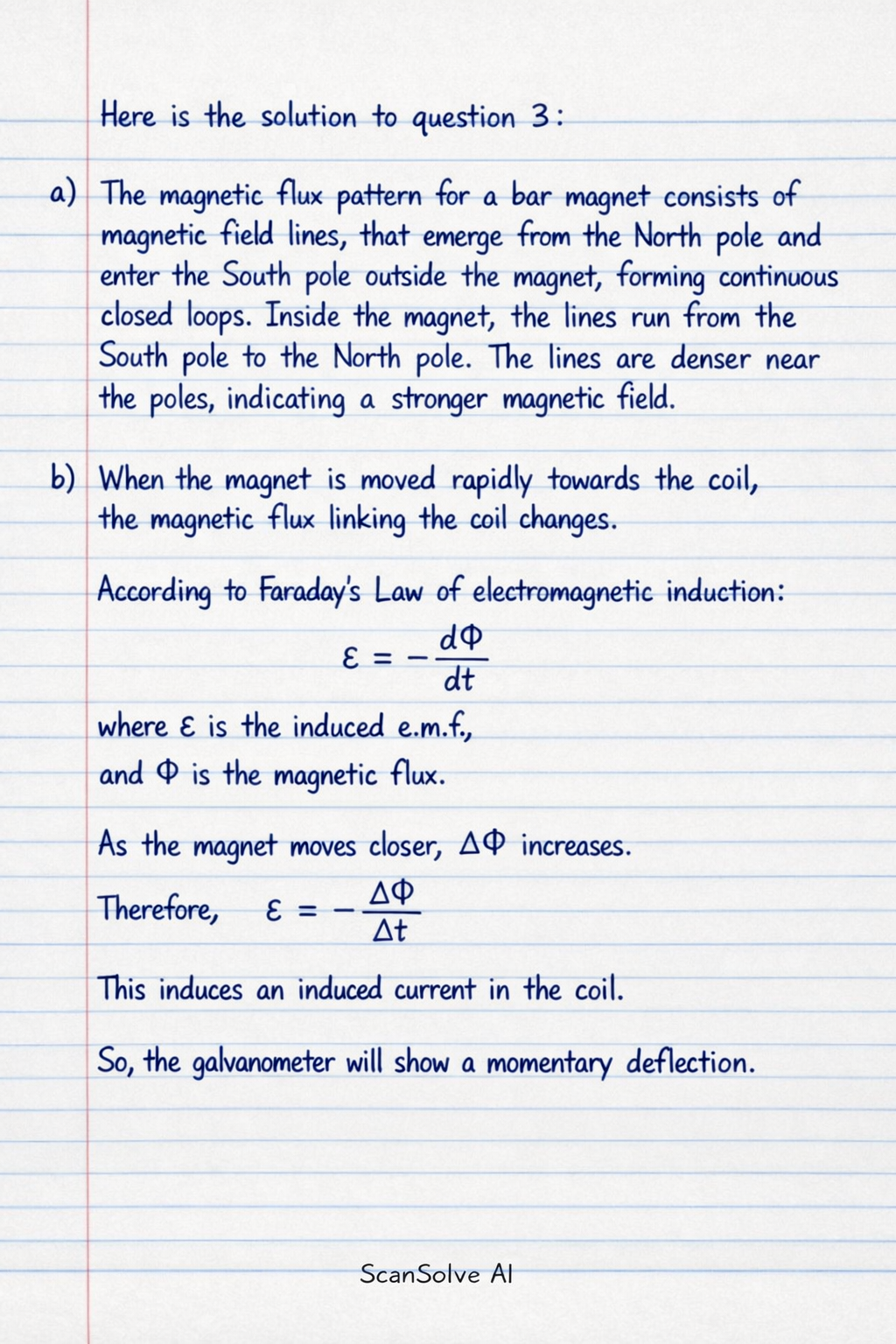
a) The magnetic flux pattern for a bar magnet consists of magnetic field lines that emerge from the North pole and enter the South pole outside the magnet, forming continuous closed loops. Inside the magnet, the lines run from the South pole to the North pole. The lines are denser near the poles, indicating a stronger magnetic field.
b) When the magnet is moved rapidly towards the coil, the magnetic flux linking the coil changes. According to Faraday's Law of electromagnetic induction, this change in magnetic flux induces an electromotive force (e.m.f.) and thus an induced current in the coil.
Therefore, the galvanometer will show a momentary deflection.
c) As the North pole of the magnet approaches the coil, an induced current flows in the coil to create a magnetic field that opposes the motion (Lenz's Law). To oppose the approaching North pole, the face of the coil nearest the magnet (the left face in the diagram) will become an induced North pole. The magnetic flux pattern for the coil will show magnetic field lines emerging from this induced North pole (left side of the coil) and entering the induced South pole (right side of the coil), similar to the field lines of a bar magnet.
Still stuck on this one?
Ask a follow-up, and the answer starts from this question.
More Physics Questions
Handwritten Step-by-Step Solution
Get this as a handwritten image on WhatsApp — like a tutor wrote it for you.
Try on WhatsApp